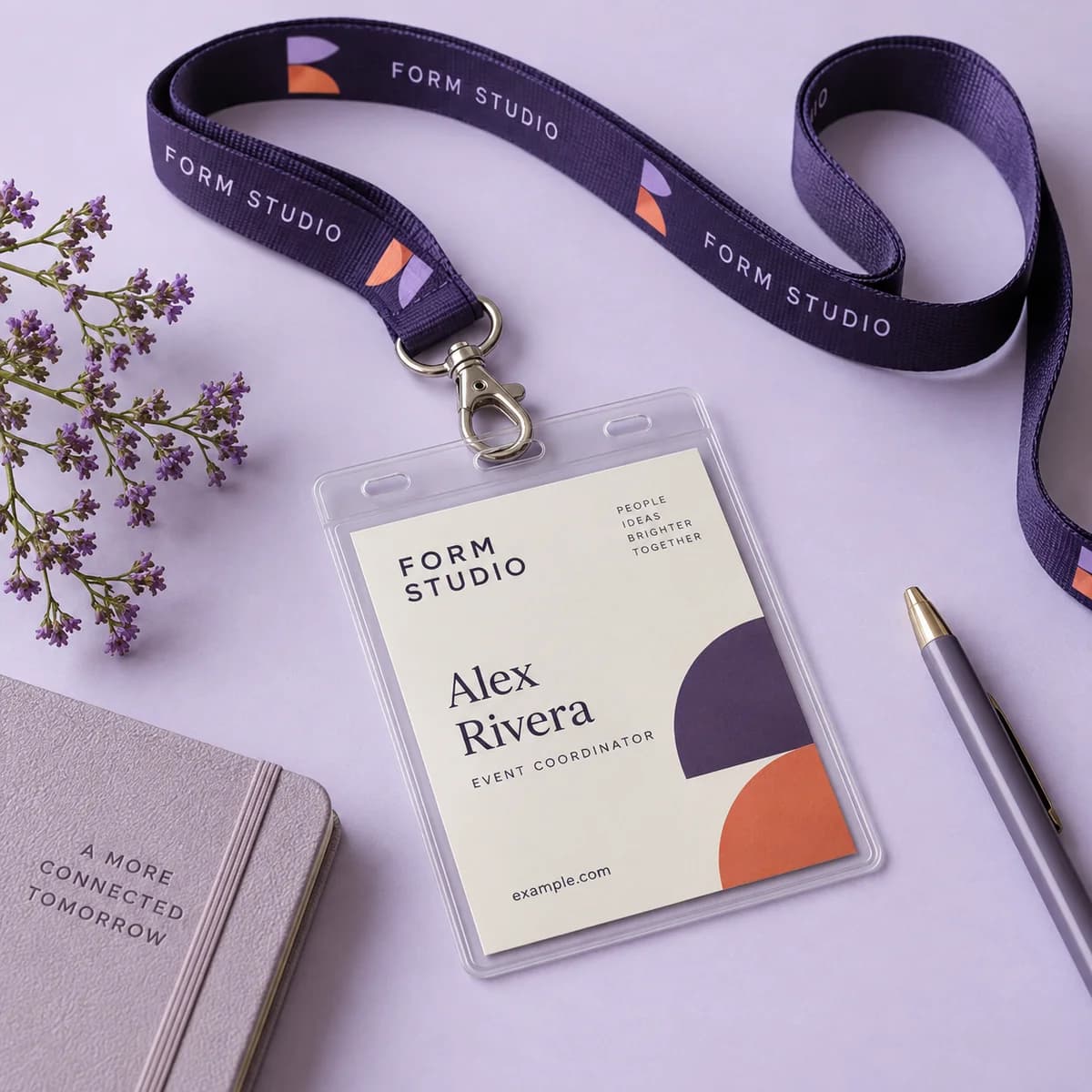
What size is an event badge?
There is no single standard, but a few sizes dominate because holders are made for them.
| Format | Approximate size | Typical use |
|---|---|---|
| Card size, ID-1 | 3.37 x 2.13 in | Access cards, reusable staff badges |
| Business card size | 3.5 x 2 in | Small events, printed in house |
| Name badge | 4 x 3 in | Conferences, the most common holder size |
| Large badge | 4 x 6 in | Multi day shows, agenda on the back |
Decide the holder first and print to it. A badge trimmed to a size no holder fits is a common and annoying mistake, and holders are much harder to source at short notice than paper.
If you are printing a badge yourself at a small event, business card stock at 3.5 x 2 inches is the practical shortcut, because the stock, templates and trimming already exist. It is smaller than ideal for names, so set the name as large as the card allows.
How large should the name be?
Badges are read at roughly 3 feet, standing. Using the ADA benchmark for visual characters, a 3 foot reading distance supports characters around 5/8 inch tall as a minimum, which is far larger than the 10 or 12 point type most badge templates use.
In practice, aim for a first name at 36 to 60 point on a 4 x 3 inch badge, a last name smaller beneath it, and the organization smaller again. If the name does not fit at that size, shorten the name rather than the type.
- First name: largest element on the badge, bold, high contrast.
- Last name: clearly smaller, on its own line.
- Organisation: smaller still, one line, no legal suffixes.
- Role or category: only if the event uses it to route conversations, such as exhibitor, speaker or press.
- Nothing else. No email, no phone, no tagline, no social handles.
Print the same information on both sides. Badges flip constantly, and a blank reverse means half the day your name is invisible.
What goes on the lanyard?
The lanyard is a long, narrow, repeating surface that hangs at chest height, so it is the right place for a logo and the wrong place for detail.
Our badge holders and lanyards are 1 inch wide and 21.3 inches long, made from 100 percent recycled polyester, with a print area of 0.75 x 6 inches, breakaway safety clips on both ends, a zinc alloy D ring with a swivel snap, and eight strap colors.
A 0.75 x 6 inch print area means one repeating element. Use a logo or a short name, repeated so it reads however the strap twists. Avoid long URLs, straplines and anything with fine detail, because the strap folds and rotates all day.
Why do breakaway clips matter?
Because a cord around the neck in a crowded hall, near machinery or at a trade show with moving equipment is a snag risk. Breakaway clips release under load, which is why they are standard on event lanyards and worth confirming on any you buy.
The swivel snap matters for a duller reason: it lets the badge rotate to face forward instead of sitting sideways. A badge that spends the day edge on is the most common reason nobody uses your name.
Who needs which badge?
Split your badges by role before you print, because mixing them wastes the most useful design tool you have: color.
Give your own booth staff one color and one layout, so visitors can tell instantly who works there. Give speakers or demonstrators a second color if the event allows it. If you are running the event, use a distinct strap color per attendee type so staff can read the room at a glance, which is exactly what eight strap colors are for.
For reusable staff badges, a card size badge in a rigid holder outlasts a paper insert. For attendees, paper inserts printed the week before are cheaper and can carry the current agenda on the reverse.
How do you handle late changes and spares?
Names change, people cancel and a badge always goes missing. Plan for it.
- Order about 10 percent more holders and lanyards than the headcount.
- Print a small batch of blank badges with the layout but no name.
- Bring a fine permanent marker that writes on the badge stock.
- Use uncoated or matte badge stock so a marker does not smear.
- Keep a list of who has which badge if they carry access rights.
A blank badge plus a marker is not elegant, but a legible handwritten name beats a perfect badge that says the wrong thing.
What is the badge checklist?
- Choose the holder size first, then print the badge to fit it.
- Set the first name as the largest element, at 36 point or more.
- Print both sides identically, because badges flip.
- Limit the lanyard to one repeating logo inside the 0.75 x 6 inch print area.
- Confirm breakaway clips and a swivel snap.
- Use strap color to separate staff, speakers and attendees.
- Order 10 percent spares plus blanks and a marker.
Frequently asked questions
What is the standard size for an event name badge?
There is no single standard, but 4 x 3 inches is the most common conference format because most holders are made for it. Card size at 3.37 x 2.13 inches suits reusable staff badges, business card size at 3.5 x 2 inches is a practical shortcut for small events, and 4 x 6 inches gives room for an agenda on the reverse.
How big should the name be on a badge?
Much bigger than most templates suggest. Badges are read standing at about 3 feet, which supports capital letters around 5/8 inch as a floor using the ADA character height benchmark. On a 4 x 3 inch badge that means a first name around 36 to 60 point, with the surname smaller and the organization smaller again.
What should be printed on a lanyard?
One repeating element, usually a logo or a short name. Our badge holders and lanyards have a 0.75 x 6 inch print area on a 1 inch wide strap, which is not enough space for a URL or a strapline. Repeat the mark so it reads whichever way the strap twists.
Do event lanyards need breakaway clips?
They are strongly preferable. A cord worn around the neck in a crowded hall or near equipment is a snag risk, and a breakaway clip releases under load. Ours have breakaway safety clips on both ends plus a swivel snap, which also stops the badge sitting edge on where nobody can read it.
Sources & specification notes
The references below support the relevant technical or product details in this guide. Examples and checklists are not claims of practical testing or universal supplier requirements. Confirm the current specifications for your chosen product before production.
- U.S. Access Board: Guide to the ADA Standards, chapter 7 signs ↗
Minimum visual character height of 5/8 inch for viewing distances up to 6 feet, used as the floor for badge name sizing at conversation distance.
- University of Cambridge (Markus Kuhn): International standard paper sizes ↗
Reference for the ISO/IEC 7810 ID-1 card format of 85.60 x 53.98 mm quoted as the card size badge format.