What should an event planner business card include?
A planner's card is judged twice: once for the information and once as a sample of your eye for detail. Keep the information short so the design can breathe. The front carries who you are and what you plan; the back carries proof, usually a portfolio link and a line about how to start.
| Side | What goes there | Tip |
|---|---|---|
| Front | Name, business name, logo | Your name is what clients remember after a venue tour |
| Front | Specialty line | Weddings and private celebrations, or corporate meetings and retreats |
| Front | Phone, email, website | One phone number, one email |
| Back | Portfolio QR code with a label | Say what the scan opens, such as See 12 recent weddings |
| Back | Service area and booking note | Orlando and Central Florida, booking 2027 dates now |
| Back | Credential, if earned | CMP only if you hold it |
Leave out full service menus and price lists. Packages change every season, and a card that lists them goes stale fast. Put detail on the page the QR code opens instead.
Should you list every service or pick a specialty?
Pick a lead specialty and let the rest live online. The Bureau of Labor Statistics describes planners as arranging every aspect of events and professional gatherings, from locations to transportation, which is exactly why a card cannot list it all. A bride, a nonprofit gala chair and a sales director scan the same card for one question: do you do my kind of event?
If you truly split your business, consider two card versions with the same design and different specialty lines and QR destinations. One pile goes to wedding shows and venue open houses, the other to chamber events and corporate networking. The print cost difference is small and each card speaks to one audience.
How do you put a portfolio on a small card?
Use a QR code that opens a gallery built for phones, not your home page. Group the gallery by event type so a corporate client never has to scroll past centerpieces to find a conference setup. Label the code in words, because an unlabeled square gets ignored.
- Link to a page you control, such as your own website, so the code keeps working if you change platforms.
- Keep a clear margin around the code; the QR standard calls for a quiet zone four modules wide on every side.
- Print the code no smaller than you have tested, and scan the physical proof with two different phones.
- Add a campaign tag to the link so you can tell card scans from social traffic.
The free QR generator makes the code, and the campaign links tool builds the tagged URL so your analytics show which event or show produced each inquiry. Worked example: if 400 cards go out at a spring wedding show and your analytics record 30 visits tagged with that show, you know roughly how many people took the next step, and you can compare that against the booth cost.
Which finish matches the events you plan?
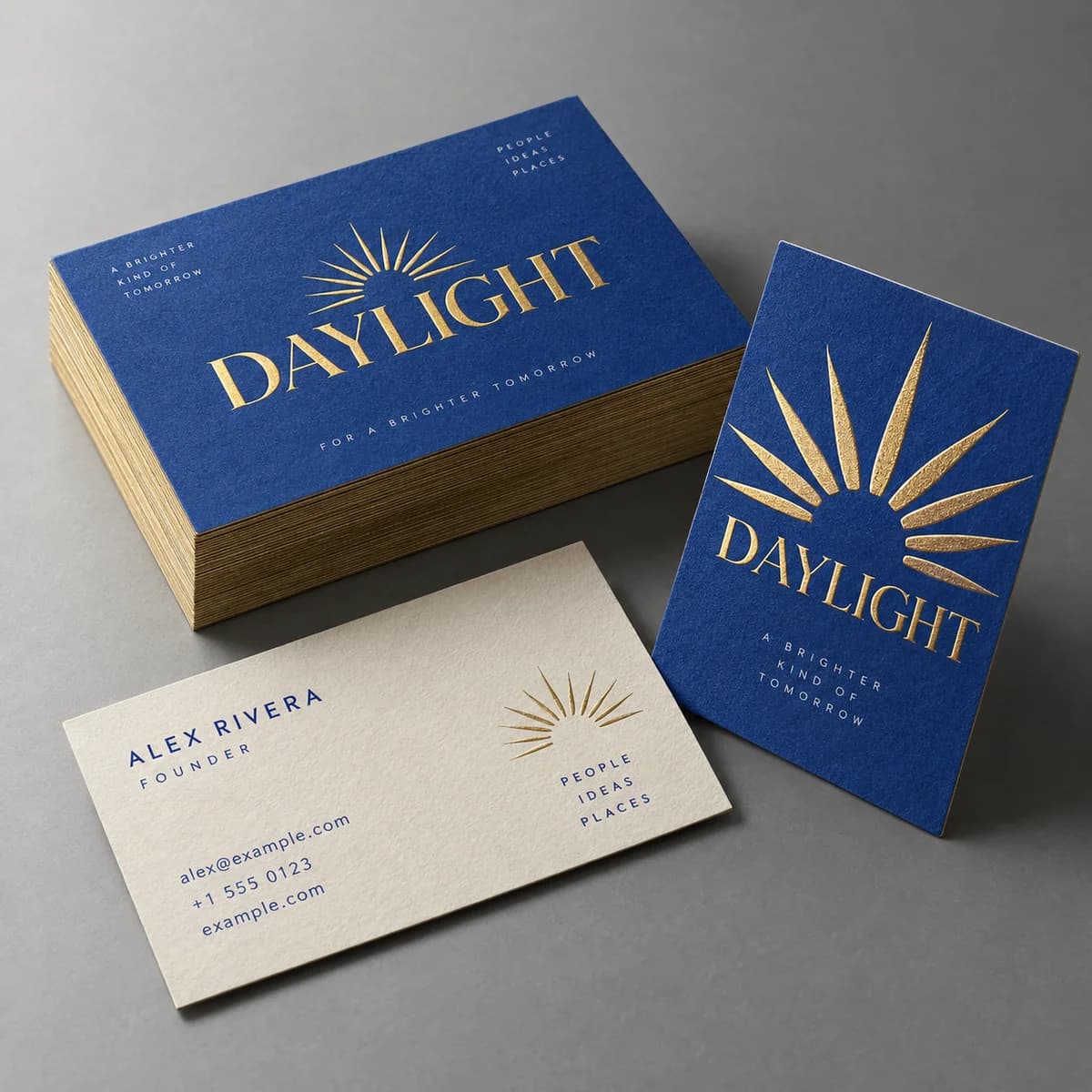
Your card finish should look like a preview of the events you produce. A minimalist planner handing out heavy foil sends a mixed message, and so does a luxury planner handing out thin gloss. Use the table as a starting point, then order a sample if the finish is new to you.
| Your event style | Finish that fits | Why it works |
|---|---|---|
| Black tie, galas, luxury weddings | Raised foil or painted edge | Texture and shine read as formal and deliberate |
| Modern, editorial, design led | Soft touch or ultra thick | Velvet feel and weight without decoration |
| Garden, rustic, boho | Cotton, linen or kraft | Natural texture echoes the setting |
| Corporate meetings and retreats | Matte or premium plus | Clean, easy to write on, easy to file |
| Bridal and celebration boutiques | Pearl | Subtle shimmer under venue lighting |
On raised foil business cards, the foil works best on a few bold elements such as a logo or monogram. Fine lines and very small type can fill in, so ask your printer for its minimum line and type size before you finalize. Keep the back free of foil if you like writing a date or venue name on cards you hand out.
Should your cards match your event stationery?
Your business card belongs to your brand, not to any one client, so it should match your own proposal decks, invoices and thank you notes. That consistency is what makes a planner look established. When you design pieces for a client's event, such as itineraries, menus or place cards, those follow the client's palette instead.
If you want credit at events, ask the client first. Some couples and companies are happy to have a small stack of cards at the welcome table or a discreet planning credit on the program; others want the day to feel entirely theirs. When a client says yes, the event printing collection covers matching menus, place cards and signage so your credit card sits beside pieces of the same quality.
How do you use cards at venue tours and vendor networking?
Most planning referrals travel through vendors: venue coordinators, caterers, florists, photographers and bakers. Hand two cards to every vendor you enjoy working with, one to keep and one to pass along. When you meet a baker you trust, our guide to home baker business cards shows what small vendors often need from their own cards, which makes swapping referrals easier.
At a venue tour, write the date and one detail on the back before you hand the card over, such as the courtyard layout for 120 guests. It turns a generic card into a reminder of a specific conversation. That is the strongest argument for keeping one side writable.
Which credentials belong on the card?
Only credentials you have actually earned. Planners are not licensed in the way contractors or notaries are, and the BLS notes that a number of voluntary certifications exist. The best known for meeting planners is the Certified Meeting Professional, or CMP, from the Events Industry Council.
Its eligibility rules are demanding. Candidates need 36 months of full time industry experience in the past five years, or a related degree plus 24 months, along with 25 clock hours of education or a qualifying internship, and then must pass the exam. If you hold it, CMP after your name is worth the space. If you are working toward it, leave it off until you pass.
How many cards to order, and when?
Order before your busy networking season, not during it. Wedding show and venue open house schedules cluster in winter and early spring in many markets, and corporate planning conferences follow their own calendars. A planner attending three shows and a steady run of venue tours can easily hand out several hundred cards in a season.
Specialty finishes also need more lead time than plain stock. Voqado ships within the United States, with 2 to 4 business days of handling plus 5 to 8 business days of standard transit, so allow about three weeks before a show to leave room for a proof round. For more profession specific ideas, see business card ideas by industry.
Event planner business card checklist
- Specialty line matches the clients you want most.
- QR code opens a phone friendly portfolio grouped by event type.
- QR code is labeled and tested on a printed proof.
- Finish matches your event style, not just your budget.
- Foil is limited to bold elements; small text stays in ink.
- One side stays writable for dates and venue notes.
- Credentials listed are earned, not in progress.
- Cards arrive at least a week before your first show.
Frequently asked questions
What should an event planner put on a business card?
Put your name, business name, a specialty line, phone, email and website on the front. On the back, add a labeled QR code to a phone friendly portfolio, your service area and a short booking note. Skip price lists and full service menus, since packages change each season. Add a credential such as the CMP only if you have earned it.
What is the best finish for event planner business cards?
Match the finish to the events you plan. Raised foil and painted edges suit black tie galas and luxury weddings. Soft touch and ultra thick stock suit modern, design led work. Cotton, linen and kraft suit garden and rustic events. Matte or premium plus suits corporate planners who want a clean card that is easy to write on.
Should an event planner use a QR code on a business card?
Yes, if it opens something useful. Link the code to a portfolio page grouped by event type, not a generic home page. Label it with what the scan shows, keep a quiet zone of four modules around it, and test the printed proof with more than one phone. A tagged link lets you see which event produced the visits.
Can I put CMP on my business card before I pass the exam?
No. List the Certified Meeting Professional credential only after you have earned it. The Events Industry Council requires qualifying experience, education hours and a passing exam score. Showing a credential you do not yet hold misleads clients. Once you pass, adding CMP after your name is a strong signal for corporate and association clients.
Sources & specification notes
The references below support the relevant technical or product details in this guide. Examples and checklists are not claims of practical testing or universal supplier requirements. Confirm the current specifications for your chosen product before production.
- U.S. Bureau of Labor Statistics: Meeting, Convention, and Event Planners, Occupational Outlook Handbook ↗
Supports the description of what event planners arrange and that voluntary certifications are available.
- Events Industry Council: CMP Eligibility Requirements ↗
Supports the CMP experience, education and internship eligibility options and the exam step.
- DENSO WAVE: QR Code size and quiet zone ↗
Supports the four module quiet zone required around a QR code.