What are the parts of a check you fill in?
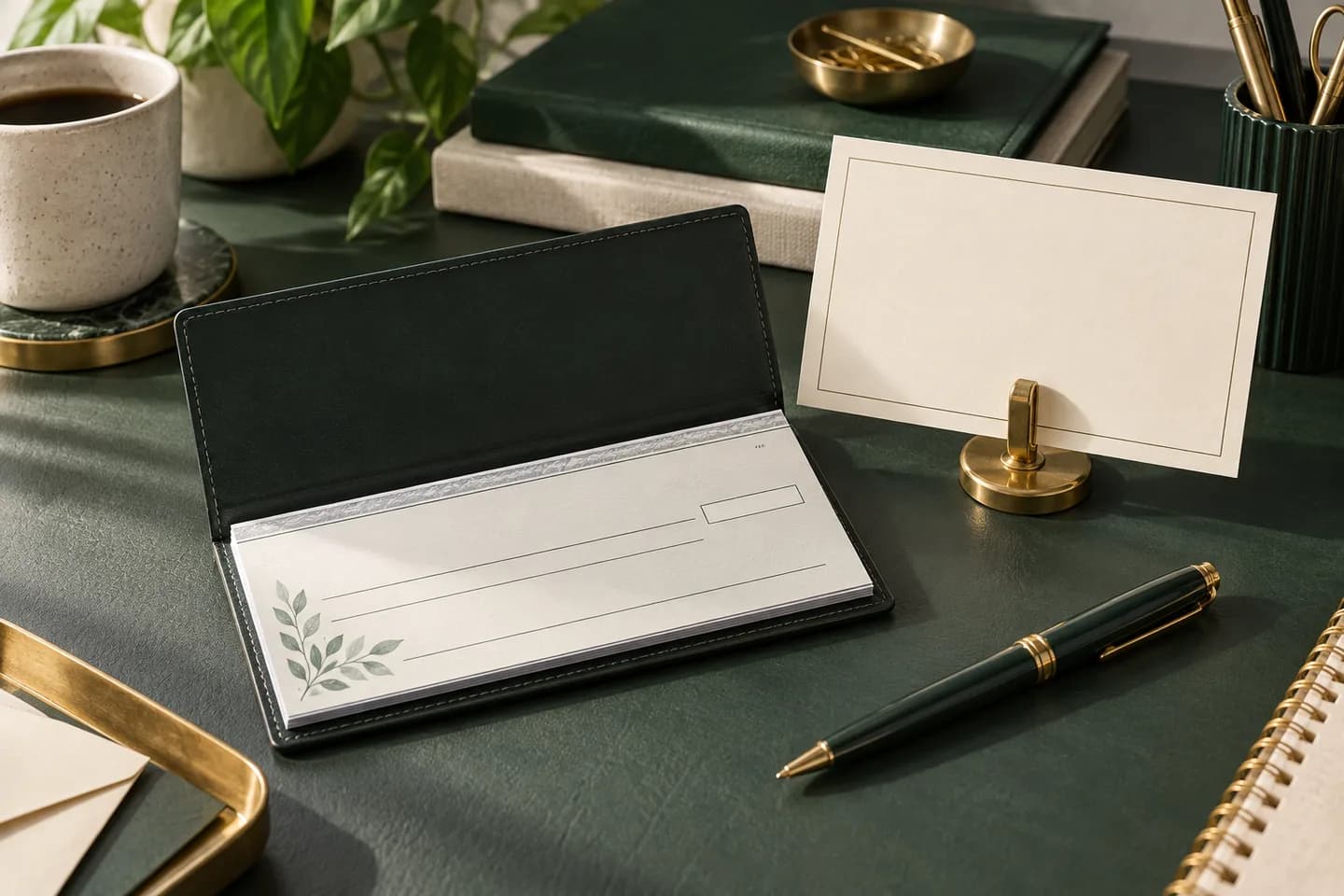
A check has printed parts and parts you write. The printed parts include your name and address, the bank name, the check number in the top right corner, and the MICR line along the bottom with the routing number, account number and check number. You never write on the MICR line. Our guide to the parts of a check explains every printed element.
You fill in six fields. The order matters because it keeps you from signing something incomplete.
| Order | Field | Where it is | What to write |
|---|---|---|---|
| 1 | Date | Top right | Today's date, such as 9/23/2026 or September 23, 2026 |
| 2 | Payee | Pay to the Order of line | The exact legal name of the person or business |
| 3 | Numeric amount | Box with the dollar sign | The amount in digits, tight to the dollar sign |
| 4 | Written amount | Long line ending in Dollars | Dollars in words, cents as a fraction over 100 |
| 5 | Memo | Bottom left | Invoice number, account number or purpose |
| 6 | Signature | Bottom right line | Your usual signature, matching the bank's records |
How do you write a check step by step?
- Write the date. Use the actual date; banks can pay a check before a later date written on it unless you give them notice.
- Write the payee's full name, starting at the far left of the line. For a business, use its legal or trade name as it banks.
- Write the numeric amount starting right against the dollar sign, with a clear decimal point.
- Write the amount in words starting at the far left, then the cents as a fraction, then draw a line to the word Dollars.
- Add a memo, such as an invoice number, so the payee applies the payment correctly.
- Sign last, only after everything else is complete and correct.
What does a filled out check look like?
Here are three worked examples showing exactly what goes on the two amount lines.
| Amount | Numeric box | Written line |
|---|---|---|
| $86.00 | 86.00 | Eighty six and 00/100 |
| $1,250.50 | 1,250.50 | One thousand two hundred fifty and 50/100 |
| $3,017.09 | 3,017.09 | Three thousand seventeen and 09/100 |
Say you pay Rivera Plumbing LLC $1,250.50 for invoice 4471 on September 23, 2026. The date line reads 9/23/2026. The payee line reads Rivera Plumbing LLC. The box reads 1,250.50. The written line reads One thousand two hundred fifty and 50/100, followed by a line to the word Dollars. The memo reads Invoice 4471. Then you sign.
Writing cents
Cents go after the word and, written as a fraction over 100: 50/100 for fifty cents, 09/100 for nine cents and 00/100 for a whole dollar amount. Use the word and only once, where the decimal point would go. Many people hyphenate numbers such as forty five in the written line; the hyphen is a spelling convention and does not change the amount. Our guide to writing a check with cents covers odd amounts, including checks for less than a dollar.
Why does the written amount matter more than the numbers?
The written amount is the legal amount. Under the Uniform Commercial Code, when an instrument has contradictory terms, words prevail over numbers. If the box says 1,250.50 but the line says One thousand two hundred five and 50/100, the bank can treat the check as $1,205.50.
That is why you write the amount twice and why you check that both agree before signing. It is also why you start both amounts at the far left of their spaces: an empty gap is where someone could add a digit or a word.
What are the most common check writing mistakes?
- Leaving space before or after the payee name or the amounts
- Forgetting the cents fraction, such as writing only Eighty six
- Mismatching the numeric and written amounts
- Writing the payee as a nickname or abbreviation the payee cannot deposit
- Signing before filling in the rest, or presigning blank checks
- Using pencil, an erasable pen or a light colored ink
- Writing over the MICR line or the signature line edge
If you make a mistake, do not cross it out and initial it on a business check. Void the check and write a new one. Our guide on how to void a check explains how to do that and record it.
Which pen should you use to write a check?
Use a dark blue or black pen with pigmented gel ink, often sold as fraud resistant or security ink. Pigment particles lodge in the paper fibers and resist the chemicals used in check washing better than many dye inks. Never use an erasable pen, which is designed to disappear. Our guide to the best pen for writing checks compares ink types.
How do you record a check in your register?
Every check should be recorded before it leaves your hands, in a paper register or your accounting software. A register entry has the check number, date, payee, amount, and the running balance after subtracting it. Duplicate checks leave a carbon copy behind as a backup record, and three to a page business checks have a stub for the same purpose.
Recording right away is what lets you reconcile later. When your statement arrives, you match each cleared check against the register and list any that are still outstanding. Our guide to balancing a checkbook walks through a full monthly reconciliation with a worked example.
What happens after you give someone a check?
The payee endorses it by signing the back, then deposits or cashes it. Many banks ask for a restrictive endorsement such as For deposit only, and many require specific wording for mobile deposit. A check is not good forever: under the Uniform Commercial Code a bank is not obligated to pay a personal or business check presented more than six months after its date, though it may choose to. Our guide to endorsing a check covers the payee side, and our guide to how long a check is good for covers stale dates and void after notices.
If you are learning to write checks for a new business, a small first order is a sensible start. Voqado wallet trial checks start at $5.99 for 25 at the time of writing, enough to practice the routine before ordering a full supply.
Frequently asked questions
How do you write $1,500 on a check?
Write 1,500.00 in the numeric box, tight against the dollar sign. On the written line, write One thousand five hundred and 00/100, then draw a line to the word Dollars. You can also write Fifteen hundred and 00/100; both are clear. Start at the far left of each space so nothing can be added.
Do you have to write cents on a check if there are none?
You should. Write 00/100 on the written line and .00 in the numeric box. It shows the amount is exact and closes the space where someone could add cents or more words. Some people write the word no in place of 00, as in no/100, which is also clear to read.
Can I postdate a check?
You can write a future date, but under the Uniform Commercial Code a bank may pay the check before that date unless you give the bank notice of the postdating in a way it can act on. If timing matters, hold the check until the date or ask your bank how to give notice.
What should I write in the memo line?
Write whatever helps the payee apply the payment: an invoice number, a customer account number or a short purpose such as September rent. The memo is optional and has no legal effect on the amount. Avoid sensitive details like your full Social Security number.
Sources & specification notes
The references below support the relevant technical or product details in this guide. Examples and checklists are not claims of practical testing or universal supplier requirements. Confirm the current specifications for your chosen product before production.
- Cornell LII: UCC 3-114, contradictory terms of instrument ↗
States that handwritten terms prevail over printed ones and words prevail over numbers.
- Cornell LII: UCC 4-404, bank not obliged to pay check more than six months old ↗
Supports the six month stale check rule mentioned in the final section.
- FDIC Money Smart Podcast: Make Deposits and Write Checks ↗
Lists the fields for writing a check and recording it in the register.
- Cornell LII: UCC 4-401 ↗
Sets the rule that a bank may pay a postdated check before its date unless the customer gives notice.