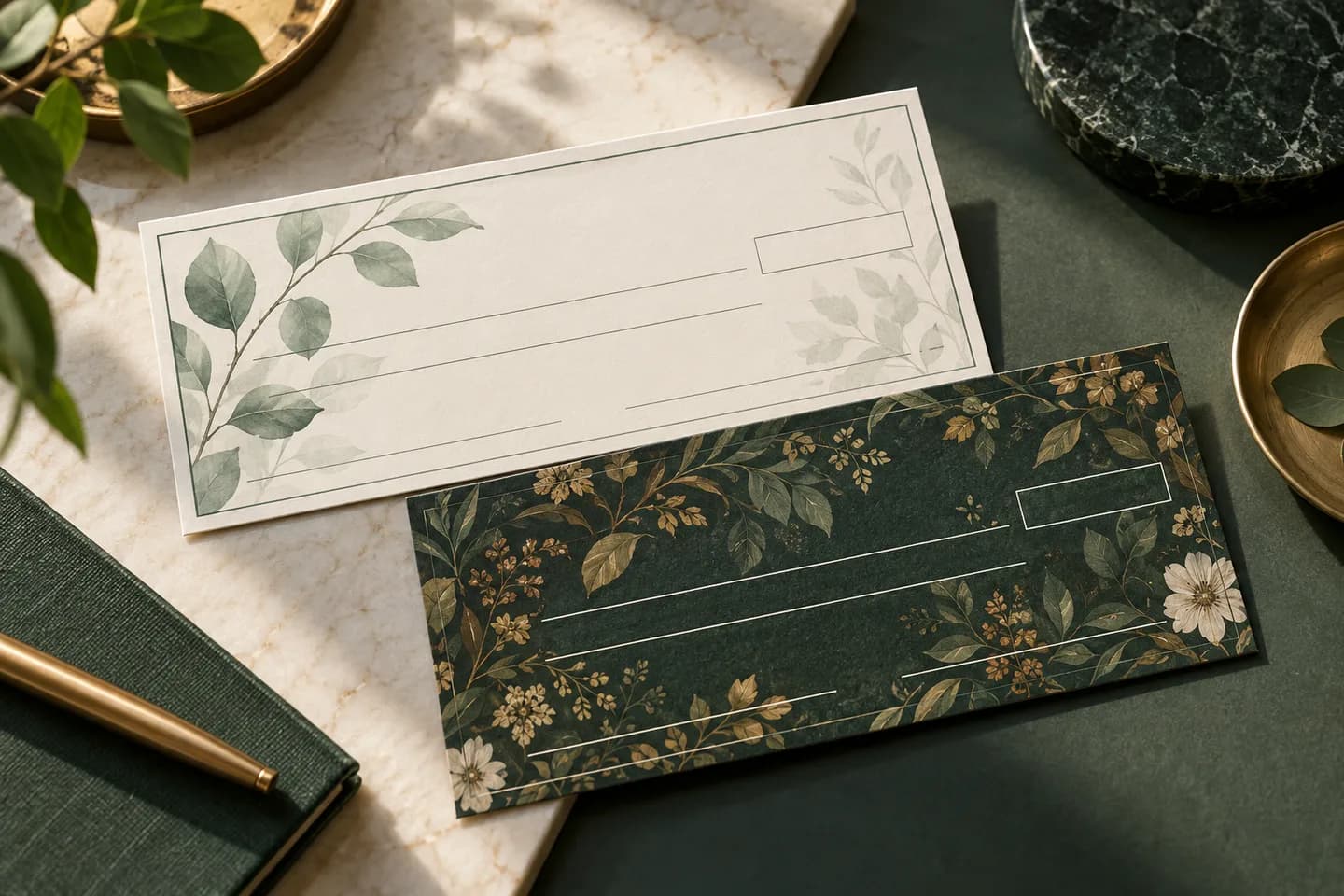
What are the parts of a check?
Every US check carries the same core elements, whether it is a 6 inch wallet check or a laser business check. The TROY MICR handbook lists them as the check number, fractional routing area, payee, date, convenience amount, legal amount, signature, bank name and the account holder block, with the MICR line along the bottom.
| Part | Where it sits | What it does |
|---|---|---|
| Payer block | Top left | Account holder name and address |
| Check number | Top right | Serial number for your records |
| Fractional routing number | Near the check number, if printed | Older form of the routing information |
| Date line | Top right, below the number | Date the check is written |
| Payee line | Middle, after Pay to the order of | Who receives the money |
| Amount box | Right of the payee line | Amount in numerals |
| Written amount line | Below the payee line | Amount in words, the legal amount |
| Bank name | Lower left or center | The bank that pays the check |
| Memo line | Bottom left | Optional note, such as an invoice number |
| Signature line | Bottom right | Authorizes payment |
| MICR line | Bottom edge | Routing, account and check numbers in magnetic ink |
What is in the payer block?
The payer block is the account holder's name and address, printed in the top left. On a business check it is the business name as titled on the bank account, often with a logo beside it and sometimes a phone number. It tells the payee who wrote the check and gives the bank a name to match against the account.
The bank name, and sometimes the bank's city and state, prints separately, usually in the lower left or center of the face. It tells the payee which institution will pay the check and gives them someone to call if they want to verify funds before shipping goods.
Where are the check number and fractional routing number?
The check number sits in the top right corner and repeats in the MICR line so your bank statement and your register can be matched. Business checks usually start at a higher number than personal checks, often in the thousands.
Some checks also show a small fraction near the check number. The TROY handbook describes the top part as a bank identification code and the bottom part as the Federal Reserve district transit symbol. It predates magnetic reading, and many checks still carry it.
How do the date, payee and amount lines work?
The date line records when the check was written. A bank is not obliged to pay an uncertified check presented more than six months after its date under UCC 4-404, though it may pay in good faith. Our guide to how long a check is good for covers stale dates in detail.
The payee line names who gets paid. The amount appears twice: in numerals in the box, called the convenience amount, and in words on the line below, called the legal amount. When the two disagree, UCC 3-114 says words prevail over numbers. Worked example: a box reading 1,250.00 and a line reading One thousand two hundred five and 00/100 would be paid as $1,205.00, so write the words carefully and draw a line through unused space. Start each entry at the far left of its line so nobody can add digits or words in front of yours.
What is the memo line for?
The memo line is optional. Businesses use it for an invoice number, your customer number with the payee or a short description, which helps the payee apply the payment and helps you when reconciling. Keep it short and never write your own account numbers or sensitive details there, because the check passes through many hands.
What does the signature line do?
The signature authorizes the bank to pay. Business checks may print one or two signature lines, and some add a line of text such as Two signatures required over a set amount. That text is an internal control; ask your bank whether it actually checks dual signatures before you rely on it. The signature should stay above the bottom 5/8 inch so no stroke drops into the magnetic line.
What is in the MICR line at the bottom?
The MICR line uses the E-13B font in magnetic ink so bank machines can read it. It has up to four fields, and their order depends on check width.
- Auxiliary on us field, far left: the check serial number, only on checks longer than 6.5 inches
- Routing field: the nine digit routing number between two transit symbols
- On us field: the account number, and on personal checks usually the check number too
- Amount field, far right: blank until the bank of first deposit encodes the amount
On its checks, Wells Fargo describes the account number as sitting to the right of the routing number and to the left of the check number. On many business checks the serial number moves to the auxiliary field on the far left instead, so the order reads check number, routing number, account number. For the difference between the two key numbers, read routing number vs account number. For the symbols and standards, see what MICR is and why it matters.
How do business and personal checks differ?
The parts are the same; the proportions change. Business checks are wider, carry more in the payer block and often add stubs.
| Feature | Personal check | Business check |
|---|---|---|
| Typical size | 6 x 2.75 in | About 8.25 to 8.5 in wide |
| Check number in MICR line | After the account number | Often in the auxiliary field, far left |
| Signature lines | One | One or two |
| Logo | Rare | Common |
| Stub or voucher | Register or carbon copy | Side stub or voucher sheet |
What should you check on your own checks?
Before you order or reorder, hold one of your current checks and walk through it.
- Payer name matches the account title exactly
- Address is current
- Check number in the corner matches the number in the MICR line
- Routing number between the transit symbols has nine digits
- Account number matches your statement
- Nothing prints inside the bottom 5/8 inch except the MICR line
- Signature lines match how many people must sign
If you want to see a new design on real paper before committing, start with a 25 check trial run. Our check format guide explains how wallet, desk and laser layouts arrange these same parts, and the check printing guide covers the rest of the ordering decisions.
Frequently asked questions
What are the numbers at the bottom of a check?
They are the MICR line, printed in magnetic ink. From left to right on a personal check you usually see the nine digit routing number, the account number and the check number. On many business checks the check number moves to the far left, before the routing number. The amount is added later by the bank when the check is deposited.
Which amount counts if the numbers and words on a check differ?
The written words count. Under UCC 3-114, words prevail over numbers when a check's numeric amount and written amount conflict. Banks may still return or question a mismatched check, so the safest move is to void it and write a new one with the words and numerals matching exactly.
Is the memo line on a check required?
No, the memo line is optional and has no effect on whether the check is paid. It is useful for an invoice number or customer account number so the payee can apply the payment correctly. Keep it brief and do not write your own bank account number or other sensitive details on it.
What is the small fraction number on a check?
It is the fractional routing number, an older way of writing the bank's routing information. The top part identifies the bank and the bottom part is the Federal Reserve district transit symbol. It dates from manual check sorting, and some banks still print it. The nine digit routing number in the MICR line is what machines read.
Sources & specification notes
The references below support the relevant technical or product details in this guide. Examples and checklists are not claims of practical testing or universal supplier requirements. Confirm the current specifications for your chosen product before production.
- TROY Group: MICR Basics Handbook ↗
Manufacturer handbook summarizing ANSI check size limits, the E-13B character set, MICR field positions, the 5/8 inch clear band and reject fees.
- Cornell LII: UCC 3-114, Contradictory terms of instrument ↗
Establishes that words prevail over numbers when the written and numeric amounts disagree.
- Cornell LII: UCC 4-404, Bank not obliged to pay check more than six months old ↗
States that a bank is not obliged to pay an uncertified check presented more than six months after its date but may do so in good faith.
- Wells Fargo: Routing and account number information ↗
States that the account number sits to the right of the routing number and to the left of the check number on its checks.
- MICR Gauge: About MICR and E-13B ↗
Lists the MICR field order and notes that the auxiliary on us field appears only on checks longer than 6.5 inches; this refines the plan's routing, account, check number order, which applies to personal size checks.