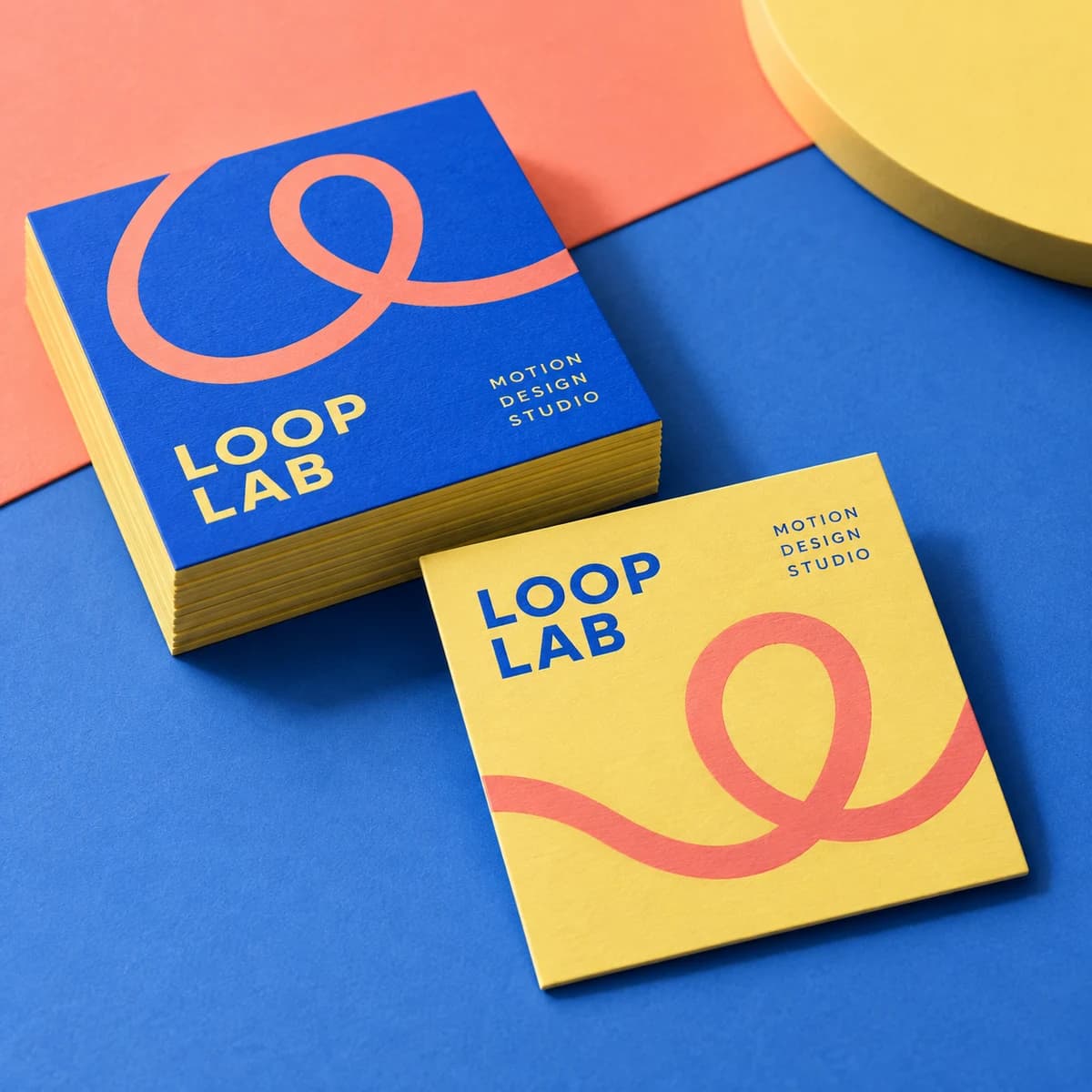
What size is a square business card?
There is no single standard, but 2.5 x 2.5 inches is the most common square size in the US. Printers cluster around a few sizes, and they are close enough that it pays to check before you design.
| Square size | Metric | Pixels at 300 ppi (trim) | Where you see it |
|---|---|---|---|
| 2 x 2 in | 50.8 mm | 600 x 600 | Mini squares for minimal layouts |
| 2.5 x 2.5 in | 63.5 mm | 750 x 750 | Vistaprint, Voqado, UPrinting standard square |
| 2.55 x 2.55 in | 65 mm | 765 x 765 | MOO square |
| 3 x 3 in | 76.2 mm | 900 x 900 | Jumbo squares, doubles as a mini flyer |
For comparison, a standard US card is 3.5 x 2 inches, so a 2.5 inch square has about 11 percent less area (6.25 square inches against 7). You trade width for height, which changes how your layout breathes.
Bleed is set by each printer. UPrinting asks for 0.125 inch on each side, while Voqado's standard card templates use 0.055 inch per side. Always start from your printer's template for the exact size you order rather than resizing a rectangular file.
What are the pros of square business cards?
- They look different in a stack of rectangles, so people notice them and remember them
- A square frames a logo, a product photo or a pattern naturally
- A QR code sits comfortably on the back with room to spare
- The shape suits visual trades such as photographers, bakers, florists, designers and studios
- They pair well with square social media posts and packaging stickers, so your brand feels consistent
What are the cons of square business cards?
- They do not fit neatly in holders built for 3.5 x 2 inch cards
- Less width means long names, emails and street addresses may need smaller type
- They usually cost more than standard rectangles from the same printer
- Some finishes are not offered on square shapes
- They look playful, which may not suit conservative fields like law or finance
Price is the con people ask about most. At Voqado, for example, square cards start at $26.99 for 100 at the time of writing, against $14.99 for 100 standard matte cards. That gap is typical across printers because the shape is less common and runs in smaller volumes.
Do square business cards fit in a wallet?
Often, but not neatly. Wallet card slots are sized for bank and ID cards, which follow the ISO/IEC 7810 ID-1 format of 3.37 x 2.13 inches. A 2.5 inch square is narrower than that slot but about 0.37 inch taller, so in most wallets the top edge peeks out. A 2 inch mini square fits almost anywhere.
The same math applies to desk holders, card sleeves and binder pages made for 3.5 x 2 inch cards. The square is short enough in width but too tall for the pocket. If your clients are likely to file your card, a standard size or a rounded rectangle is safer. If you want them to leave it on the fridge or the dashboard, a square is fine.
Who should choose square business cards?
Square cards earn their price when the look of the card is part of the pitch. They work well for creative studios, photographers, stylists, tattoo artists, bakers, boutiques and product brands, especially when you hand them out alongside a purchase or in a package.
They are a weaker fit when your card carries a lot of text, such as a law office with three phone numbers, or when clients tend to file cards in a holder. In those cases, keep a standard card as your main card and use a small square run for events or packaging inserts.
How do you design a square business card?
Treat the two sides differently. Put one strong visual on the front, such as your logo centered with generous space around it, and put the details on the back. Trying to fit a rectangular layout into a square is the most common reason square cards look cramped.
- Front: logo or mark, business name, maybe a short tagline
- Back: name, one phone number, one email or website, and a QR code
- Keep text at least 7 pt, and larger for light text on dark backgrounds
- Keep everything important inside the safe area, away from the trim
- Center align or use a strong grid; square cards reward symmetry
- Export at 300 ppi at the final size plus bleed
A worked example: on a 2.5 inch square back, a QR code of 0.8 inch leaves about 1.4 inches of width for text beside it after margins. That is enough for a name at 9 pt and two contact lines at 7.5 pt. If your email is long, stack the QR code below the text instead. For wording ideas that fit a small front, see our business card taglines guide.
Square vs circle vs standard: which should you pick?
| Card | Size | Best for | Watch out for |
|---|---|---|---|
| Standard rectangle | 3.5 x 2 in | Most businesses, lots of details | Blends in with other cards |
| Square | 2.5 x 2.5 in | Visual brands, logos, QR codes | Holder fit, higher price |
| Circle | 2.5 in diameter | Sticker style look, playful brands | Text must stay away from the curve |
Circle cards push the novelty further. Voqado's circle cards are 2.5 inches across and need text kept well away from the curved edge, so they suit a mark and a URL more than a full contact block. You can see circle cards if you are weighing the two.
Square card checklist before you order
- Confirm the exact size your printer uses before you design
- Download the printer template with the right bleed
- Put the logo on the front and details on the back
- Check that text is readable at actual size on paper
- Test the QR code from arm's length with two phones
- Decide whether rounded corners suit your brand
- Order a small first run if you are unsure about the shape
Distinctive shapes are one of the ways print still beats a contact card on a phone, a point we cover in whether business cards are still relevant. When your layout is ready, you can explore square business cards and choose from the available papers and rounded corner option.
Frequently asked questions
What is the standard size of a square business card?
The most common size is 2.5 x 2.5 inches, about 63.5 mm. Vistaprint, Voqado and UPrinting all offer it. MOO uses a slightly larger 65 mm square, about 2.55 inches, and some printers sell 2 inch minis and 3 inch jumbos. Confirm the exact size with your printer before designing, because a small difference changes the template.
Do square business cards fit in a standard card holder?
Usually not neatly. Holders and sleeves are built for 3.5 x 2 inch cards, and a 2.5 inch square is half an inch too tall for that pocket. It will sit in the holder but stick up above the edge. A 2 inch mini square fits most holders and wallet slots.
Are square business cards more expensive?
Usually, yes. The shape is less common, so it runs in smaller volumes and often needs a different cutting setup. At Voqado, square cards start at $26.99 for 100 at the time of writing, compared with $14.99 for 100 standard matte cards. Compare exact quotes with the same paper and quantity to see the real gap.
What resolution should a square business card file be?
Design at 300 pixels per inch at the final printed size. A 2.5 inch square is 750 x 750 pixels at trim, and larger once bleed is added. With a 0.125 inch bleed on each side, the full file is 2.75 inches, or 825 x 825 pixels. Use your printer's template to get the exact bleed.
Sources & specification notes
The references below support the relevant technical or product details in this guide. Examples and checklists are not claims of practical testing or universal supplier requirements. Confirm the current specifications for your chosen product before production.
- Vistaprint: Business card dimensions ↗
States square business cards are 2.5 x 2.5 inches and standard cards 3.5 x 2 inches.
- UPrinting: Square business cards ↗
Lists 2 x 2, 2.5 x 2.5 and 3 x 3 inch squares and a 0.125 inch bleed requirement.
- MOO: Business card size and dimension guide ↗
Gives the MOO square card as 6.5 cm, about 2.55 inches, on each side.
- Wikipedia: ISO/IEC 7810 ↗
Gives the ID-1 card format as 85.60 x 53.98 mm, used here to compare wallet slot height with a square card.