What is the standard business card size in the US?
In the United States and Canada the standard is 3.5 x 2 inches. It fits wallet slots, desktop holders and most card scanners, which is why it remains the safe default. At 300 pixels per inch the finished card is 1050 x 600 pixels, and with 0.125 inch bleed on every side the file becomes 1125 x 675 pixels.
A common belief is that a US business card is the same size as a credit card. It is close but not identical. Bank cards use the ISO/IEC 7810 ID-1 format of 85.60 x 53.98 mm, or 3.370 x 2.125 inches, which is slightly narrower and slightly taller than a US business card. The University of Cambridge summary of ISO paper formats notes that ID-1 is also widely used for business cards.
What size are business cards in Europe and Japan?
There is no single worldwide standard. In much of Europe the common size is 85 x 55 mm, which is close to the ID-1 card. Japan commonly uses 91 x 55 mm. Some designers also use the ISO A8 sheet size of 74 x 52 mm. If you exchange cards internationally, a US card will look a little long in a European holder and a Japanese card a little long in a US one, but all of them work in practice.
How do business card sizes compare?
The table lists the finished trim size. Pixel values assume 300 pixels per inch without bleed; add bleed before exporting your print file.
| Format | Inches | Millimeters | Pixels at 300 ppi |
|---|---|---|---|
| US and Canada standard | 3.5 x 2 | 88.9 x 50.8 | 1050 x 600 |
| ID-1 credit card | 3.370 x 2.125 | 85.60 x 53.98 | 1011 x 638 |
| Common European | 3.35 x 2.17 | 85 x 55 | 1004 x 650 |
| Common Japanese | 3.58 x 2.17 | 91 x 55 | 1075 x 650 |
| ISO A8 | 2.91 x 2.05 | 74 x 52 | 874 x 614 |
| Square | 2.5 x 2.5 | 63.5 x 63.5 | 750 x 750 |
| Slim | 3.5 x 1.5 | 88.9 x 38.1 | 1050 x 450 |
When should you choose a square or slim card?
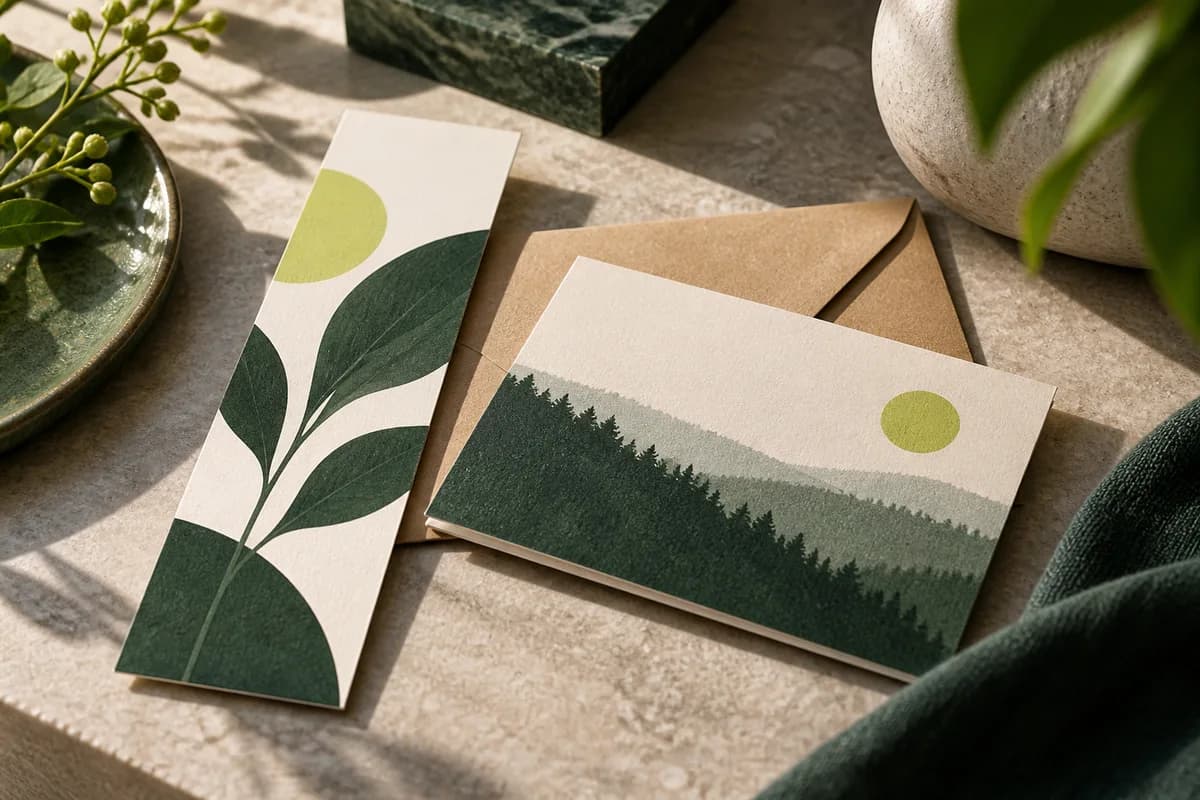
Choose a different shape when the design has one strong centerpiece and little text. Square business cards at 2.5 x 2.5 inches give a logo, product photograph or QR code room to breathe, and they fit most wallets even though they are taller than a standard card. They also double as product tags, coupons and box inserts.
Slim cards keep the 3.5 inch width but drop the height, often to about 1.5 inches, though the exact size varies by printer. They stand out in a stack and force you to edit the content down to a name, one contact route and a link. Nonstandard shapes usually cost more than a standard rectangle and hold less information, so choose them for impact rather than for convenience.
How big should a business card file be with bleed?
Add the bleed allowance twice to each dimension. The US Government Publishing Office tells designers to allow 1/8 inch minimum for any bleed as a general rule. A 3.5 x 2 inch card with 0.125 inch bleed on each side becomes 3.75 x 2.25 inches. Keep text and logos inside a safe area that sits inside the trim line, commonly about 0.125 inch in from the edge.
Bleed allowances vary by printer and by product, so always start from the template for the exact size and shape you plan to order rather than a generic number. The bleed calculator works out the full file size for any trim and allowance, and our guide to business card bleed explains the three boundaries in more detail. If you design on screen first, the article on business card size in pixels covers export settings for print and for digital use.
Which business card size should you pick?
Start from how the card will be carried and used, then let the design follow.
- Choose 3.5 x 2 inches if people will keep the card in a wallet, holder or scanner.
- Choose a square card if the card is mostly a logo, photograph or QR code.
- Choose a slim card if you want a memorable card with very little text.
- Match your local standard, such as 85 x 55 mm or 91 x 55 mm, if most recipients are abroad.
- Check that your printer offers the size before you design, not after.
- Build the file at trim size plus bleed and keep text inside the safe area.
How much do different card sizes cost?
Size and shape change the price because nonstandard shapes use different cutting. On the current published price list, 100 standard business cards start at $14.99 and 100 square business cards start at $26.99. Paper stock, corners and double sided printing change the final total, so configure the options before comparing quotes. You can browse every shape in the business card collection.
What are the most common sizing mistakes?
The first is designing at trim size with no bleed, which leaves a risk of thin white edges after cutting. The second is placing text too close to the edge, where normal cutting variation can clip it. The third is exporting a low resolution file: a 3.5 x 2 inch card needs at least 1050 x 600 pixels at 300 pixels per inch for sharp photographs. The fourth is mixing units, for example building a European 85 x 55 mm file and ordering a US 3.5 x 2 inch product. Print a copy at 100 percent scale, cut it out and hold it next to a real card before you approve the proof.
Frequently asked questions
Is a business card the same size as a credit card?
Not exactly. A US business card is 3.5 x 2 inches, or 88.9 x 50.8 mm. A credit card follows the ISO/IEC 7810 ID-1 format of 85.60 x 53.98 mm, or 3.370 x 2.125 inches. The two are close enough to share most wallet slots, but a business card is slightly wider and slightly shorter than a bank card.
What is the business card size in pixels?
At 300 pixels per inch a 3.5 x 2 inch card is 1050 x 600 pixels. With 0.125 inch bleed on every side the file becomes 3.75 x 2.25 inches, or 1125 x 675 pixels. Use 300 pixels per inch as the working target for photographs, and use vector artwork for logos and text whenever possible.
What size is a European business card?
There is no single European standard, but 85 x 55 mm is the most common size. It is close to the ID-1 bank card format of 85.60 x 53.98 mm. Some designers use the ISO A8 sheet size of 74 x 52 mm. Always confirm the exact trim size with your printer before you build the artwork file.
Do square business cards fit in a wallet?
A 2.5 x 2.5 inch square card fits in most wallets, although it is taller than a standard 3.5 x 2 inch card and may sit higher in the slot. Square cards work best for designs with one strong centerpiece, such as a logo, a product photograph or a QR code, with minimal supporting text.
Sources & specification notes
The references below support the relevant technical or product details in this guide. Examples and checklists are not claims of practical testing or universal supplier requirements. Confirm the current specifications for your chosen product before production.
- University of Cambridge (Markus Kuhn): International standard paper sizes ↗
Gives the ISO/IEC 7810 ID-1 card size of 85.60 x 53.98 mm, notes its use for business cards, and lists the A8 size of 52 x 74 mm.
- U.S. Government Publishing Office: GPO Publishing Guidelines ↗
Bleeds section: allow 1/8 inch minimum for any bleed as a general rule.