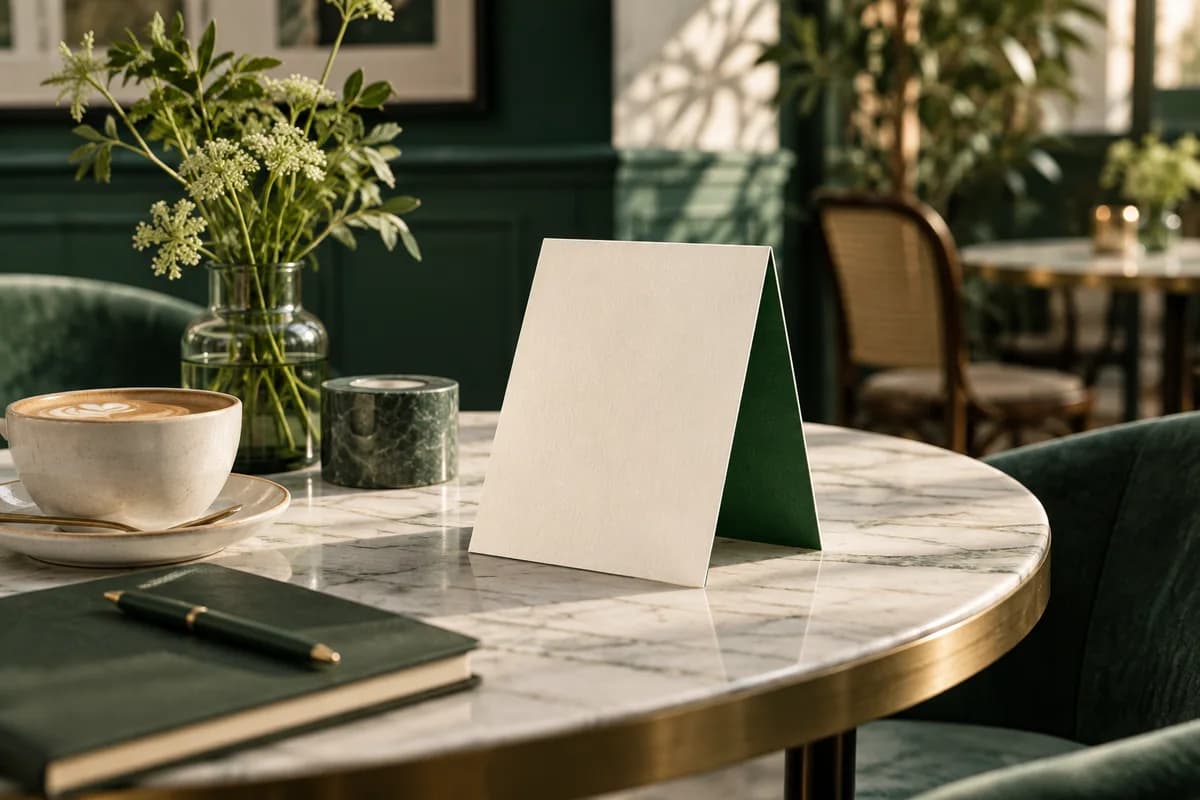
What are the common table tent constructions?
Every construction solves stability differently, and each one changes the artwork you need to supply. A simple folded tent is a scored sheet folded into an A shape with a message on each face. A tent with a base flap adds a third panel that tucks under or locks into the others, which keeps the display from sliding open. A holder insert is a flat printed card that slides into an upright or slanted acrylic frame, so the frame provides the stability and the card can be replaced without a new holder.
| Construction | How it stands | Readable faces | Watch for |
|---|---|---|---|
| Folded A shape tent | Two panels lean on each other | 2 | Splaying open on smooth tables |
| Tent with base flap | Third panel locks the base | 2 | Fold and flap alignment in the file |
| Upright acrylic holder | Frame holds a flat insert | 1 or 2 | Glare from the front panel |
| Slanted acrylic holder | Angled frame, one reading side | 1 | Only one side of the table can read it |
Ask the producer for the exact template, including which panels print upside down relative to each other. On a folded tent, one face is rotated 180 degrees in the flat file so that both read upright once folded.
How big should the text be on a table tent?
A table tent is read from a seat, often by someone mid conversation, so the headline has to work at a glance. There is no single rule for tabletop displays, but the ADA Standards for permanent visual signs make a useful benchmark: characters viewed from less than 6 feet should be at least 5/8 of an inch tall. Treat that as a target for the main line, and keep supporting text large enough to read from the far side of the table.
The same standard asks for characters that contrast with their background and a non glare finish. Both points matter on a table under pendant lights, and they matter even more behind acrylic.
How do you keep a table tent stable?
Stability comes from the stock, the fold and the base. Heavier card holds a crisp score and resists bowing. A base flap or holder stops the panels drifting apart on smooth or wet tables. Think about air conditioning vents, outdoor breezes and staff wiping around the display. If the tent will be handled constantly, ask about water resistant or synthetic materials, or use a holder so only the insert is replaced. Count how many tables need a display, add a few spares, and order enough to replace damaged tents without a second rush order.
Where should the QR code or offer sit?
Put the one action you want in the upper half of each face, where it stays visible above glasses and plates. A QR code needs a clear margin of four modules on every side, so keep folds, frame edges and decorative borders out of that area. Make codes with the free QR code generator, print a short instruction beside the code, and add a readable fallback URL for guests who prefer typing. If the tent points to a menu, the QR menu sign guide covers the menu page itself.
How do you set up the file with bleed and fold lines?
Build each panel at its finished size, add bleed around the outer edges if the color runs to the trim, and keep text and codes well away from the score line. The bleed calculator gives the full file size for a given trim, and the explainer on how bleed works covers why the extra margin is needed. Label the fold and base panels in the file so the proof shows the orientation clearly. Place a thin guide on a separate layer for the score line rather than drawing it in the artwork, so it never prints by mistake. When the proof arrives, fold a printout of it before approving, because a flat preview rarely reveals an upside down panel.
How do you test sightlines before printing a batch?
- Print the file at actual size on ordinary paper and fold it.
- Set it on a real table with glasses, plates and a menu in place.
- Sit in the seats on both sides and read each face without touching it.
- Scan the QR code from a seat under the room's normal lighting.
- Check the display from standing height for staff and passing guests.
- Wipe the table around it to see whether it tips or slides.
If one side is often blocked by a condiment caddy or a lamp, change the position or simplify that face. A photograph taken straight on can make a tent look perfect while missing the angle most guests actually see.
How often should table tents be replaced?
Replace tents when the offer, prices or menu link change, and when edges start to curl or stain. Keep the approved template and artwork files together so an updated version keeps the same panel geometry. If the messages change often, a durable holder with paper inserts is usually easier to maintain than a fully printed tent. Keep a small stock of spare tents or inserts behind the counter so a stained or bent display can be swapped during service, and note who on the team owns updates so an expired offer never stays on the tables for weeks. Pair the tent with printed restaurant menus when guests need the full list at the table, and keep the tent focused on the one message a full menu does not carry, such as a daily special or an event night.
Frequently asked questions
What size is a table tent?
Table tents do not have one standard size. Sizes depend on the construction, such as a folded tent or an insert for an acrylic holder, and on the producer's template. Choose the construction first, ask for the exact template with panel and fold positions, and then design each face at its finished size with bleed where color runs to the edge.
How do you make a table tent stand up?
Use heavier card with a clean score, and choose a construction with a locking base flap or a separate holder. A plain two panel tent can splay open on smooth or wet tables. Test a folded mockup on the actual table, including when staff wipe around it, and move it away from air vents or breezes if it tips.
How big should text be on a table tent?
Make the headline readable at a glance from the far seat. There is no tabletop rule, but the ADA Standards ask for visual sign characters at least 5/8 of an inch tall when viewed from under 6 feet, which is a practical benchmark for the main line. Keep strong contrast and a non glare finish so lights do not wash the text out.
Should a table tent be double sided?
Usually yes. A table tent sits in the middle of a table, so guests on both sides need a readable face. On a folded tent, one face is rotated 180 degrees in the flat file so both read upright once folded. A slanted acrylic holder is the exception, because it only presents one reading side and suits tables against a wall.
Sources & specification notes
The references below support the relevant technical or product details in this guide. Examples and checklists are not claims of practical testing or universal supplier requirements. Confirm the current specifications for your chosen product before production.
- U.S. Access Board: Guide to the ADA Accessibility Standards, Chapter 7 Signs ↗
Visual character height by viewing distance, contrast and non glare finish for permanent signs, used here as a benchmark rather than a requirement for table tents.
- DENSO WAVE: QR Code area and quiet zone ↗
A QR Code needs a four module wide margin on all sides of the symbol.