How do you measure a jar for a label?
Start with the actual container, filled and closed, rather than a catalog drawing. Mark the top and bottom of the usable label zone, where the side is straight and clear of shoulders, ridges and the lid. A jar's widest point does not tell you whether a rectangular label will lie flat at that height.
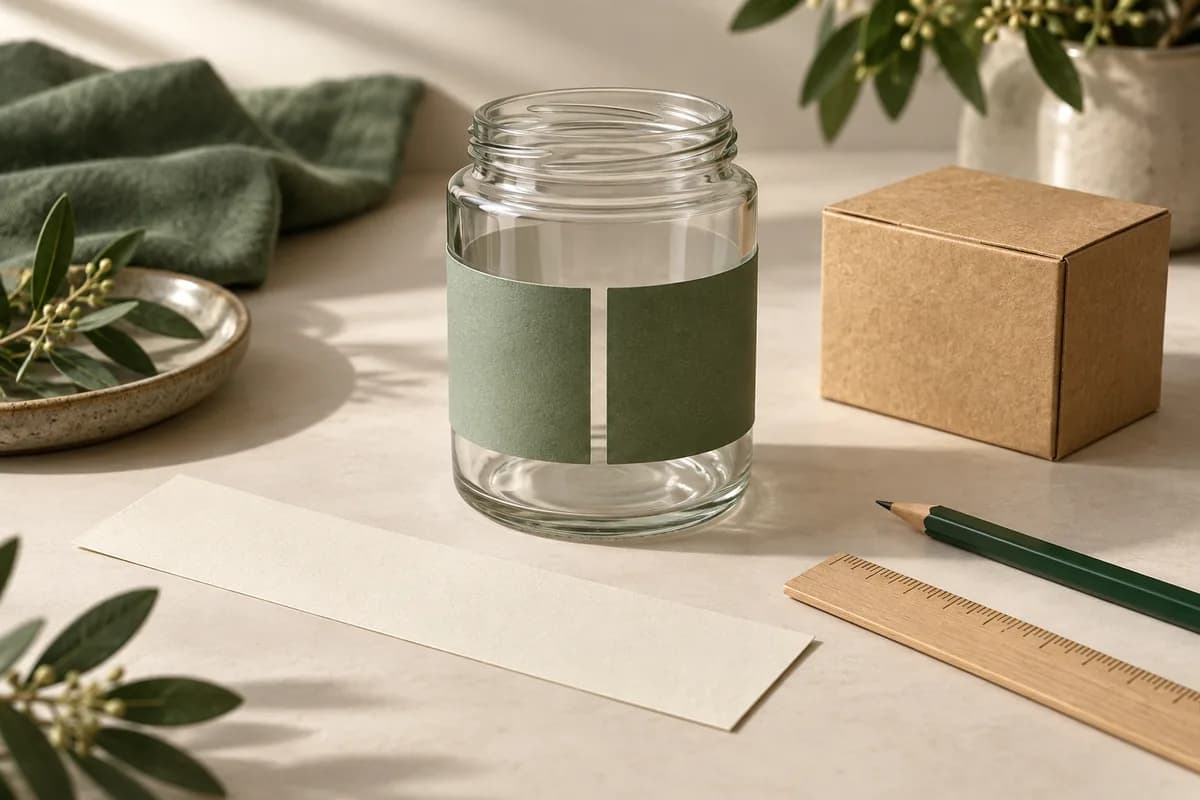
A paper strip gives a practical first check. Wrap it around the intended zone, mark where it meets itself and lay it flat to measure. Repeat near the top and bottom of the zone. If the numbers differ, the jar tapers, and a straight rectangle will wrinkle or climb. Avery's measuring guide describes the same wrap and cut method and notes that tapered containers may need a curved label shape.
How do you calculate a wraparound label size?
For a straight cylinder, circumference equals diameter times pi. Then decide whether the label should stop short of meeting itself or overlap.
| Input or result | Gap example | Overlap example |
|---|---|---|
| Outside diameter | 60 mm | 60 mm |
| Circumference, pi x 60 | 188.50 mm | 188.50 mm |
| Gap or overlap chosen | 3 mm gap | 3 mm overlap |
| Label width | 185.50 mm | 191.50 mm |
| Label height chosen | 45 mm | 45 mm |
The two versions differ by 6 mm, because one subtracts 3 mm and the other adds it. These are planning choices for the example, not universal label specifications. Ask the label supplier whether an overlap suits the material and application method. If you measured circumference directly with a strip, keep that number as a cross check rather than entering it as the diameter. A label wrap calculation cannot establish adhesive compatibility.
How do you size a label for a box?
For a box, cylinder arithmetic does not apply. Measure the flat panel of the assembled box, then subtract a margin from each edge so the label does not sit on a fold or crease. A label that crosses a fold lifts at the corner. Avoid placing essential information across an opening or a tear strip. If the box is sealed with a label, measure the path across the lid and down each side separately and treat it as a seal rather than a front panel.
How much label area is the front panel?
Food labels in the United States use a defined area called the principal display panel. Under 21 CFR 101.1, the panel on a rectangular package is the height times the width of that side. On a cylindrical container, it is 40 percent of the height times the circumference. For a jar 80 mm tall with a 188.5 mm circumference, that gives 0.4 x 80 x 188.5, about 6,032 square millimeters.
Required statements have their own rules about placement and type size. This planning guide does not certify compliance, so have the responsible reviewer check any regulated product. The guide to what to put on a product label covers the common content blocks.
Should you choose stickers, sheet labels or roll labels?
The size decision comes first, then the format. Sheet labels suit small batches and hand application. Roll labels suit repeated labeling in volume or with a dispenser. Die cut shapes suit jars and lids where a rectangle looks wrong. The comparison of roll labels vs sheet labels explains when each makes sense.
- Small batch, hand applied: product label sheets.
- High volume or dispenser: roll labels.
- Round lids: a circle sticker sized to the flat top.
- Tapered or curved surfaces: a supplier dieline.
For round lids, circle stickers should be a little smaller than the flat area inside the rim so the edge does not ride up.
Labels that wrap a jar also need a clear front. Decide which part of the wrap faces the shelf, place the product name and main claim there and keep the seam at the back, where a small gap or overlap is least visible. On any round jar, no more than half of the circumference faces a shopper at once.
How do you test the label before printing?
Cut the proposed rectangle from plain paper at exact size and wrap it around the jar. Check the height, the seam location and the front reading area when the jar sits on a shelf. Then review the actual size artwork separately: small text, required panels and any code need their own proof. Add bleed only as the printer's template specifies; the planned label size is not the same as the artwork's full bleed size.
What about moisture, oil and temperature?
A paper mockup tests geometry only. Tell the supplier what the container is made of and whether it will meet moisture, oil, friction, refrigeration or heat. Those conditions decide the material and adhesive, and the guide to water resistant labels explains how to describe the exposure. Request the chosen material for a trial on the real container before a full order.
What goes in a complete label brief?
- The container and the usable label zone.
- Diameter or measured circumference, with units.
- The chosen gap or overlap and the label height.
- The paper mockup and the supplier template.
- Surface material and exposure conditions.
- Quantity, application method and the reviewer for required text.
Frequently asked questions
What size label do I need for a jar?
Measure the outside diameter of the straight part of the jar and multiply by 3.1416 for the circumference. Subtract a small gap, often a few millimeters, for a label that should not meet itself, or add an overlap if the supplier approves. Choose the height from the straight zone between the shoulder and the base, then test a paper cutout.
How do you measure a tapered jar for a label?
Wrap a paper strip around the top and bottom of the intended label zone and compare the two lengths. If they differ, the jar tapers and a straight rectangle will wrinkle or climb when applied. Ask the label supplier for a curved dieline based on the actual container, and test a paper version of that shape before ordering.
Should a wraparound label overlap or leave a gap?
Both can work. A gap avoids label material sitting on itself and makes small differences in container size less visible. An overlap covers the full circumference but depends on the label material bonding to its own surface. In the 60 mm example, a 3 mm gap gives 185.5 mm and a 3 mm overlap gives 191.5 mm.
Are roll labels or sheet labels better for jars?
Sheet labels suit small batches applied by hand, because you can print a mix of designs on one sheet. Roll labels suit larger quantities and dispensers, where speed and consistent placement matter. The label size and shape should be decided first from the container, then the format chosen from volume and application method.
Sources & specification notes
The references below support the relevant technical or product details in this guide. Examples and checklists are not claims of practical testing or universal supplier requirements. Confirm the current specifications for your chosen product before production.
- Avery: How to choose the correct label size ↗
Describes the paper wrap and cut method for measuring a product and notes that tapered containers may need a curved label shape.
- 21 CFR 101.1: Principal display panel of package form food (Cornell LII) ↗
Defines the principal display panel area as height times width for a rectangular side and 40 percent of height times circumference for a cylindrical container.