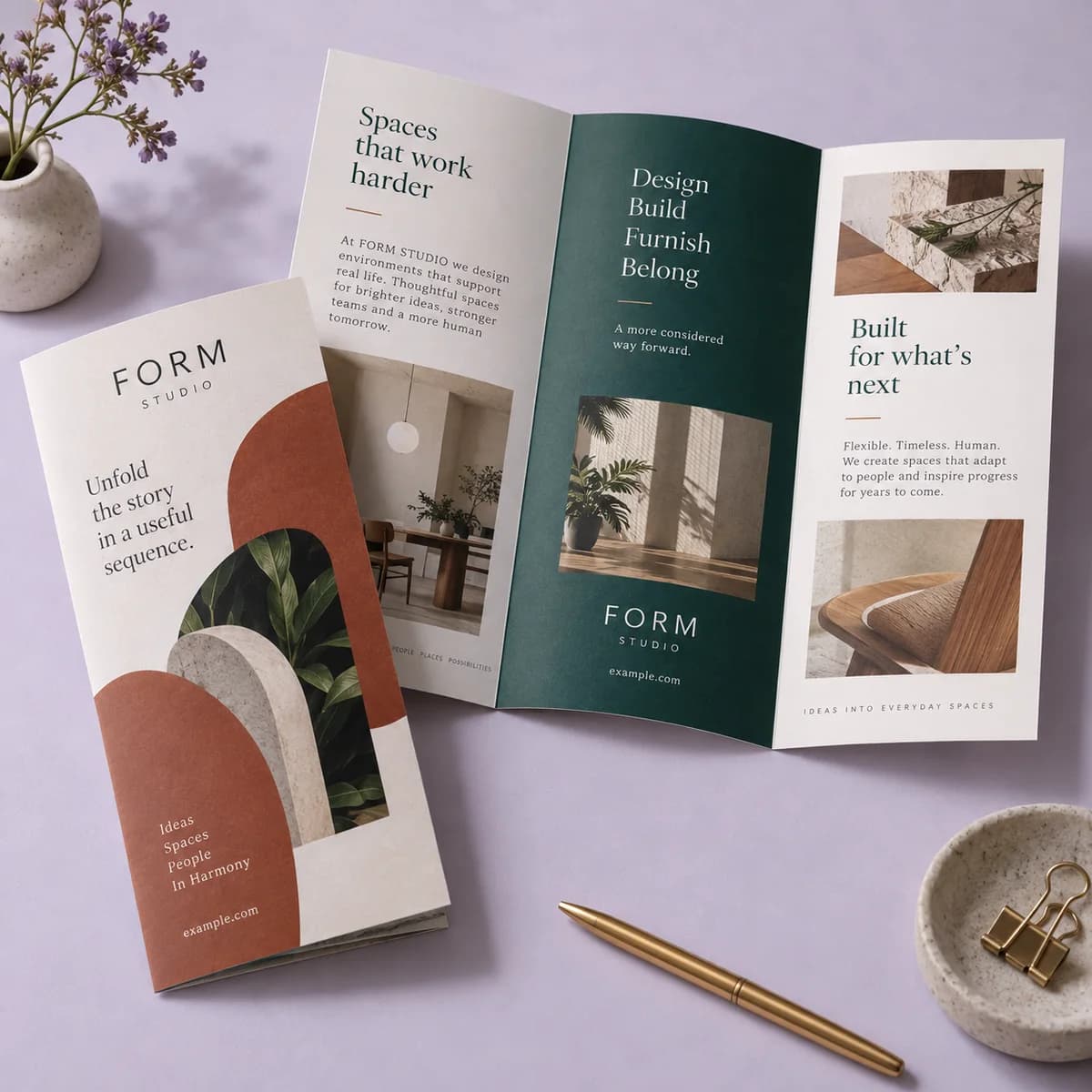
How does each fold behave?
| Fold | Panels | Reading behavior | Suits |
|---|---|---|---|
| Half, or bi fold | 4 | Front, open to a spread, back | One idea plus detail, menus, programs |
| Tri fold, letter fold | 6 | Front, flap, then full spread | A three step story, classic brochure |
| Z fold, accordion | 6 | Panels revealed one at a time | Sequences, timelines, step by step |
| Double parallel | 8 | Two stages of opening | Dense information, price lists |
| Gate fold | 6 | Two flaps open to a centre | A reveal, a hero image, a launch |
| Roll fold | 8 | Panels unroll in order | Long narratives, instructions |
| French fold | 4 plus | Opens twice, right angles | Maps, posters folded to pocket size |
The distinction people miss is between the tri fold and the Z fold. Both use two folds and six panels, but a tri fold tucks one panel inside so the reader opens a flap and then a spread, while a Z fold zigzags so each panel appears in turn. If your content is a sequence of equal steps, the Z fold serves it better. If it has an introduction and then a main spread, the tri fold does.
Why are some panels made narrower?
Because a panel that folds inside has to fit inside the ones wrapping around it. On a tri fold, the panel that tucks in is trimmed slightly narrower, commonly by a small fraction of an inch, so the fold closes flat without buckling.
This catches people who divide the flat width by three and build three identical panels. The result is a brochure that will not close cleanly, with the inner panel bowing at the fold.
Always start from the production template for the exact product and fold. It carries the panel widths, the fold positions and the safe margins already adjusted. Do not rebuild those numbers by hand, and do not move content across a fold line just because a panel looks empty.
How does paper weight change the fold?
Heavier stock resists folding and can crack along the fold, especially where there is heavy ink coverage. Thicker sheets also need more allowance for the inner panels, because the folded bulk is greater.
- Light and medium text weights fold cleanly and suit multiple folds.
- Heavier cover weights usually need scoring before folding.
- Dark, full coverage ink across a fold line shows cracking most.
- Coated stock cracks more visibly than uncoated at the same weight.
- More folds on heavy stock means a thicker, springier finished piece that will not lie flat.
If a design needs both a heavy feel and several folds, that is usually a sign the piece should be a booklet instead. The guide to booklet binding options covers where that line sits.
Which fold suits which job?
Work from the reader's situation.
A half fold suits anything read at a table, such as a menu or an event program, because it opens to one clean spread. A tri fold suits a rack or a counter, because it is pocket sized closed and holds enough to explain a service. A Z fold suits instructions and processes, because each step arrives on its own. A gate fold suits a single dramatic image or announcement, because opening it is an event. A roll fold suits long content where the reader progresses steadily. A French fold suits anything that must become a large flat sheet, such as a map.
Avoid choosing a fold because it looks unusual. Unusual folds cost more, take longer, and are frequently misassembled by readers who open them in the wrong order.
Does the fold affect mailing?
Yes, significantly, if the folded piece is mailed without an envelope. USPS standards for commercial mail set out requirements for folded self mailers, including where the final fold must sit and how the piece must be sealed with tabs or glue depending on its weight and fold configuration.
Getting this wrong means the mailing is rejected or surcharged at the counter, after it has been printed. If a folded piece will travel as a self mailer, confirm the fold orientation and sealing requirement before approving artwork, not after.
How do you test a fold before printing?
Make a paper dummy. Print the layout at 100 percent on ordinary paper, fold it by hand along the marked lines, and hand it to someone who has not seen it.
- Watch which panel they look at first and whether it is the one you intended.
- Watch whether they open it in the order the content assumes.
- Check that no headline or image lands across a fold.
- Check that the piece closes flat and the inner panel is not proud.
- Check the finished closed size against the rack, envelope or pocket it must fit.
Five minutes with a folded sheet of office paper prevents most folded print problems.
What is the fold checklist?
- Write the content sequence before choosing the fold.
- Match the fold to how the reader will hold and open the piece.
- Use the production template rather than dividing the width yourself.
- Allow for narrower inner panels on tri fold and roll fold work.
- Score heavy stock and keep heavy ink off fold lines.
- Check self mailer folding and sealing requirements before approval.
- Fold a paper dummy and hand it to someone else.
Frequently asked questions
What is the difference between a tri fold and a Z fold?
Both use two folds and six panels, but they reveal content differently. A tri fold tucks one panel inside, so the reader opens a flap and then a full spread. A Z fold zigzags, so panels appear one at a time. Use the Z fold for a sequence of equal steps and the tri fold when you want a lead in panel followed by a main spread.
Why are the panels on a brochure not all the same width?
Because the panel that folds inside must fit within the panels that wrap around it. If all three panels on a tri fold are identical, the piece will not close flat and the inner panel bows at the fold. The production template already accounts for this, which is why you should build from it rather than dividing the flat width by three.
Which fold is best for a menu?
A half fold in most cases, because it opens to a single clean spread that can be read flat on a table and returned to the stack easily. Tri folds suit racks and counters where the piece has to be small when closed, and heavier menus are often better as a booklet than a folded sheet.
Can I mail a folded brochure without an envelope?
Often, but it has to meet the postal standards for folded self mailers, which cover how the piece is folded, which edge leads and how it is sealed with tabs or glue. Confirm those requirements before approving artwork, because a piece that fails them is rejected or surcharged after it has already been printed.
Sources & specification notes
The references below support the relevant technical or product details in this guide. Examples and checklists are not claims of practical testing or universal supplier requirements. Confirm the current specifications for your chosen product before production.
- USPS Domestic Mail Manual 201: Commercial Letters, Cards, Flats and Parcels Design Standards ↗
Sets out folded self mailer standards, including fold configuration and the tabbing or glue sealing required by weight.
- University of Cambridge (Markus Kuhn): International standard paper sizes ↗
Used for the panel arithmetic when a standard sheet is divided into equal folded panels.