What are the steps in a postcard campaign?
Most campaigns follow the same sequence. The timings below are planning estimates for a first campaign. Production and delivery use the times published on the Voqado shipping page; confirm postal delivery times with your mail provider.
| Step | Output | Planning estimate |
|---|---|---|
| Brief | Audience, offer, action, budget, dates | 1 to 3 days |
| Copy and design | Front and back artwork | 1 to 2 weeks |
| Proof and approval | Approved print file | 2 to 5 days |
| Production and delivery | Printed cards delivered | 2 to 4 business days production plus 5 to 8 business days delivery |
| Mailing | Cards entered with USPS | Varies by mail class and provider |
| Measurement | Responses counted in a set window | Often 4 to 8 weeks after delivery |
What goes into a campaign brief?
A one page brief keeps every later decision consistent. Name the audience and why they should care now, the offer and its conditions, the single response action, the mailing window, the total budget and the person who will count results. Add the business's capacity: if the team can handle only a certain number of appointments a week, size the mailing to match. Our offer copy guide covers how to write the message itself.
Agree on who approves each stage before work begins. A campaign with one decision maker for copy, one for the budget and one for the mailing list moves faster than one where every change circles back to a group. Put those names and the approval dates in the brief so the schedule has an owner.
How do you choose the audience: a list or every door?
The two main mailing methods reach different people, so choose by goal rather than habit.
| Method | Who receives it | Addressing | Suits |
|---|---|---|---|
| Mailing list | Named people, such as past customers | Individual names and addresses | Return offers, renewals, loyalty |
| Every Door Direct Mail | Every address on chosen carrier routes | Postal Customer | Openings, new services, local awareness |
| Hand distribution | People at events, counters or in bags | None | Local events and existing visitors |
USPS says EDDM Retail lets you send from 200 up to 5,000 pieces per day per ZIP Code and target neighborhoods by route. EDDM pieces must meet USPS Marketing Mail flat standards, so confirm the size with the mail provider before design starts. For a named list, clean the addresses before printing. Our EDDM print checklist covers route mailings in more detail.
How much should you budget?
Add every cost: design, printing, postage or distribution, any list purchase and your own time. Then decide what the campaign must return. A simple way is to divide the total cost by the profit contribution of one additional sale. As an illustration, a campaign costing 1,200 dollars with a contribution of 30 dollars per sale needs 40 additional sales to break even. The campaign break even calculator runs this for your own numbers. Treat the result as a target to measure against, not a forecast.
What size and format should the postcard be?
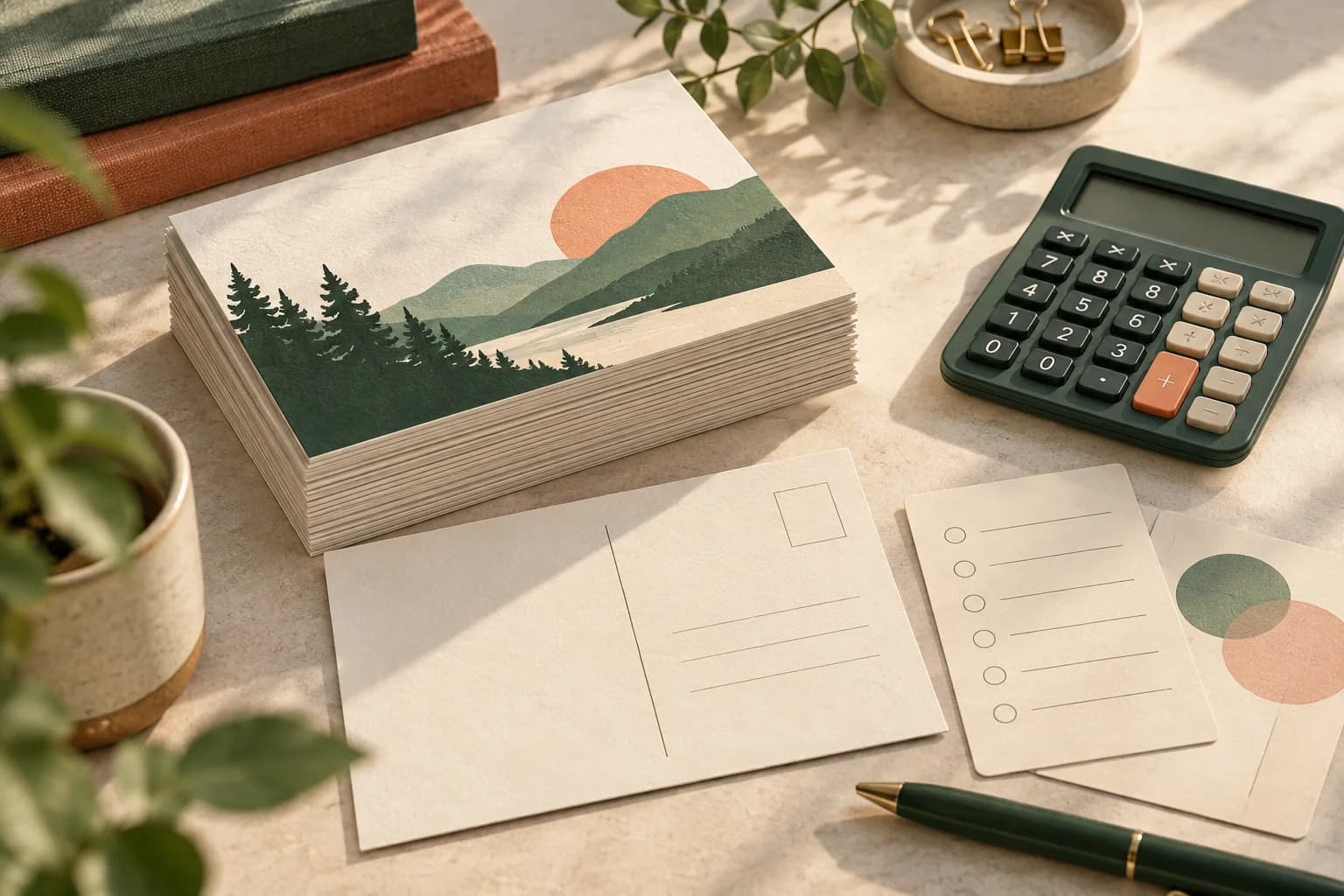
Pick the size from the mailing method. A single card mailed with a stamp gets the First Class Mail postcard price only from 3.5 x 5 up to 4.25 x 6 inches and 0.007 to 0.016 inch thick. Presorted or automation First Class mailings can use card prices for postcards up to 6 x 9 inches, at least 0.009 inch thick once a card is larger than 4.25 x 6. Cards outside those limits pay letter or flat postage. Our guide to postcard sizes for mailing compares common formats. Route mailings use the flat size standards instead. Whatever the size, reserve the address, postage and barcode area on the back before placing any artwork.
How do you connect the postcard to a landing page?
Send readers to a page that repeats the postcard's offer, headline and conditions and works well on a phone. Use a short URL people can type and, if you add a QR code, tag the destination so visits from the card can be separated from other traffic. The campaign link builder adds consistent UTM tags. Test the printed URL and the QR code from a physical proof before approving production.
How do you measure a postcard campaign?
Decide the measurement window and method before the cards mail. Count responses through a unique code, a dedicated phone line, tagged links or cards handed to staff. The basic response rate is responses divided by pieces delivered. Track inquiries and completed sales separately, and note any other promotions running at the same time so the results are read in context. Record quantity, cost and dates for each mailing so the next campaign can be compared fairly.
Keep the counting method consistent between campaigns. If one mailing used a code and the next used a QR code, the difference in results may reflect the method rather than the offer. A short results note after each campaign, listing what was mailed, to whom, what it cost and what came back, becomes the most useful planning document you have for the next one.
Campaign planning checklist
- A one page brief with audience, offer, action, budget and dates.
- A mailing method chosen to match the audience.
- A size that fits the mail class, with the address area reserved.
- A landing page that repeats the offer and a tested URL or QR code.
- A break even target and a set measurement window.
- A record of quantity, cost and mailing date for comparison.
Where should you start?
Write the brief first, then choose the mailing method. For a route mailing, direct mail postcards arrive printed, addressed and bundled for the post office, with postage paid separately to USPS.
Frequently asked questions
How do you plan a direct mail postcard campaign?
Start with a one page brief naming the audience, offer, response action, budget and dates. Choose a mailing method, either a named list or Every Door Direct Mail, then write the copy, design the card and approve a proof. Set up a landing page and tracking method, calculate a break even target and decide the measurement window before the cards are mailed.
How long does a postcard campaign take to plan and mail?
Allow at least four to six weeks for a first campaign. Briefing, copy and design often take one to two weeks, and proofing a few more days. Production and shipping add handling plus transit time, and postal delivery depends on the mail class. Build the schedule backward from the date the offer starts so the cards arrive with time to act.
What is the difference between EDDM and a mailing list?
A mailing list sends cards to named people at specific addresses, such as past customers. Every Door Direct Mail sends cards to every address on the carrier routes you choose, addressed to Postal Customer, with no list required. USPS allows from 200 up to 5,000 EDDM Retail pieces per day per ZIP Code. Lists suit return offers; EDDM suits local awareness.
How do you measure the results of a postcard campaign?
Give the campaign a way to be counted, such as a unique offer code, a dedicated phone number, a tagged URL or a QR code. Divide responses by pieces delivered for the response rate, and track completed sales separately from inquiries. Compare the results against your break even target within a set window, and note other promotions running at the same time.
Sources & specification notes
The references below support the relevant technical or product details in this guide. Examples and checklists are not claims of practical testing or universal supplier requirements. Confirm the current specifications for your chosen product before production.
- USPS: Every Door Direct Mail ↗
EDDM Retail daily limits per ZIP Code, route targeting and Postal Customer addressing.
- USPS Domestic Mail Manual 201: Physical Standards ↗
Card price limits, including postcards up to 6 x 9 inches in commercial mail, thickness and aspect ratio.
- FTC: Advertising FAQs: A Guide for Small Business ↗
Advertising claims must be truthful and supported before they run.
- USPS PostalPro: FAQs for the new larger sized postcard ↗
Presorted and automation First Class postcards may be up to 6 x 9 inches and 0.009 to 0.016 inch thick.