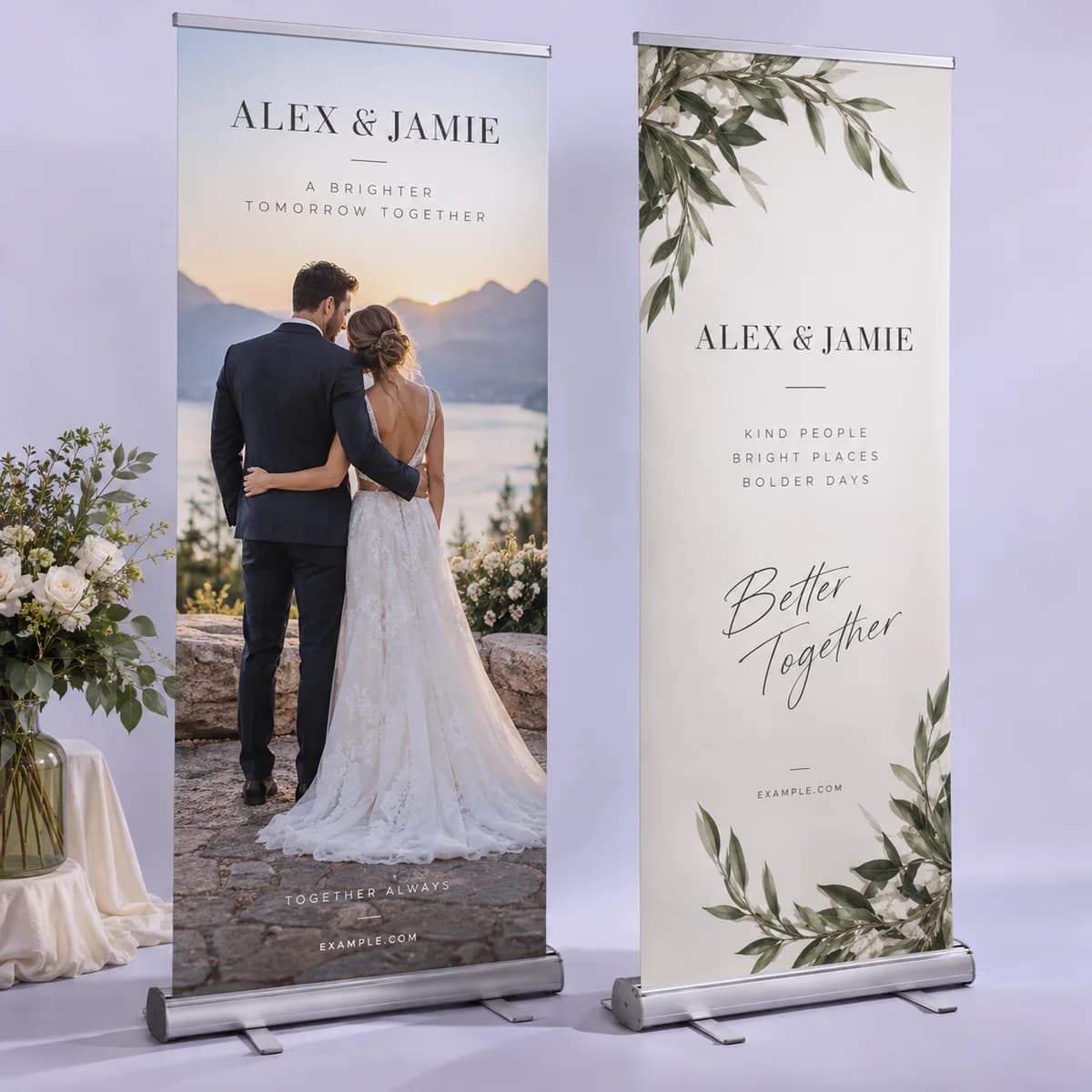
What do the four sizes suit?
| Size | Where it works | Message capacity |
|---|---|---|
| 24 x 62 in | Beside a counter, in a shop, on a tabletop run | One short line and a logo |
| 24 x 81 in | Booth corner, entrance, registration desk | A headline and three bullets |
| 33 x 81 in | The everyday booth banner | Headline, sub line and a short list |
| 47 x 81 in | Focal point, small back wall substitute | Headline plus an image |
The 62 inch height is noticeably shorter than a standing adult, which is why it reads best when it is close to the viewer and not competing with people. The 81 inch stands put the top of the graphic above head height, which is the part that stays visible in a crowd.
How many stands does a booth need?
Count messages, not feet. Each banner should carry one idea, so the number you need is the number of separate things you want to say at that show.
A 10 x 10 booth usually works with one or two. Two 33 inch stands side by side fill most of a 10 foot back wall and can be separated later for two different events. A 10 x 20 typically wants two or three, positioned at the ends and beside the counter, plus a fabric wall behind.
More than three banners in a small booth starts working against you. Every additional message reduces the chance any single one is read, and a row of four stands looks like a queue of competing posters rather than a designed space. The guide to booth sightlines from the aisle and the back of the hall covers how many words survive at each distance.
Where is the dead zone?
Every retractable stand has a cassette at the bottom that houses the rolled graphic and provides the weight that keeps it upright. The graphic emerges from the top of that cassette, so the lowest part of your artwork sits a few inches off the floor and the bottom foot or so of the visible graphic is blocked by anything in front of it, including a table edge, a bag or a visitor's legs.
Treat the bottom 12 inches as decoration. No contact details, no code to scan, no small print. Put those in the middle third, between about 40 and 60 inches from the floor, which is roughly chest to eye height for a standing adult. That placement also means a phone can be held comfortably in front of a code, which matters if the banner carries one.
What about the top?
The top of an 81 inch graphic sits above most heads, so it is the most reliably visible band in a busy booth. Put your name or the single strongest word there.
Resist the temptation to fill it with a large logo alone. A logo tells people who you are only if they already know you. For most exhibitors the top band is better spent on a category phrase, with the logo directly beneath it.
Single or double sided, and which cassette?
Retractable banners in our range are printed single sided, in vinyl, PVC free vinyl or polyester depending on the cassette, and are described as best for indoor use. Five cassette styles are offered, from Standard to Elite.
The cassette matters more than exhibitors expect. A heavier base resists knocks in a busy aisle, a better roller mechanism keeps the graphic flat rather than curling at the edges after a few shows, and a sturdier pole survives repeated setup. If a stand will travel to more than a couple of shows a year, the mechanism is where the money is best spent. Every stand includes a carrying case, which is also the thing that keeps the graphic clean between shows.
For outdoor events, a retractable stand is the wrong tool. Wind is the issue rather than rain, and a tall lightweight banner behaves like a sail. Use feather flags or a grommeted vinyl banner tied to a frame instead.
How do you plan the artwork dimensions?
Work from the visible graphic area for your chosen size, not the overall hardware dimensions, and follow the template supplied for the product. Two practical points.
- Add extra artwork at the bottom so the graphic can be pulled to different heights and still show no white gap, exactly as the template specifies.
- Extend the background at the top if the template calls for a leader strip that disappears into the rail.
- Keep the design vertical in thinking as well as shape: people scan top to bottom, so order the message accordingly.
- Check the resolution at full size. A 47 x 81 inch graphic read from 6 feet does not need 300 PPI, but it does need real pixels: use the pixels to print size calculator to confirm.
What is the banner stand checklist?
- Count the number of separate messages, then buy that many stands.
- Use 33 x 81 as the default and 47 x 81 for a focal point.
- Keep the bottom 12 inches free of anything that must be read.
- Put the strongest words in the band above head height.
- Choose a heavier cassette for stands that travel often.
- Use feather flags or grommeted vinyl outdoors, not a retractable stand.
- Follow the product template for bleed at the top and bottom.
Frequently asked questions
What is the most common retractable banner size?
A stand around 33 inches wide by 81 inches tall is the everyday choice, because it is wide enough for a headline and a short list while still fitting beside a counter. Narrower 24 inch stands suit tight spaces and multiple separate messages, and 47 inch stands work as a focal point or a small back wall.
How many roll up banners does a 10 x 10 booth need?
One or two. Each banner should carry a single idea, so the count follows the number of things you want to say. Two 33 inch stands cover most of a 10 foot back wall and can be split across two different events later, which is why they often beat one wide graphic.
Can I use a retractable banner outdoors?
It is not the right tool. Our retractable banners are described as best for indoor use, and the problem outdoors is wind rather than water: a tall lightweight graphic on a light base acts like a sail. Use a feather flag with a ground stake or a grommeted vinyl banner fixed to a frame instead.
Why should nothing important go at the bottom of a pull up banner?
The cassette sits on the floor and the graphic emerges above it, so the lowest band of artwork starts a few inches up and is then blocked by table edges, bags and people standing in the booth. Keep contact details, codes and small print between roughly 40 and 60 inches from the floor.
Sources & specification notes
The references below support the relevant technical or product details in this guide. Examples and checklists are not claims of practical testing or universal supplier requirements. Confirm the current specifications for your chosen product before production.
- U.S. Access Board: Guide to the ADA Standards, chapter 7 signs ↗
Used for the character height benchmark that decides how much copy fits on a banner read from aisle distance.