Which walls are worth printing?
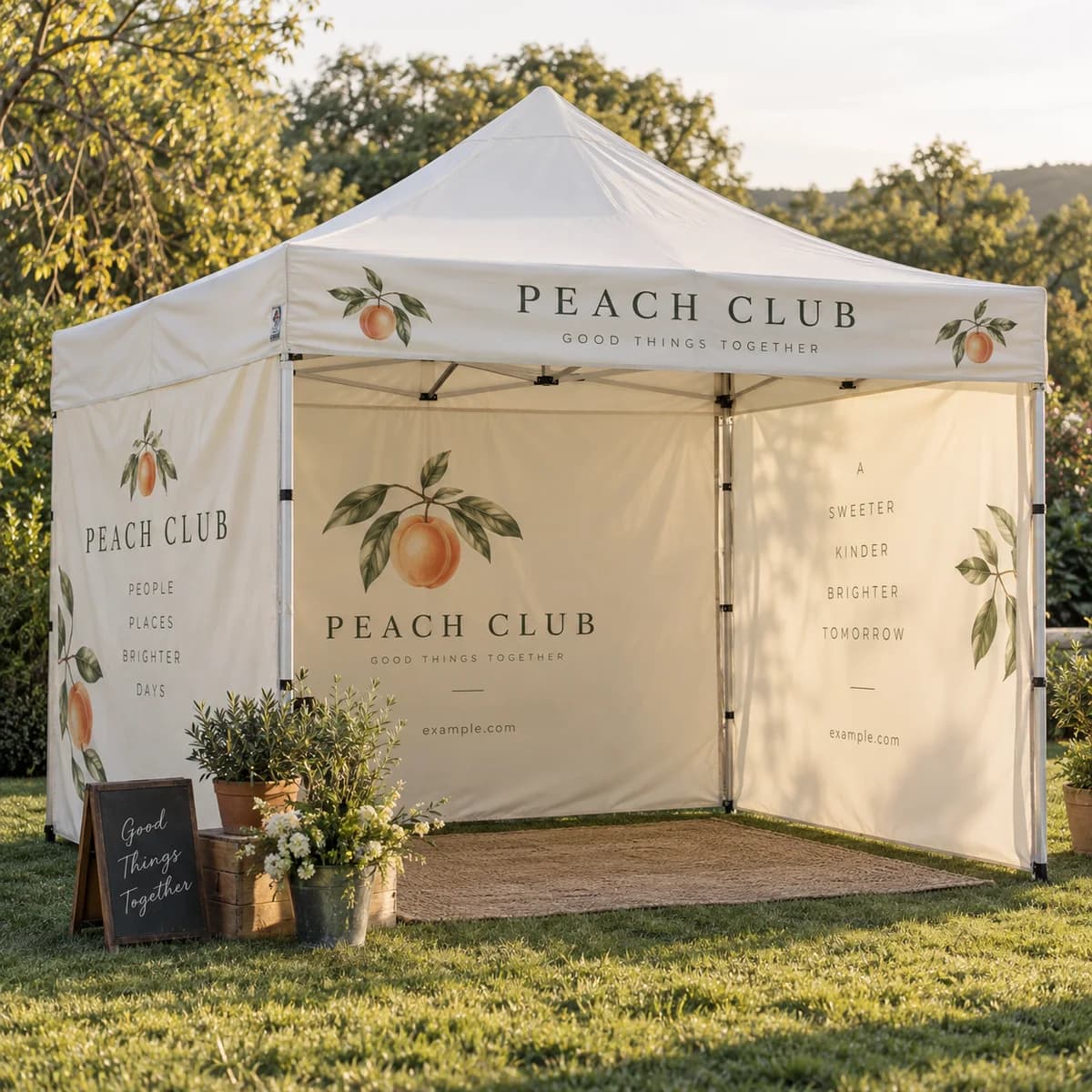
A canopy has a back, two sides and a front. They do different jobs and rarely deserve equal budget.
| Wall | Job | Priority |
|---|---|---|
| Back | Backdrop behind your staff, seen by everyone in front | First |
| One side | Read by people walking along the row | Second |
| Second side | Often faces a neighbor's tent | Last |
| Front or half wall | Closes the tent overnight, or forms a service counter | Situational |
Start with the back wall alone. It photographs behind your team, it frames the product on the table and it is visible from the front of the tent all day. A single printed back wall with plain sides looks intentional; a printed side wall with a bare back looks unfinished.
Add the side that faces open ground or the flow of traffic. Walk the event map before deciding which side that is, the same way you would read a hall floor plan for an indoor booth.
Where does the readable band sit?
A 10 foot canopy wall is roughly as tall as the frame leg, but the top of it is under the canopy roof and often shaded, and the bottom is behind tables, stock and people. In practice the reliably visible band on a tent wall is from about 3 feet to about 6 feet off the ground.
Put the name and the single strongest phrase in that band. Use the area above it for color and pattern that reads as brand at a distance, and treat the bottom 2 feet as a zone that will be covered by a table, a cooler or a queue.
Outdoor events are read from further away than indoor booths, because sightlines are long. Using the ADA character height benchmark, a phrase read from 25 feet needs capital letters near 3 inches tall, and one read from 40 feet closer to 5 inches. That is a very short phrase on a 10 foot wall, which is the point.
How does the wall attach, and does that matter outdoors?
Our canopy walls use tool free hook and loop attachment so they fasten to the frame without hardware. That makes setup quick and means one person can fit them, but it also means the wall is only as secure as the frame it is attached to.
Two outdoor realities follow. First, a walled canopy catches far more wind than an open one, so weights or anchors on every leg stop being optional. Many event organisers publish a minimum weight per leg; follow theirs rather than a general rule. Second, a wall that is fitted loosely will flap and abrade at the attachment points, so fit it taut and check the corners during the day.
If the forecast is genuinely windy, removing the walls is usually the right call. A tent is easier to replace than the person standing under it.
What about fire rules?
Tents and canopies used at public events are frequently covered by local fire regulations, and fabric is usually the material in scope. Our canopy tent walls are described as NFPA 701 certified, which is a statement about the material rather than a permit for your event.
Ask the organiser what documentation they want and keep a copy of the certificate with the tent. Indoor use of a canopy inside a hall almost always triggers the venue's fire marshal rules, which are covered in the guide to booth fire retardancy rules.
How should the artwork be built?
Canopy walls are printed by dye sublimation on fabric, single sided, and are described as machine washable and wrinkle resistant. That shapes three artwork decisions.
- Design for a soft edge. Fabric graphics are not the place for hairline rules, tight registration or fine drop shadows.
- Expect a wall to be seen with folds and movement, so avoid patterns that rely on perfect alignment.
- Keep contrast high, because outdoor light is strong from above and shaded below the canopy roof.
- Confirm which side of the wall carries the print, since single sided means the inside shows a reversed, muted version.
- Check resolution at full size rather than assuming 300 PPI: a 10 foot wall read from 15 feet does not need it, but it does need real pixels.
Remember that the inside of the wall is also a surface your staff look at for eight hours. A calm color reads better from inside than a full bleed photograph.
How do you store and reuse them?
Fabric walls fold small, which is their biggest advantage over rigid panels. Fold along the same lines each time, store them dry, and wash them according to the care instruction rather than sponging stains at the event.
Keep dated information off them entirely. A tent wall is a permanent layer piece: the event name, the year and any price belongs on a replaceable A frame sign or a table sign instead.
What is the canopy wall checklist?
- Match the wall size to the canopy frame, 10 x 10 or 10 x 15.
- Print the back wall first, then the side facing traffic.
- Keep every important word between 3 and 6 feet off the ground.
- Weight or anchor every leg once walls are fitted.
- Keep the flame resistance certificate with the tent.
- Design for fabric: high contrast, no hairlines, no perfect alignment.
- Keep dates and prices on replaceable signage, not on the walls.
Frequently asked questions
What size are canopy tent walls?
They are sold to match the canopy frame rather than as free sizes. Ours come in 10 x 10 and 10 x 15 foot versions with tool free hook and loop attachment. Measure the frame leg spacing before ordering, because a wall made for a different frame will either gap at the corners or not reach.
Do I need to print all four canopy walls?
Rarely. The back wall does most of the work because it sits behind your team and frames the table. Add the side that faces the traffic flow or open ground. A second side often faces a neighboring tent, and a front wall is mainly useful for closing up overnight or forming a service opening.
Are printed tent walls safe in wind?
Walls significantly increase wind load, so every leg needs weights or anchors, following the minimum the event organiser specifies. Fit the walls taut so they do not flap and abrade, check the corners during the day, and take the walls off entirely if the wind picks up.
Can canopy walls be washed?
Ours are described as machine washable and wrinkle resistant, which is part of why fabric walls reuse well. Follow the care instruction rather than spot cleaning at the event, and confirm with the supplier whether laundering affects the stated flame resistance certification.
Sources & specification notes
The references below support the relevant technical or product details in this guide. Examples and checklists are not claims of practical testing or universal supplier requirements. Confirm the current specifications for your chosen product before production.
- NFPA: NFPA 701, Standard Methods of Fire Tests for Flame Propagation of Textiles and Films ↗
Scope includes fabrics used in the assembly of awnings, tents and tarpaulins, which is why tent walls carry this test reference.
- U.S. Access Board: Guide to the ADA Standards, chapter 7 signs ↗
Character height benchmark used for the letter sizes quoted at 25 and 40 feet of viewing distance.