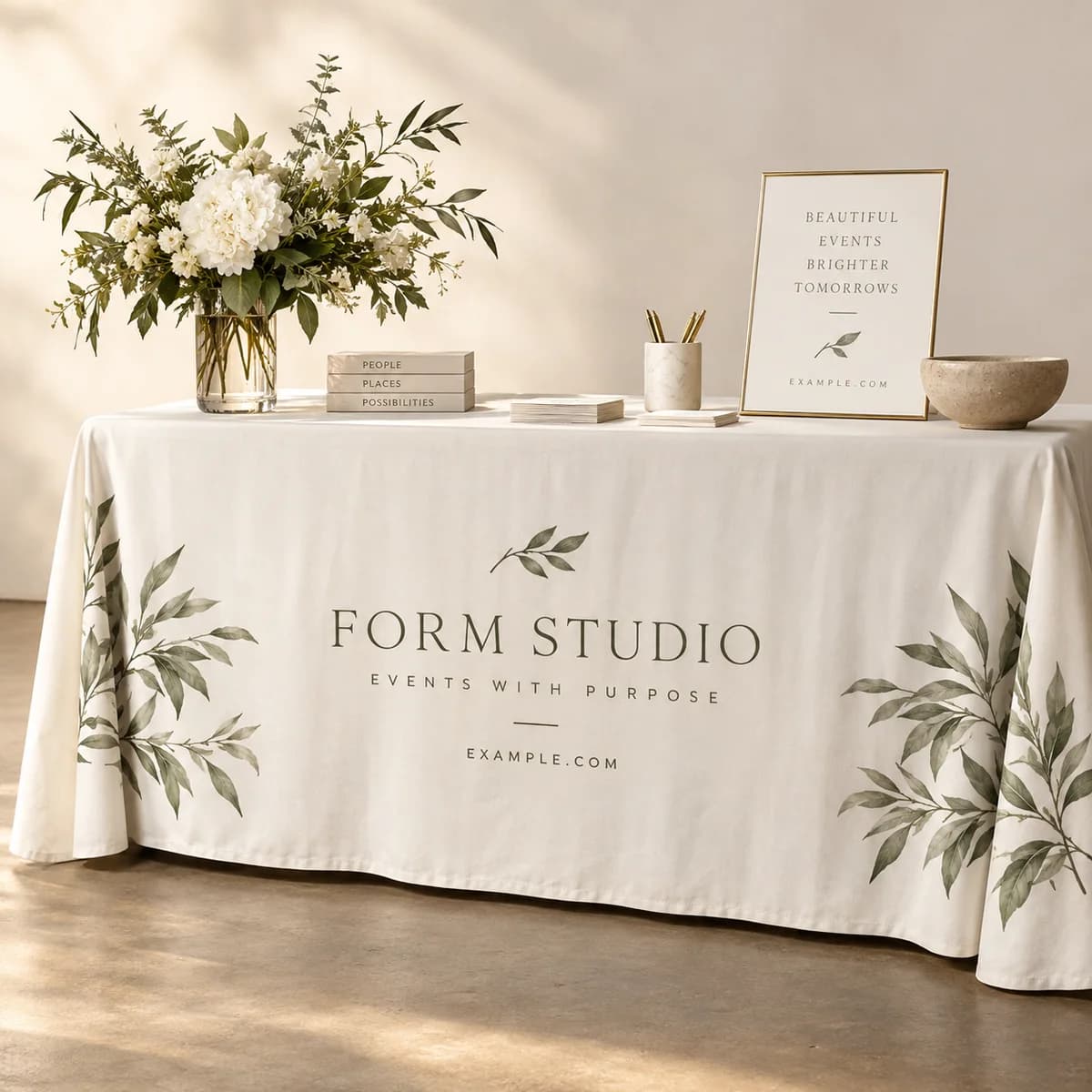
Drape or fitted?
A drape cover, sometimes called a throw, is a rectangle that hangs loosely over the table. A fitted cover is sewn to the table dimensions so it sits square with defined corners.
| Factor | Drape | Fitted |
|---|---|---|
| Look | Relaxed, softer corners | Tailored, defined edges |
| Fit tolerance | Works on slightly different tables | Made for one table size |
| Setup | Throw and adjust | Slide on and align |
| Wrinkles | More visible at the corners | Fewer, held by the seams |
| Reuse across tables | Good | Limited to that size |
If you exhibit at shows that supply different tables, drape covers survive the variation. If you always use your own 6 foot table, fitted looks noticeably sharper. Our table covers fit 4, 6 and 8 foot tables in either style.
Three sided or four sided?
A three sided cover is open at the back, which lets you store boxes, cases and coats under the table and reach them without crawling. A four sided cover closes the back, which looks better when the table is freestanding or when people can see behind it.
For an inline booth against a back wall, three sided is almost always the right answer. For a table in the middle of a room, at a conference registration desk or in a shop, four sided is worth the small extra cost.
Ours are offered in both, with front only or all over printing.
Where should the artwork go?
Think about what is left visible. A table cover has a top surface, a front panel and two short ends. The top gets covered with product, print and a laptop within minutes. The bottom few inches of the front panel sit near the floor behind bags and feet.
That leaves a usable band across the front panel, roughly between the table edge and 8 to 10 inches down, and the two short ends.
- Put the logo centered on the front panel, inside that top band.
- Keep it clear of the centre if you plan to sit at the table, since legs and chairs cover the middle.
- Use the short ends for a repeat of the name, because they face down the aisle.
- Avoid small text entirely: a table cover is read from 6 to 15 feet.
- Avoid a pattern that needs alignment, because fabric drapes and shifts.
A front only print is usually enough. All over printing photographs well but is largely hidden in use, so spend the difference on a counter graphic or a banner instead unless the table is a centrepiece.
What fabric should you choose?
Our covers come in four fabrics, including a 100 percent post consumer recycled option and a wrinkle resistant option, and are described as machine washable and flame resistant to CAN/ULC S109.
Wrinkle resistance is worth more than it sounds. A cover that travels folded in a bag and is unpacked 20 minutes before doors open will show its creases in photographs for the rest of the show. If you cannot choose a wrinkle resistant fabric, plan to hang the cover the night before or bring a travel steamer where the venue allows one.
Colour choice matters for practical reasons too. A mid tone brand color hides marks better than either white or black: white shows coffee and black shows dust and lint.
What does the fire standard mean here?
Venues commonly require that decorative materials in a booth, including table linens, be non combustible or flame resistant, with documentation available on request. Table linens are explicitly within the scope of the textile fire test standards used for event fabrics.
Our covers state flame resistance to CAN/ULC S109. Ask for the certificate at the time of order, keep a copy with the cover, and note that a topically treated fabric may have laundering limits. The guide to booth fire retardancy rules covers what the documentation should show.
How do you make the table itself work?
The cover is only half the job. A tidy table converts better than a full one.
Keep one stack of one handout rather than five stacks. Raise one product or one sign to eye level using a small stand, so the table has a focal point. Keep a clear space for someone to write or sign. Put everything else, including boxes of stock and spare print, under the table behind the three sided cover.
If you need more surface than a table gives you without the closed off feeling, a counter is usually a better buy: it gives you a writing height, hidden storage and a second printed panel.
What is the table cover checklist?
- Measure the table the show actually supplies before ordering.
- Choose drape for varying tables, fitted for your own table.
- Choose three sided against a wall and four sided in the open.
- Put the logo in the top band of the front panel and repeat the name on the ends.
- Skip small text entirely.
- Prefer a wrinkle resistant fabric or hang the cover the night before.
- Request and store the flame resistance certificate.
Frequently asked questions
What size table cover do I need?
Match it to the table the event supplies, which is usually 4, 6 or 8 feet long. Confirm the size in the exhibitor kit rather than assuming, and ask whether the table is skirted already. If you exhibit at several shows with different tables, a drape cover handles the variation better than a fitted one.
Should a table cover be open or closed at the back?
Open, or three sided, for a booth against a wall, because it gives you accessible storage under the table for cases and stock. Closed, or four sided, when the table stands in the open and people can see behind it, such as a registration desk or a table in the middle of a room.
Where should the logo go on a table cover?
Centred on the front panel, near the top, within about 8 to 10 inches of the table edge. That band stays visible when the table is loaded and when someone is standing at it. Repeat the name on the short ends, because those face along the aisle, and keep small text off the cover entirely.
Do table covers need to be flame resistant?
Venue fire guidelines commonly require decorative materials in a booth, including table linens, to be non combustible or flame resistant with documentation available on request. Our covers state flame resistance to CAN/ULC S109, so request the certificate when you order and keep a copy with the cover.
Sources & specification notes
The references below support the relevant technical or product details in this guide. Examples and checklists are not claims of practical testing or universal supplier requirements. Confirm the current specifications for your chosen product before production.
- NFPA: NFPA 701, Standard Methods of Fire Tests for Flame Propagation of Textiles and Films ↗
Confirms that table linens are within the scope of the textile flame propagation test methods used for event fabrics.
- Orange County Convention Center: Fire Marshal Guidelines ↗
Example venue requirement that decorative materials within an exhibit be non combustible or limited combustible with documentation available for review.