Start with the moment, not the item
Write down the handover in one sentence before you look at any product. Who is standing there, what are they holding, how did they get there, and what happens in the next ten minutes.
That sentence eliminates most of the catalog immediately. A guest leaving a summer terrace with a drink in one hand cannot take a framed print. A buyer at the end of a scheduled meeting can take something that needs two hands and would feel insulted by a keyring. An attendee who walked past and slowed down will take whatever fits in a pocket.
Usefulness is the property that research keeps pointing at. PPAI research on why consumers take and keep promotional products finds that usefulness and quality are the main reasons branded items are retained rather than discarded, and its related work on the things people do not throw away says the same. Useful is not a quality of the object in isolation. It is a relationship between the object and the moment.
Three moments, three tiers
| Moment | What the gift must do | Fits | Does not fit |
|---|---|---|---|
| Passing by | Be takeable in one second | Can coolers, keychains, magnetic clips, pens | Anything boxed |
| A real conversation | Reward attention and be remembered | Ceramic coasters, tumblers, notebooks, tote bags | Items too cheap to feel earned |
| A relationship | Signal that this person matters | Drinkware gift sets, acrylic photo blocks, beach towels, framed prints | Items with a date on them |
Running two tiers at once is usually better than one bigger order of one item. Keep the open tier on the table and the earned tier behind it, so handing over the better gift becomes a natural point to ask for something in return.
Perceived value is not price
The gap between what something costs and what it seems to be worth is most of the craft here.
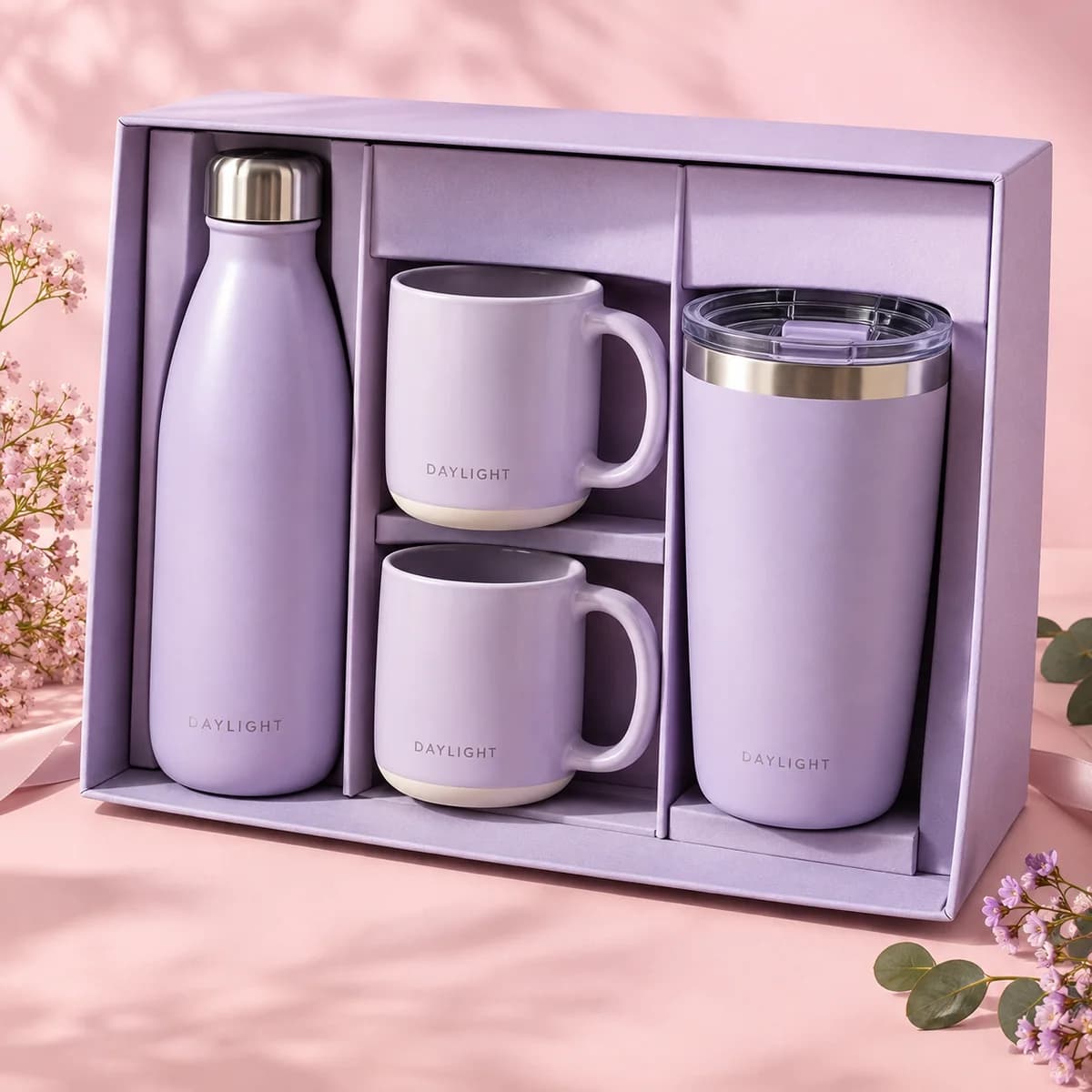
Weight raises perceived value more reliably than size. A heavyweight ceramic coaster with a cork backing feels considered; a thin printed card does not, even at similar size. Packaging raises it sharply: our drinkware gift sets arrive in a gift box and are described as ready to give, which turns three vessels into one object. Restraint raises it too. A small mark on a good object reads as confidence, while a large mark on a cheap object reads as advertising.
What lowers it: a date, an event name, a slogan and a URL all competing on a small surface. Every one of those makes the object expire.
Imprint area against object size
The most common disappointment is not the object, it is how little of it can carry a mark.
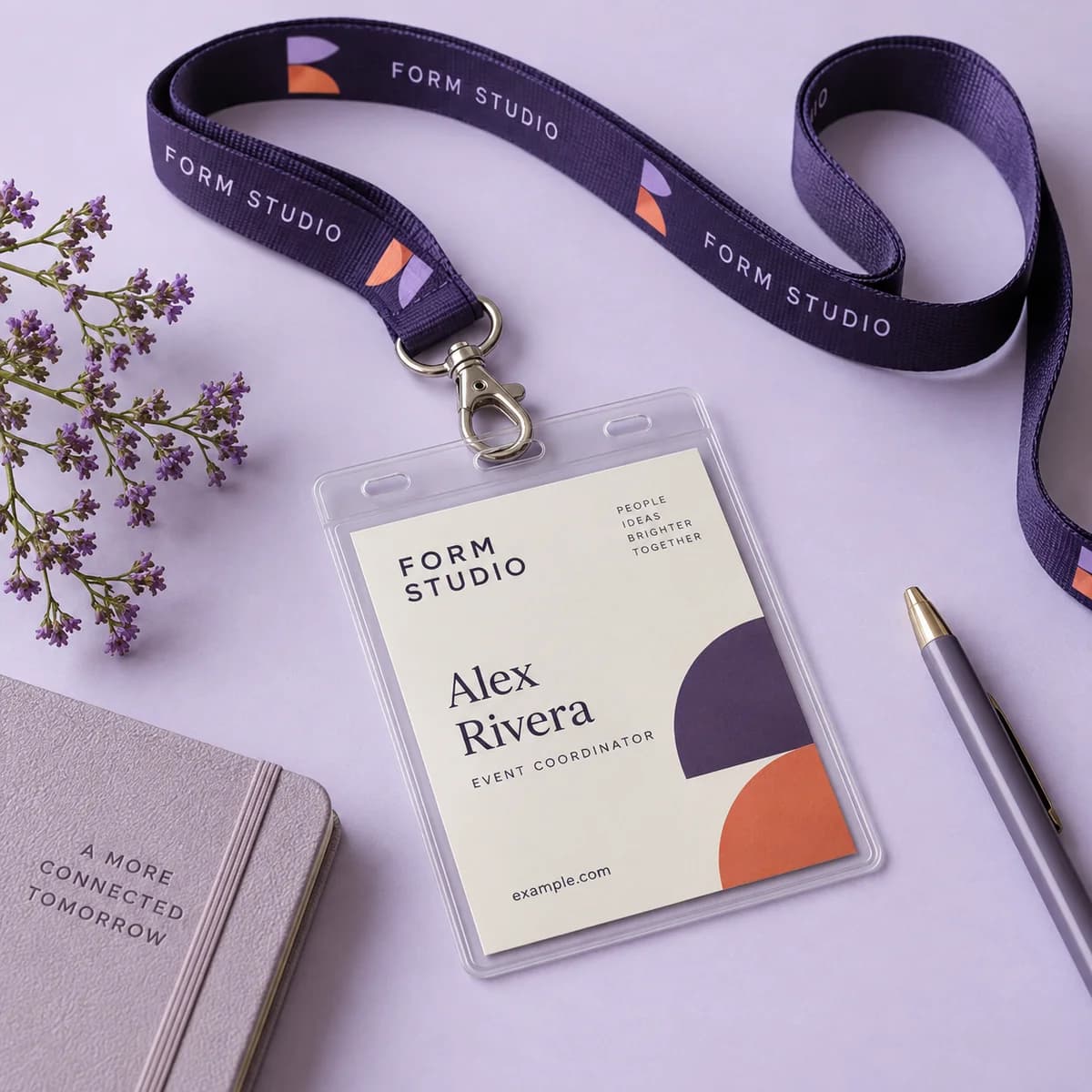
Some of our products state a print area outright. Badge holders and lanyards state 0.75 by 6 inches on a strap 1 inch wide and 21.3 inches long. Magnetic clips state 0.5 by 1.5 inches. Those are real numbers you can design to.
Most do not, and that is deliberate. For structural and three dimensional goods we hold no imprint sheet, so the size recorded in the catalog is a layout default and the written dimensions describe the object rather than a printable rectangle. The design canvas for those products draws no trim, bleed or safe area, and presents itself as a visual concept instead. A flat rectangle cannot show how artwork sits on a curved vessel or a sewn panel, and we would rather say so than draw a boundary nobody measured.
When there is no published area, the two honest routes are the same as ever: ask us for the product's template, or send print ready artwork at the largest size you want it, and our team sets the placement with you before production.
Match the artwork to the surface, not the other way round
- Tiny hard goods, one color: a silhouette mark only, no tagline.
- Ceramic and acrylic: full color photographic work survives well.
- Textiles: full color on a polyester face, but expect softer edges than paper.
- Metal drinkware: either permanent and single tone, or colorful and printed.
- Narrow straps: a repeated short logotype, since 0.75 inches of height is not a lockup.
Our Studio works in RGB and we do not offer color matching, so treat brand color on any object as close rather than exact, and expect a colored or textured base to shift it further.
Lead times are set by assembly, not printing
A printed sheet and an assembled object are different scheduling problems. Anything that has to be sewn, boxed, kitted or made to order carries steps after the print, and each step has its own queue.
Plan backwards from the date the gift must be in the recipient's hand, not the date of the event, and add a buffer. For anything shipped to a venue, work back from the receiving date in the exhibitor manual rather than the show opening. Where a product offers it, order a single unit first: several of our products invite exactly that, and a sample answers questions a screen cannot.
A short brief that gets a good answer
- The moment: who receives it, where, and what they are holding.
- The tier: open, earned, or relationship.
- Quantity, and how you calculated it.
- The object, named exactly.
- One idea for the imprint, not four.
- The date it must be in hand, and where it ships.
Promotional gift checklist
- Describe the handover in one sentence before choosing an object.
- Run two tiers rather than one large order of one item.
- Buy weight and packaging before buying size.
- Leave dates and event names off anything meant to last.
- Check whether a print area is published, and ask for the template when it is not.
- Schedule from assembly steps, not from print time.
- Order one sample and hold it the way the recipient will.
Frequently asked questions
What makes a promotional gift worth keeping?
Usefulness in the moment it is received. PPAI research points to usefulness and quality as the main reasons people keep branded items rather than discarding them. Usefulness is relational, so an item that is perfect at an outdoor event can be useless at a conference. Describe the handover before you choose the object.
How much of a promotional item can you print on?
It depends on the item, and some of ours publish it. Badge holders and lanyards state a 0.75 by 6 inch print area and magnetic clips state 0.5 by 1.5 inches. For structural goods we hold no imprint sheet, so no rectangle is drawn in the design canvas. Ask us for that product's template and we set the placement with you.
Should you put the event date on a promotional gift?
Only if you want the item to expire. A date turns a usable object into a souvenir, and souvenirs get put in drawers. If the gift is meant to stay in use, keep a single mark on it and put the event detail on a card that goes with it rather than on the object itself.
How far ahead should you order promotional gifts?
Further than printed items, because assembled goods carry steps after the print: sewing, kitting, boxing and made to order finishing all queue separately. Work backwards from the date the gift must be in hand, or from the venue receiving date in the exhibitor manual, and add a buffer. Order a single sample first where the product allows it.
Sources & specification notes
The references below support the relevant technical or product details in this guide. Examples and checklists are not claims of practical testing or universal supplier requirements. Confirm the current specifications for your chosen product before production.
- PPAI: New PPAI Research Shows Why Consumers Take And Keep Promo Products ↗
Trade association research finding usefulness and quality to be the main reasons consumers keep promotional products.
- PPAI: The Things We Don't Throw Away ↗
Companion PPAI research on retention of branded items, supporting the argument that utility rather than novelty drives keeping.