Why a stated print area matters here
Most structural and three dimensional products in our range have no published imprint rectangle, because we hold no imprint sheet for them. In those cases the design canvas draws no trim, bleed or safe area and presents itself as a visual concept, and the routes to a correct file are the product template or your own print ready artwork with placement confirmed before production.
Lanyards are one of the exceptions where a number exists. Magnetic clips are another, at 0.5 by 1.5 inches. When a number is published, design to it. When it is not, ask us for the template rather than inferring a size from the object's dimensions, because an object's dimensions describe the object and not a printable area.
What 0.75 by 6 inches will actually hold
Think of it as a single line, not a panel. At three quarters of an inch high you have room for one row of type or one horizontal mark, and nothing above or below it.
- A horizontal logotype: yes, if it is genuinely horizontal.
- A stacked logo with a symbol above the name: no, unless you unstack it.
- A symbol beside the name: yes, and this is usually the best answer.
- A tagline under the name: no.
- A web address alongside the name: only if both are short.
- A QR code: possible at this height but small, so test it before ordering.
Six inches of length sounds generous until you remember the strap is 21.3 inches long and hangs in a loop. The print area is one section of that loop, and where it sits on the wearer depends on how the badge hangs.
Design for a repeat, not a single instance
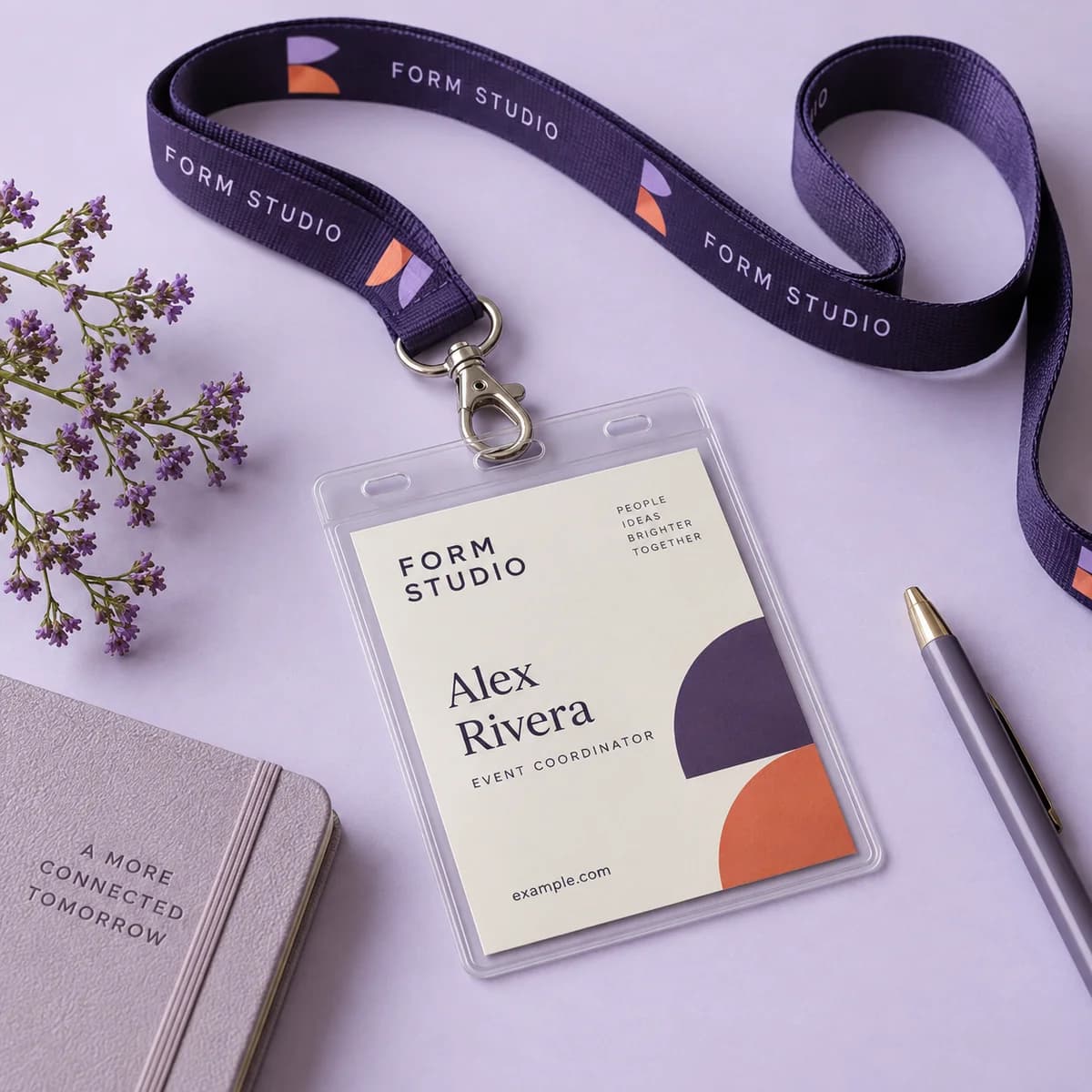
The practical answer on a narrow strap is a repeating mark. One instance of a logo on a 21.3 inch strap is visible only if the wearer happens to be turned the right way.
A repeat solves three problems at once. It is readable from any angle, it tolerates the strap twisting, and it looks deliberate rather than accidental. Choose the repeat spacing so the mark is not cut in half at the point where the strap enters the D ring.
Keep the repeat simple. On a woven or printed polyester strap, fine hairlines and small counters in letterforms fill in, so a bolder weight of your logotype will read where the standard weight will not.
Color on a colored strap
Eight strap colors are offered, and the strap color is part of your result. A light ink on a light strap disappears, and a mid tone ink on a mid tone strap disappears faster.
Our Studio works in RGB and we do not offer color matching, so plan for a close rather than exact brand color, and expect the strap color beneath to shift it. The reliable approach on any colored substrate is high contrast: a dark mark on a light strap, or a light mark on a dark one, rather than two colors of similar value.
The hardware, and why breakaway matters
The strap is only part of the product. Breakaway safety clips on both ends are a safety feature: the strap separates under load rather than staying around a neck, which is why they are standard on conference and workplace lanyards.
Do not design around removing them. If a client asks for a lanyard without breakaway clips for aesthetic reasons, that is a conversation about risk rather than about print.
The zinc alloy D ring with swivel snap is what holds the badge, and the swivel is what lets a badge turn to face forward. A badge that faces backwards is the most common complaint about lanyards, and hardware rather than artwork decides it.
Recycled polyester, claimed carefully
The strap is 100 percent recycled polyester. That is a specific material fact and it is worth stating plainly in your own materials.
What it is not is a license for a general environmental badge. The FTC Green Guides caution marketers against broad, unqualified claims such as eco friendly and advise that environmental claims need a reasonable basis and clear qualification. Recycled polyester strap is defensible. Sustainable lanyard is not.
Where lanyards earn their place
- Conferences and trade shows, where every attendee wears one all day.
- Office and site access, where they are worn daily for months.
- Volunteer and staff identification at events.
- Schools and campus programs.
- Paired with badge printing so the whole credential is one job.
Lanyards are among the highest impression per dollar items available, because the wearer carries your mark at chest height for the entire event. That is also why the design has to survive being read at three feet while moving.
Lanyard checklist
- Design to the stated 0.75 by 6 inch print area.
- Unstack your logo into a single horizontal line.
- Drop the tagline and keep one mark.
- Use a repeating mark rather than a single instance.
- Choose high contrast against the strap color.
- Use a bolder weight, since hairlines fill in on polyester.
- Keep the breakaway clips, and check the swivel for badge orientation.
Frequently asked questions
What is the print area on a custom lanyard?
Ours state 0.75 by 6 inches, on a strap 1 inch wide and 21.3 inches long. That is a published figure, unlike most structural products in our range where no imprint sheet exists. Treat it as one line of content: a horizontal logotype, or a symbol beside a short name, with nothing above or below.
Can you put a QR code on a lanyard?
It is possible at 0.75 inches of height but it will be small, and a small code on a moving strap is hard to scan. If the code is essential, test a printed sample at final size with several phones before ordering a run, and consider putting it on the badge rather than the strap.
Should a lanyard logo repeat along the strap?
Almost always. The strap is 21.3 inches long and hangs in a loop, so a single instance of a mark is only visible when the wearer happens to be turned the right way. A repeat reads from any angle and tolerates twisting. Choose the spacing so no instance is cut in half at the D ring.
Why do lanyards have breakaway clips?
Safety. Breakaway clips on both ends let the strap separate under load rather than staying around a neck, which is why they are standard on conference and workplace lanyards. Removing them for appearance is a risk decision rather than a design decision, so raise it before you order.
Sources & specification notes
The references below support the relevant technical or product details in this guide. Examples and checklists are not claims of practical testing or universal supplier requirements. Confirm the current specifications for your chosen product before production.
- Federal Trade Commission: Green Guides ↗
FTC guidance cautioning against broad, unqualified environmental claims and requiring a reasonable basis, cited for how to describe recycled polyester.
- PPAI: New PPAI Research Shows Why Consumers Take And Keep Promo Products ↗
Research on why branded items are kept and used, supporting the case for wearable credentials as high exposure items.