What each product is
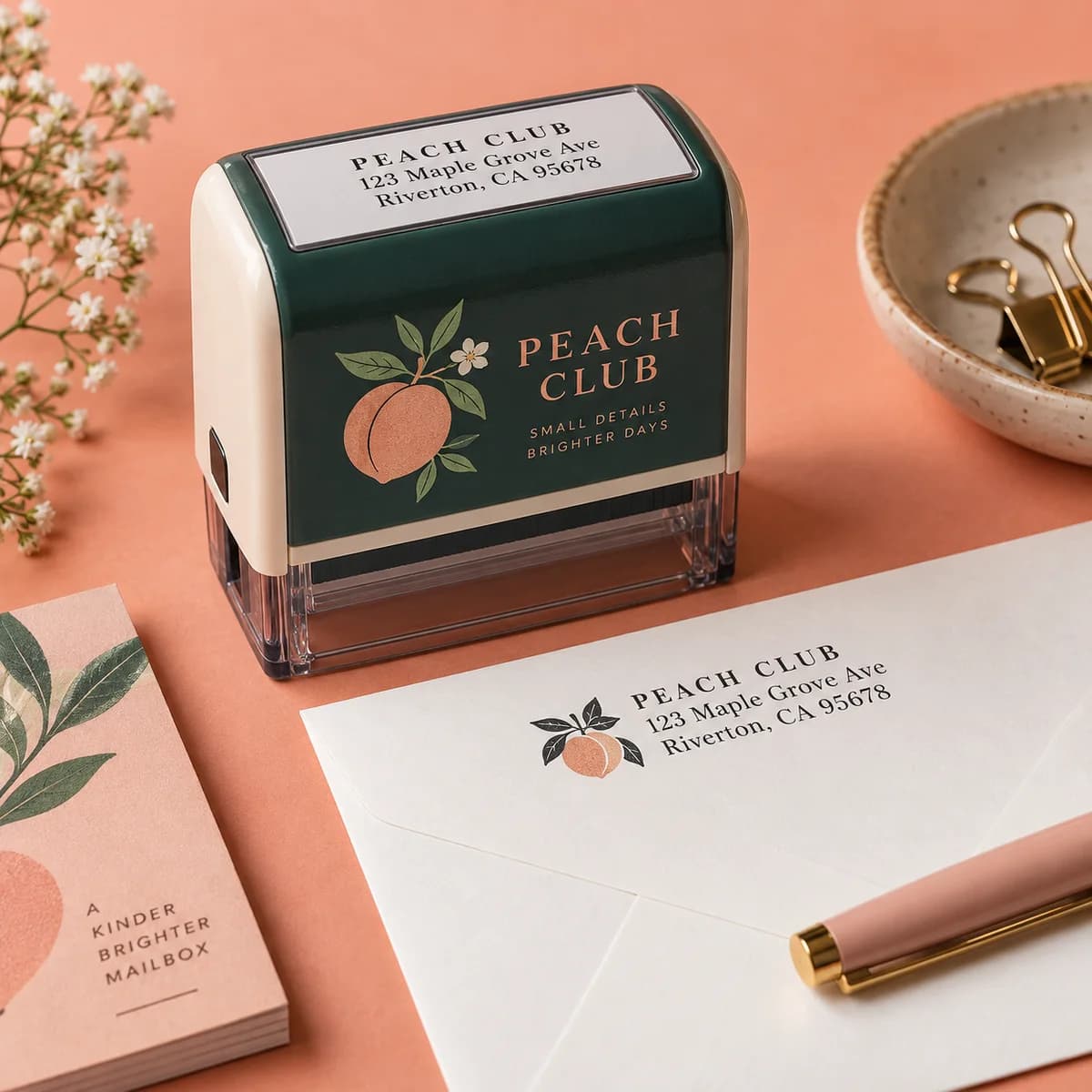
Rectangular address stamps come in three sizes with ink colors including black, blue and red, are good for up to 10,000 impressions, and arrive pre inked in a plastic shell with a rubber stamp. The design guidance is specific: best with three lines of text or fewer, keep fonts at 8 pt or larger, and skip fine lines and tiny graphics.
Circular address stamps come in two sizes with three ink colors, up to 5,000 impressions, and carry the same advice about small fonts and fine detail. The smallest circular size is for images or icons only, with no text.
Return address labels are 2.67 by 0.83 inches each, available on sheets or rolls, in four materials: semi gloss paper, gold foil, silver foil or clear plastic. The foil and plastic options are waterproof and the paper is not, and quantities run from 50 up to 50,000 and beyond.
Envelope seals are the third relative: 1.5 by 1.5 inches, 24 per sheet, in white, gold foil, silver foil, or clear or white plastic, with permanent adhesive.
The cost shape, which is the real difference
A stamp is a tool. You buy it once and every impression after that costs nothing but a second of your time. At 10,000 impressions the unit cost approaches zero, which is why stamps win for anything you do continuously.
A label is a consumable. You buy a quantity and when they run out you buy more. That is a worse deal at high volume and a better deal at low volume, because you are not buying a tool for a hundred envelopes.
| Factor | Custom stamp | Printed labels |
|---|---|---|
| Cost model | One tool, then free | Per unit, always |
| Volume sweet spot | Continuous use | Fixed batch |
| Color | One ink color | Full color, foil or clear |
| Text | Fixed, three lines or fewer | Can vary per unit |
| Water resistance | Depends on the surface | Foil and plastic are waterproof |
| Detail | No fine lines or tiny graphics | Fine detail reproduces well |
| Speed per piece | One press | Peel and place |
What a stamp cannot do
The limits are worth stating plainly, because they are where people are disappointed.
A stamp is one color. A rubber die transfers ink from raised areas, so there is no halftone, no gradient and no second color. Your mark has to work as a silhouette.
A stamp has a minimum feature size. The guidance to avoid fonts under 8 pt and to skip fine lines and tiny graphics is not conservatism, it is physics: thin raised rubber either fails to transfer or spreads and fills in. On the smallest circular stamp the guidance goes further and rules out text entirely.
A stamp depends on its surface. Ink sits on a glossy coating instead of soaking in, so it smudges and can transfer. Uncoated and matte surfaces take stamp ink cleanly, which is the same reason our loyalty card guidance recommends an uncoated stock for stamping.
And a stamp is fixed. Changing a line of text means a new stamp.
What labels do that a stamp cannot
Labels bring color, materials and variability.
Full color means a photograph, a gradient or a multi color logo all reproduce. Foil and clear plastic bring finishes a stamp cannot imitate at all. Waterproof matters for anything that meets weather or a wet shelf, and the material note is explicit: foil and plastic are waterproof, paper is not.
Variable text is the quiet advantage. Labels can carry different content per unit, which is the difference between a return address and a batch of individually addressed items.
Addressing, done properly
If either product carries a mailing address, the format matters more than the finish. USPS Publication 28, Postal Addressing Standards, sets out the standards for delivery addresses, including secondary unit designators, street suffix abbreviations and line structure.
Two practical consequences. Keep the address lines in standard order and standard abbreviation, because automated processing reads them, and keep the printed or stamped mark clear of the areas the mail stream uses. A decorative seal belongs on the flap, not near the address block.
Choosing in one line
- Continuous small business use, same three lines, matte envelopes: rectangular stamp.
- A round mark for packaging, loyalty cards and paper bags: circular stamp.
- Full color logo or a photograph: printed labels.
- Anything that meets moisture: foil or plastic labels.
- Individually addressed items: labels with variable text.
- Sealing invitations with a monogram: envelope seals.
Using both together
The most efficient setup is often both. A stamp handles the everyday return address on matte envelopes and kraft bags, and a small run of foil labels handles the occasions that need to look special.
That split also protects the stamp. Ten thousand impressions is a real limit, and using it on routine post rather than on presentation pieces is the right allocation.
Stamp or label checklist
- Estimate annual volume, since that decides tool or consumable.
- Reduce your mark to one color before considering a stamp.
- Keep stamp text to three lines and 8 pt or larger.
- Test stamp ink on your actual envelope stock, and avoid gloss.
- Choose foil or plastic labels where moisture is possible.
- Use labels when text has to change per item.
- Follow USPS addressing standards for anything that gets mailed.
Frequently asked questions
Is a custom stamp cheaper than address labels?
It depends on volume. A stamp is a one time purchase good for up to 10,000 impressions on our rectangular address stamps, so the unit cost approaches zero with continuous use. Labels are a consumable, which is better value for a single fixed batch and worse value if you keep reordering.
How much text fits on a custom address stamp?
Three lines or fewer, with fonts at 8 pt or larger, and no fine lines or tiny graphics. Those are the published limits and they come from how a raised rubber die transfers ink. The smallest circular stamp size is for images and icons only, with no text at all.
Will a stamp work on glossy envelopes?
Poorly. Stamp ink sits on a glossy coating instead of soaking in, so it smudges and can transfer to anything it touches. Uncoated and matte surfaces take stamp ink cleanly. Test your actual ink on your actual stock before committing, and use printed labels where the surface has to be glossy.
Which address labels are waterproof?
The gold foil, silver foil and clear plastic options are waterproof, and the semi gloss paper option is not. Sizes are 2.67 by 0.83 inches, available on sheets or rolls, from 50 units up to 50,000 and beyond. Choose a waterproof material for anything that will meet weather or a wet shelf.
Sources & specification notes
The references below support the relevant technical or product details in this guide. Examples and checklists are not claims of practical testing or universal supplier requirements. Confirm the current specifications for your chosen product before production.
- USPS Publication 28: Postal Addressing Standards ↗
USPS standards for delivery address format, abbreviations and secondary unit designators, cited for stamping or labeling a mailing address correctly.
- U.S. Consumer Product Safety Commission: Lead in Paint ↗
CPSC guidance on 16 CFR part 1303, noting that printing inks which become part of the substrate are outside the surface coating definition.