Two different kinds of loss
Hardware takes area in two distinct ways, and confusing them is how layouts fail.
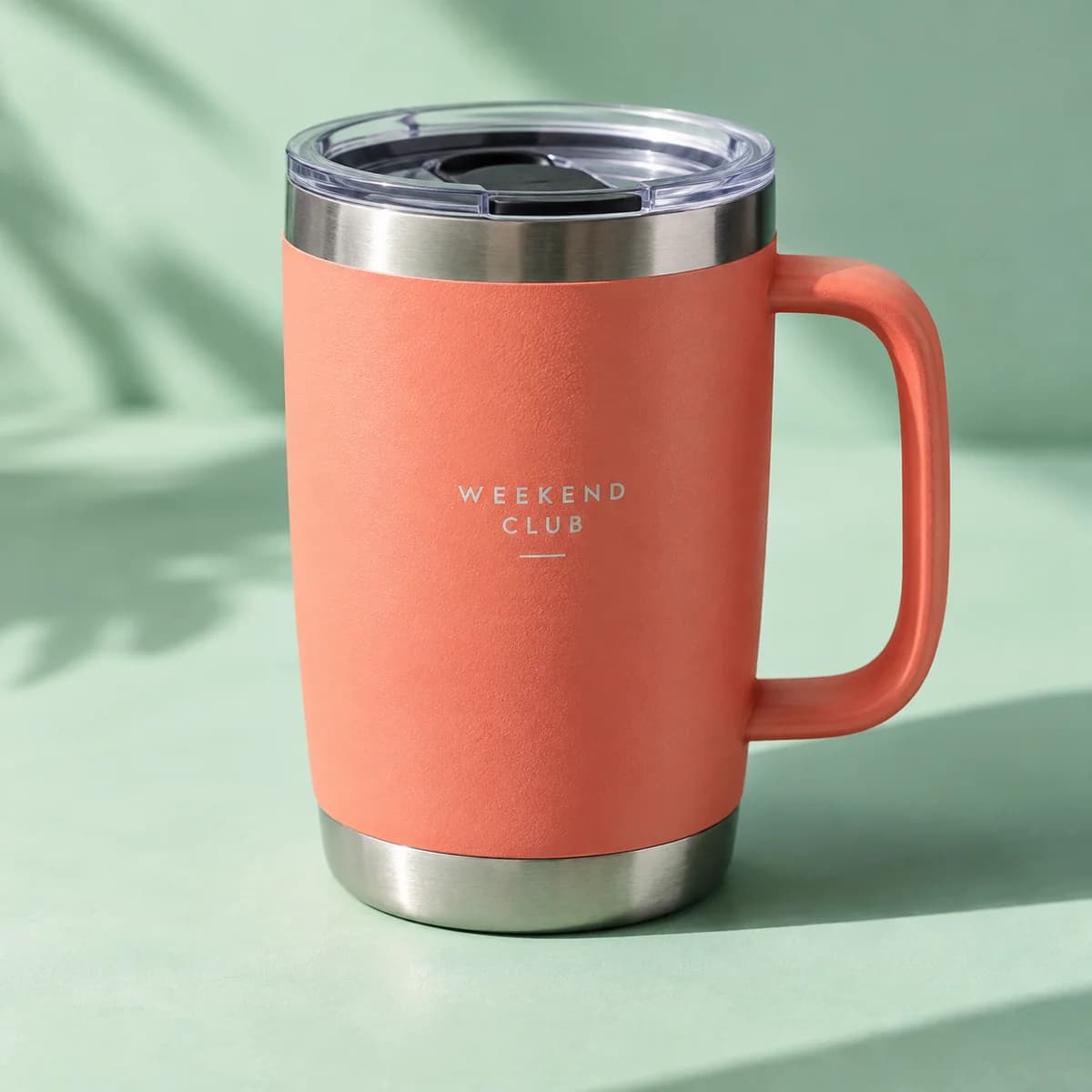
A handle takes width, in the middle, permanently. Whatever the circumference was, a handled vessel gives you two arcs rather than one. Nothing spans the handle.
A lid takes height, at the top. It covers the rolled lip and some of the shoulder, so the top of your usable band is lower than the top of the vessel. Threads, sliders and straw openings all sit in that zone.
The third, less obvious loss is grip. On a vessel people hold without a handle, a hand covers roughly the lower middle of the front arc in normal use. A logo placed there is technically printed and practically invisible.
What our handled and lidded products actually carry
| Product | Hardware | Consequence for artwork |
|---|---|---|
| Travel mugs, 40 oz | Easy grip handle, transparent slider lid with straw | Band splits into two panels; lid covers the top |
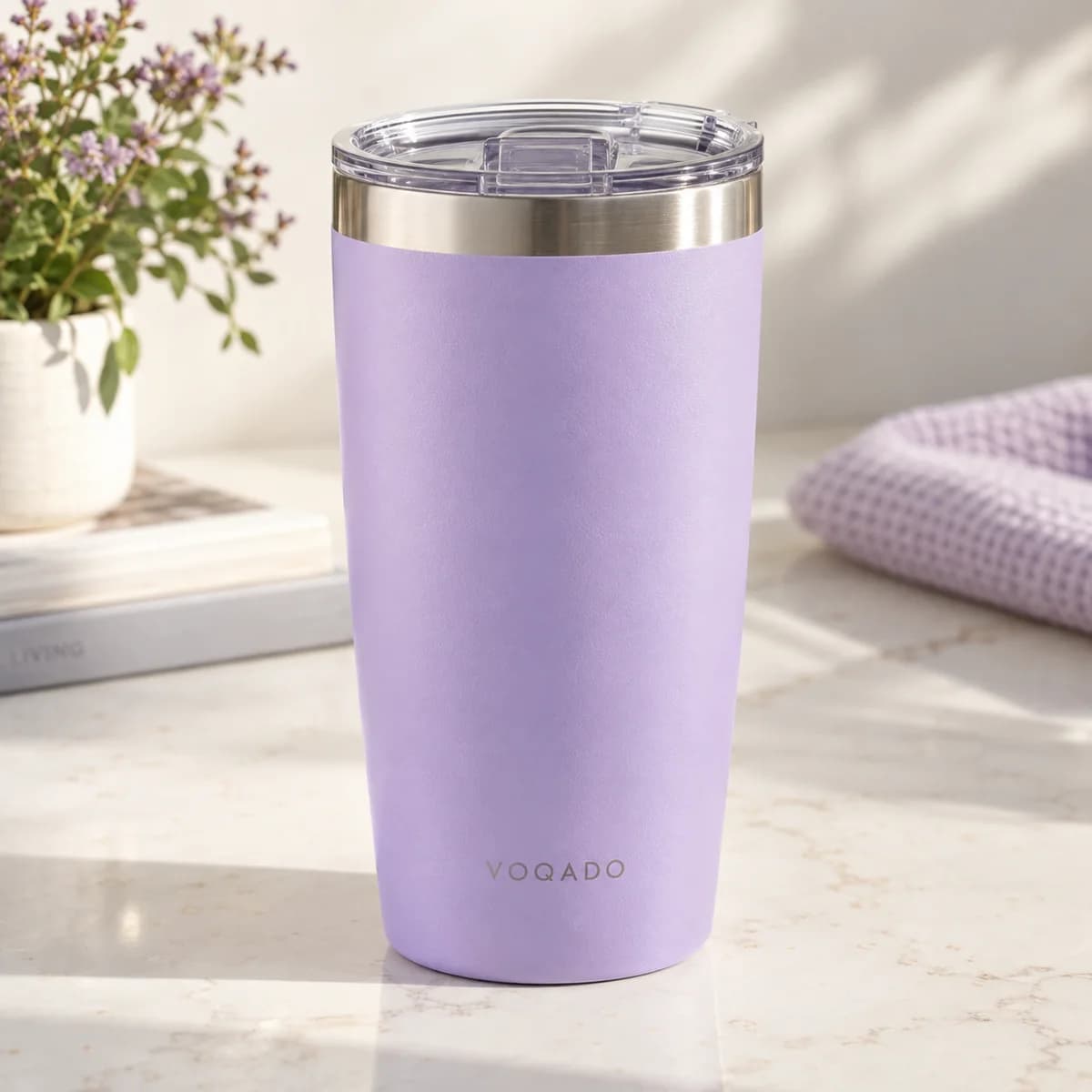
| Tumblers, 17 oz | 360 degree all round drinking lid | Lid covers the whole rolled lip |
| Custom mugs, 11 oz | Ceramic handle, eight handle and interior colors | Two sided or wraparound printing around the handle |
| Water bottles, 26 oz | Twist on lid plus a carabiner | Lid height plus a fixture on the body |
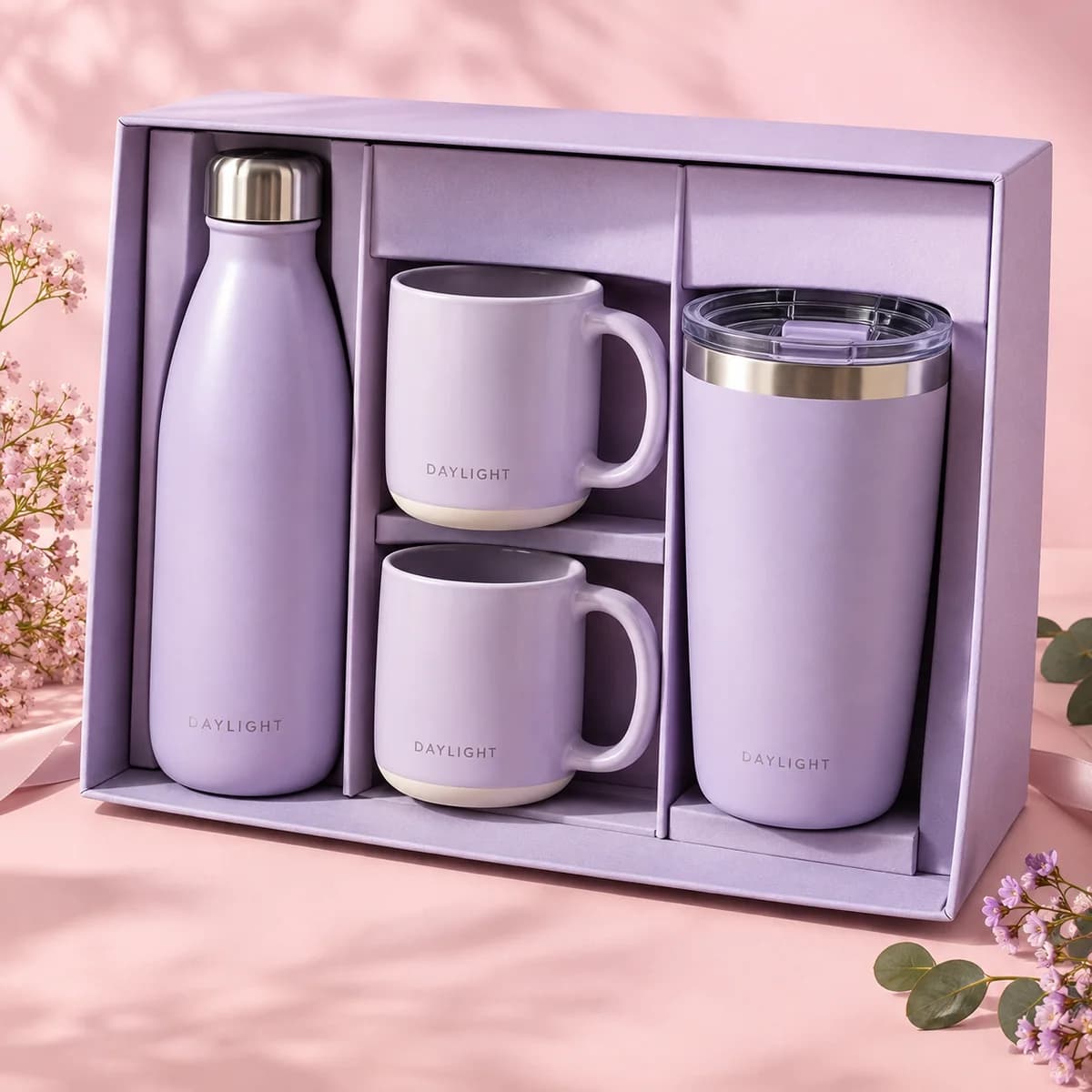
| Drinkware gift sets | Lids on the cups, screw cap on the canteen, flat grip sides | Lid clearance plus flat and curved areas in one vessel |
The mug is the interesting case. It offers two sided or wraparound printing and collage layouts of up to three photographs per side, so the handle is designed around rather than ignored: two sided means one panel each side of it.
Designing for two panels instead of one
Once you accept two panels, the layout problem becomes easier rather than harder.
Give each panel one job. A common and reliable split is the mark on one panel and the message on the other, so neither has to compete with a handle in the middle. Keep both panels the same optical weight, because the vessel rotates and either one may be the one a person sees.
Avoid designs that assume symmetry you have not confirmed. Handle position relative to the panels is set in production, so if your two panels must relate to each other in a specific way, say so in writing when you order.
For wraparound printing on a ceramic mug, treat the handle as the seam. That is the one place a join is already expected, which turns the obstruction into an advantage.
Clearing the lid
Measure down from the top of the vessel, not up from a rim you can see in a photograph.
A 360 degree drinking lid, like the one on our tumblers, covers the entire lip because it is designed to be drunk from at any angle. A slider lid with a straw, like the travel mug, adds a mechanism above the vessel and a fitting inside it. A twist on lid on an aluminum bottle occupies a threaded neck that is already tapering.
The practical rule is to leave clearly more headroom than looks necessary, and to put nothing critical in the upper band. If a design needs a top aligned element, an engraved or printed rule sitting well below the shoulder reads far better than a line that disappears under a lid.
The grip zone nobody plans for
On a handleless vessel, one hand covers a surprising amount of the front. A tumbler held in a car, a canteen carried on a strap and a can cooler in use all hide their lower front arc.
That suggests two habits. Put the mark slightly above centre rather than dead centre, and repeat it on both sides if a single placement risks being covered. Our gift set cups have flat grip sides, which is exactly the surface a hand finds, so it is the last place a logo belongs.
Why we cannot give you a rectangle for this
Everything above is geometry you can reason about. What we cannot do is hand you a measured box.
We hold no imprint sheet for these vessels. The dimensions in their specifications describe the object, and the size recorded against them in the catalog is a layout default, so the design canvas draws no trim, bleed or safe area for them. Drawing a boundary from a number that never described a printable area would carry the authority of a real specification without the substance of one.
So the canvas is a visual concept and the routes to a correct file are the vessel's own template or your print ready artwork, with our team setting the placement with you before production. On a handled or lidded vessel that conversation is the point, not a formality.
A short brief that prevents rework
- Product name and capacity, exactly as listed.
- One side, both sides, or wrap.
- Which panel carries the mark and which carries the message.
- Decoration method: engraving, etching, screen print, heat transfer or inkjet.
- Any element that must align across the two panels.
- Whether the vessel will be used with a strap, a carabiner or a cup holder.
Hardware clearance checklist
- Treat a handle as a divider, not a reduction.
- Give each panel a single job and matching visual weight.
- Measure lid clearance from the top of the vessel.
- Keep nothing critical in the upper band or the grip zone.
- Use the handle as the seam for a wraparound ceramic mug.
- Put alignment requirements in the order notes, in words.
- Order one unit and hold it the way the recipient will.
Frequently asked questions
How much of a mug can you print on around the handle?
We do not publish an imprint rectangle for our mugs, because we hold no imprint sheet for them. In practice the handle splits the barrel into two panels, and our 11 oz ceramic mug is offered as two sided or wraparound printing with up to three photographs per side. Ask us for the mug template and our team sets the placement with you.
Does the lid cover part of the design on a tumbler?
It covers the rolled lip and some of the shoulder. Our 17 oz tumbler uses a 360 degree drinking lid, which is designed to be drunk from at any angle and therefore covers the entire lip. Keep nothing critical in the upper band and measure clearance from the top of the vessel rather than from a visible rim.
Can a design span across a mug handle?
No. Nothing prints across a handle, so a design that needs to be continuous has to go on a handleless vessel such as a tumbler or a canteen. On a ceramic mug, the most reliable approach is to treat the handle as the seam of a wraparound layout, or to run two separate panels.
Where should a logo sit on a vessel people hold?
Slightly above centre, and ideally repeated on both sides. A hand covers much of the lower front arc in normal use, so a single centered mark can be hidden exactly when the vessel is being seen. Flat grip panels, like those on our insulated gift set cups, are the worst place to put a mark.
Sources & specification notes
The references below support the relevant technical or product details in this guide. Examples and checklists are not claims of practical testing or universal supplier requirements. Confirm the current specifications for your chosen product before production.
- U.S. Food and Drug Administration: Packaging and Food Contact Substances ↗
FDA framework for materials in contact with food, cited for the principle that lids, seals and drinking surfaces are food contact areas rather than decoration areas.
- NSF: Food Equipment Standards ↗
NSF overview of food equipment material standards, referenced for the convention that food zone surfaces are treated separately from decorative surfaces.