Flat or folded
This is the decision that matters, and it comes down to writing space and formality.
| Format | Writing area | Reads as | Thickness in the envelope |
|---|---|---|---|
| Flat card | One side | Direct, modern, efficient | One layer |
| Folded card | Inside spread, about double | Formal, personal, ceremonial | Two layers |
A flat card is the right choice for a short line: a thank you, a delivery note, a short congratulation. It is also the better choice when the card carries printed content on the front and you want the back left clean for two or three handwritten lines.
A folded card is the right choice when you intend to write a paragraph or more, and when the occasion calls for a little ceremony. The moment of opening a folded card is part of what makes it feel personal.
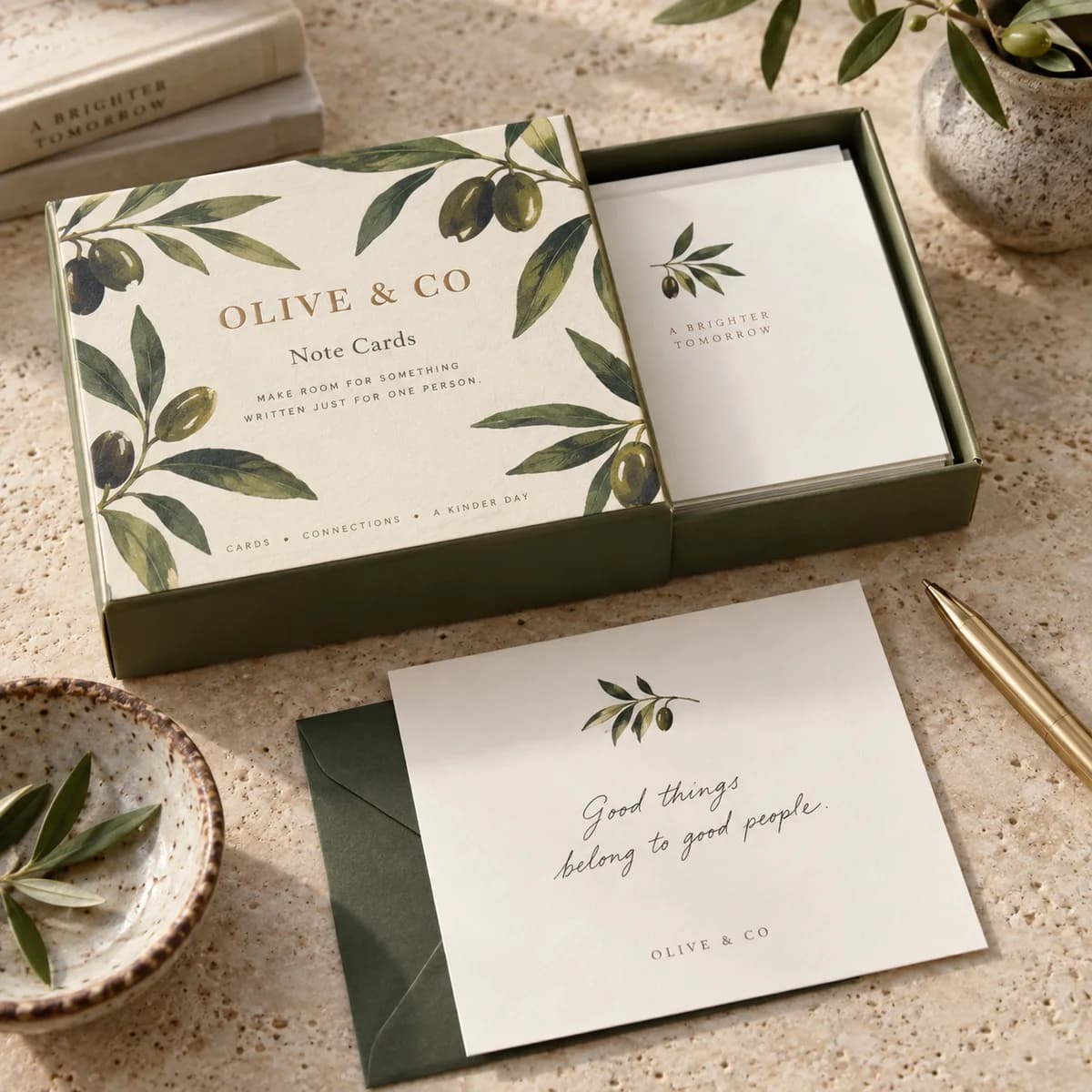
Note cards here come in both formats in 5.5 x 4 in and 5 x 7 in, in horizontal or vertical orientation, with standard or rounded corners, across six paper stocks, and white envelopes are included. Folded cards ship flat and scored, so you fold them yourself along a crease that is already made.
Why scored and shipped flat matters
A folded card shipped flat with a score line is easier to print and arrives without a crushed spine. You fold it at the point of use.
Two practical notes follow. First, fold along the score with a bone folder or the back of a spoon rather than a fingernail, because a heavy stock creased by hand cracks along the fold and the crack shows the paper core. Second, fold before you write, not after, because writing on an unfolded sheet almost always results in a line that runs across the crease.
If you are ordering a large quantity for an event, factor the folding time in. A hundred cards is twenty minutes.
Matching the envelope to the card
The working rule for envelope sizing is to leave about 0.125 to 0.25 in of clearance on each dimension. Less and the card jams or tears the envelope; much more and it slides around and looks cheap.
| Card | Envelope | Clearance |
|---|---|---|
| 4.25 x 5.5 in | A2, 4.375 x 5.75 in | About 0.125 in each way |
| 4 x 6 in | A6, 4.75 x 6.5 in | Generous |
| 5 x 7 in | A7, 5.25 x 7.25 in | About 0.125 in each way |
| 5.5 x 8.5 in | A9, 5.75 x 8.75 in | About 0.125 in each way |
A folded card is two layers thick, so it needs marginally more room than a flat card of the same trimmed size, and a fully assembled folded card in a snug envelope can be a struggle to insert. Test with a real folded card, not a single sheet.
The full envelope sizes chart covers the business and announcement families side by side if you are matching several pieces.
Machinability, and the A2 that only just qualifies
All of these sizes mail as letters, but two deserve a second look.
A machinable letter needs an aspect ratio between 1.3 and 2.5. An A2 envelope at 5.75 x 4.375 in has a ratio of about 1.31, which clears the minimum with almost nothing to spare. An A7 at 7.25 x 5.25 in is about 1.38, which is comfortable.
The piece also has to stay under the letter thickness maximum and remain flexible. A folded card on a heavy stock with a wax seal and a ribbon will be handled as nonmachinable. A folded card on a medium stock with a flat sticker seal will not.
Paper and finish, from the pen's point of view
A note card is written on, which rules out some otherwise attractive finishes. Glossy coatings resist ink, smear under a ballpoint and are very slow to dry with a fountain pen.
Use uncoated or matte stock for the writing surface, every time. If you want a coated or foiled front, keep the writing side uncoated: a coated front with an uncoated back is a common and sensible combination. Embossed gold, silver and glitter foil options give the front some ceremony while the writing side stays practical.
Stock weight follows format. A flat card wants enough weight to feel like a card rather than a leaflet. A folded card is already two layers, so a medium weight folds and writes better than a very heavy one, which cracks on the score.
Ordering a single card first
Because a note card is a small, cheap piece where the feel of the paper is most of the product, ordering one card before the run is genuinely worth the delay. Order one, write on it with the pen you will actually use, fold it if it is folded, put it in the envelope and seal it.
That single card answers the questions no screen can: whether the ink feathers, whether the fold cracks, whether the card slides out of the envelope too easily, and whether the type is the right size for the space that is left.
Note card checklist
- Choose flat for a short line, folded for a paragraph or an occasion.
- Remember folded cards ship flat and scored, so plan the folding time.
- Fold along the score with a bone folder, and fold before writing.
- Allow 0.125 to 0.25 in of envelope clearance on each dimension.
- Test insertion with a real folded card, not a single sheet.
- Check the aspect ratio if machinability matters; A2 clears 1.3 only just.
- Keep the writing surface uncoated or matte whatever the front finish is.
- Order one card, write on it, fold it and seal it before the run.
Frequently asked questions
What are standard note card sizes?
5.5 x 4 in and 5 x 7 in are the two common sizes, each available flat or folded and in horizontal or vertical orientation. A flat card gives one writing side; a folded card gives the inside spread, roughly double the space.
What envelope fits a 5 x 7 note card?
An A7 envelope at 5.25 x 7.25 in, which leaves about 0.125 in of clearance each way. A folded card is two layers thick, so test insertion with a real folded card rather than assuming a single sheet fit will translate.
Do folded note cards arrive already folded?
They ship flat with the fold already scored, so the crease exists and you fold at the point of use. Fold along the score with a bone folder or the back of a spoon so the stock does not crack, and fold before writing.
Can you write on a glossy note card?
Poorly. Glossy coatings resist ink, smear under a ballpoint and dry very slowly with a fountain pen. Keep the writing surface uncoated or matte, and if you want a coated or foiled look, put it on the front and leave the writing side uncoated.
Sources & specification notes
The references below support the relevant technical or product details in this guide. Examples and checklists are not claims of practical testing or universal supplier requirements. Confirm the current specifications for your chosen product before production.
- USPS Postal Explorer: DMM 101 Physical Standards ↗
Letter size limits, thickness maximum and the 1.3 to 2.5 aspect ratio rule used to check the A2 and A7 envelope families.
- ISO 216:2007 Writing paper and certain classes of printed matter, trimmed sizes ↗
The A series trimmed sizes and the square root of two ratio, for matching cards and envelopes outside North America.