Which layer does each piece belong to?
Decide this before you design, because it changes what goes on each surface.
| Layer | Typical pieces | Replace every |
|---|---|---|
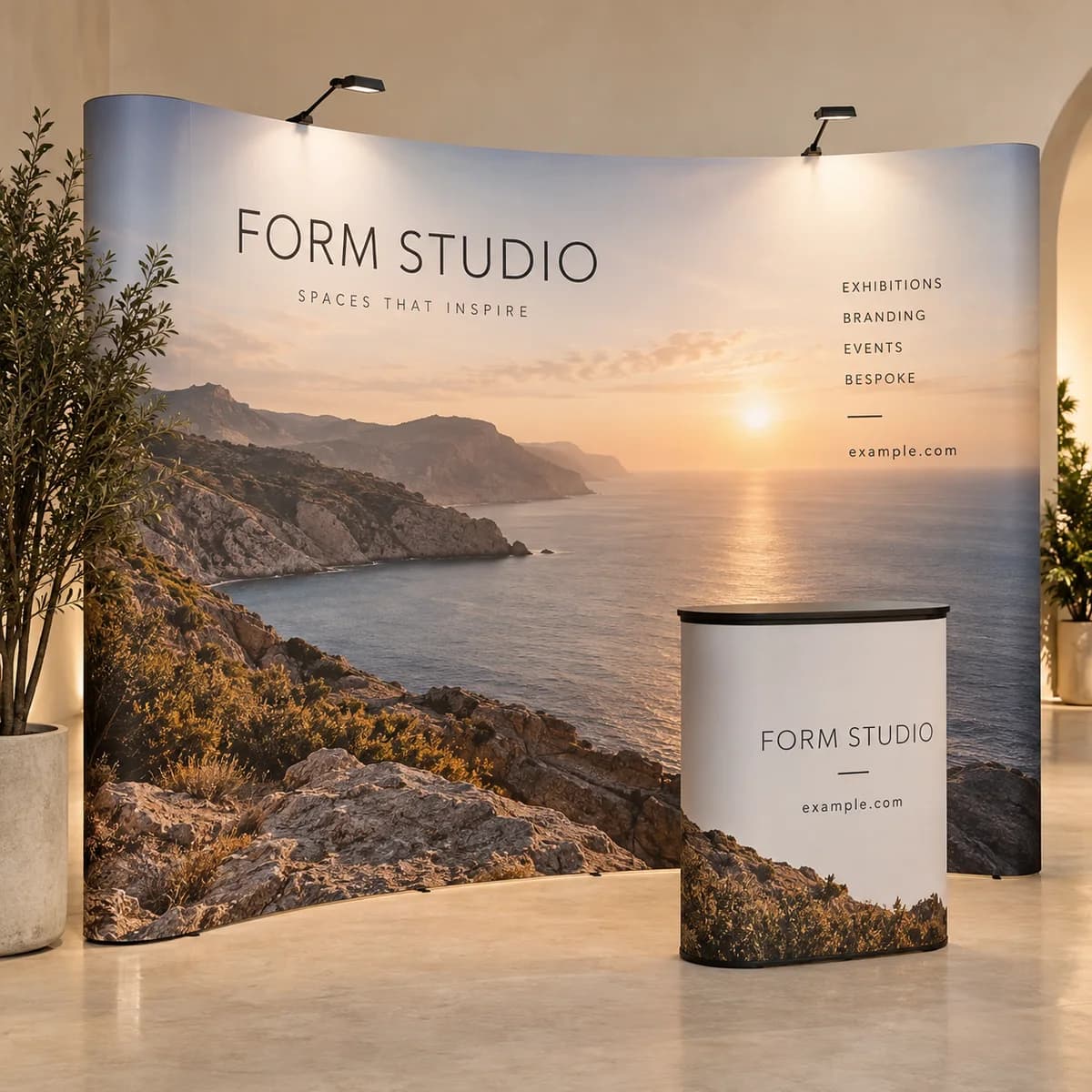
| Permanent | Back wall, counter wrap, table cover, tent walls | Two to four years |
| Seasonal | Roll up banners, flags, small signs | One to two years |
| Disposable | Handouts, price sheets, table signs, badges | Every show |
The permanent layer answers who you are. The seasonal layer answers why stop now. The disposable layer answers the specific questions of this audience. Mixing them is what turns a 400 dollar wall into a single use item.
What should never go on a permanent panel?
Anything with a date on it, explicitly or implicitly.
- A show name, year, booth number or city.
- A price, a discount percentage or a promotional code.
- A specific product model number or version.
- An individual person's name, title or direct phone number.
- A campaign tagline you are not confident about in two years.
- An award year or a follower count.
A website address is usually safe if it is your main domain. A campaign specific short link is not, because campaigns end. Keep those on the seasonal layer.
How do you build a wall that works at two booth sizes?
Panels, not one image. Build the back wall as two or three self contained panels, each of which reads correctly on its own. Then a 10 x 20 booth uses all three and a 10 x 10 uses one or two.
Keep the logo inside a single panel rather than spanning a seam. Keep any headline on one panel. Use background color, texture or photography to carry across the seams so the set still looks like one wall. Check the layout at both widths before approving, and note in the file name which panel is the primary one.
Systems help here too. Retractable banners are the most portable seasonal layer because each one is an independent 24 to 47 inch wide message you can add, remove or reorder per show. A fabric wall plus two interchangeable banners covers more show variations than a single wide graphic ever will.
How do you store and name the files?
The practical reason booths get reprinted is that nobody can find last year's file. Fix that with a folder per display and a name that says what the file is.
Use a pattern such as Company Backwall Panel1 96x89 v3, with the finished size in the name and a version number rather than words like final. Store the production file, a low resolution preview and the flame resistance certificate in the same folder. Add a plain text note recording the product ordered, the size, the material and the date, so the next reorder starts from facts instead of memory.
Keep the physical graphics the same way. One labelled sleeve per panel, stored flat or rolled with the printed side out, in a dry place that does not reach attic temperatures. Fabric graphics tolerate folding, vinyl does not.
When is reprinting cheaper than reusing?
Sometimes replacement is the right call, and the test is visible damage or a changed message.
Replace a graphic when there is a crease or scuff in the top third where people look, when the color has drifted visibly from your current brand, when the message no longer matches what you sell, or when the hardware has changed and the graphic no longer fits its frame. Do not replace a graphic because it is a year old and you are bored of it: visitors are seeing it for the first time.
A useful habit is to photograph each graphic at the end of every show in even light. Comparing the photos year on year makes wear obvious long before it becomes embarrassing.
What about fabrics that get washed?
Several event fabrics are machine washable, which is what makes them reusable in practice. Our table covers and canopy tent walls are both described as machine washable, and both are supplied with a stated flame resistance standard.
Two cautions. First, laundering can affect a topically applied flame retardant treatment, so keep the certificate and confirm any laundering limits with the supplier. Second, wash and dry exactly as the care instruction says, because dye sublimated color is durable but fabric can shrink out of fit around a frame.
What is the reuse checklist?
- Assign every booth piece to the permanent, seasonal or disposable layer.
- Keep dates, prices, codes, show names and staff names off permanent panels.
- Build back walls as self contained panels that read at two booth widths.
- Name files with size and version, and store the certificate alongside.
- Record product, size, material and order date in a note per display.
- Photograph every graphic after each show and compare year on year.
- Replace only for visible wear in the top third or a genuinely changed message.
Frequently asked questions
How long do trade show graphics last?
A fabric back wall kept in its sleeve and handled carefully commonly serves several years of shows, because the failure mode is creasing and scuffing rather than fading indoors. The usual reason for replacement is a changed message, not a worn material, which is why keeping dated information off the permanent layer saves the most money.
Should I put my show booth number on my banner?
No. Booth numbers, show names, years and cities are the fastest way to make a graphic single use. Put them on a disposable table sign or a printed handout instead, and keep the banner limited to a message you would be happy to show at any event this year.
Can I wash a printed table cover or tent wall?
Several event fabrics are made to be washed: our table covers and canopy tent walls are both described as machine washable. Follow the stated care instructions, and check with the supplier whether laundering affects a flame retardant treatment, since some treatments are topical rather than built into the fibre.
Is it cheaper to reprint a wall or swap a banner?
Swapping a banner, almost always. A roll up banner is a fraction of the cost of a full back wall and carries the part of your message that changes most often. Design the booth so the offer lives on a banner and the wall carries only your name and category.
Sources & specification notes
The references below support the relevant technical or product details in this guide. Examples and checklists are not claims of practical testing or universal supplier requirements. Confirm the current specifications for your chosen product before production.
- NFPA: NFPA 701, Standard Methods of Fire Tests for Flame Propagation of Textiles and Films ↗
Referenced for why flame resistance documentation should be stored with reusable fabric graphics and re confirmed after laundering or reorder.