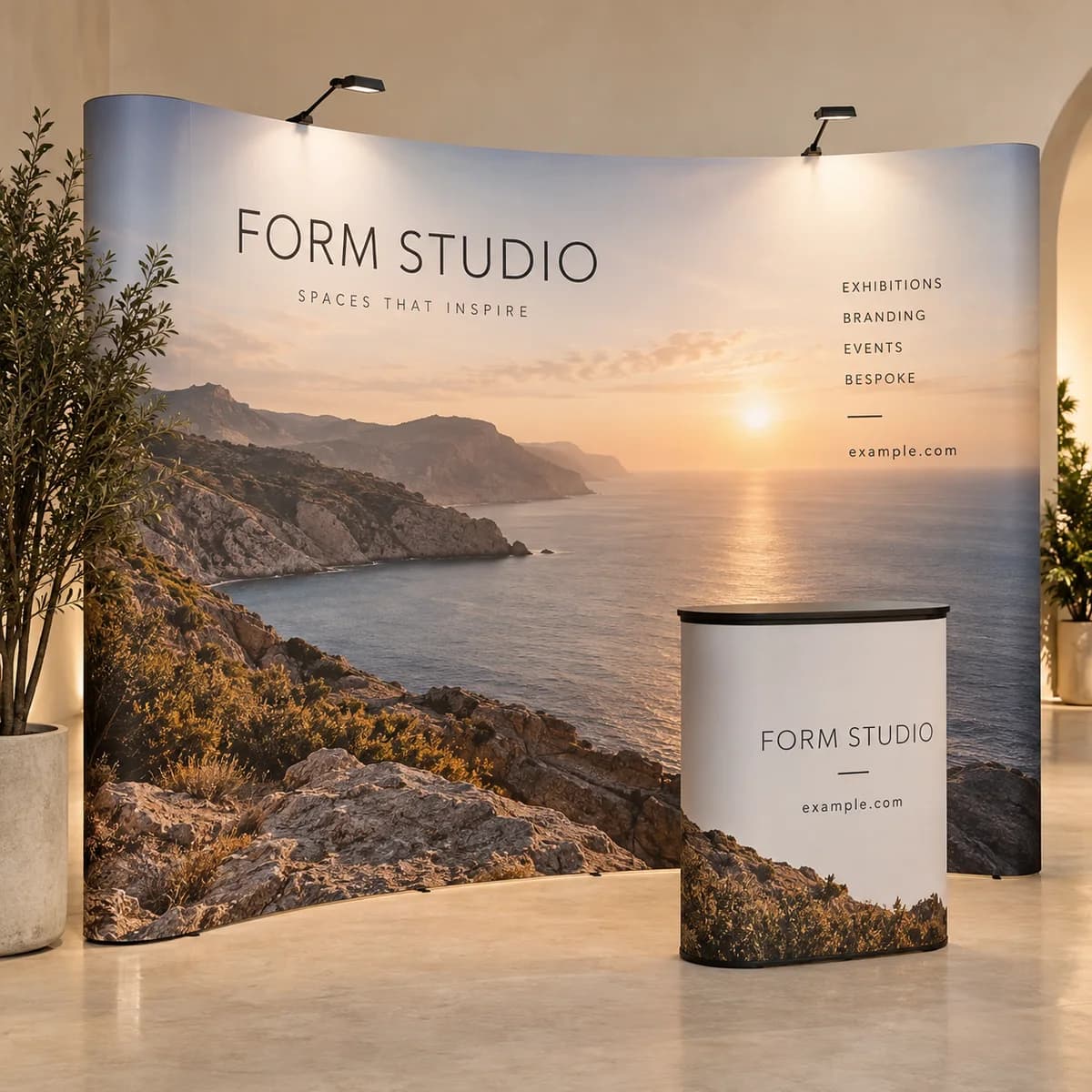
What types of back wall are there?
| System | How the graphic attaches | Strengths | Trade offs |
|---|---|---|---|
| Curved fabric pop up | Hook and loop onto a collapsible frame | Light, tool free, forgiving of creases | Curved shape crops flat artwork |
| Straight tension fabric | Graphic stretched over a frame or into a channel | Flat, seamless look | Frame must match the graphic exactly |
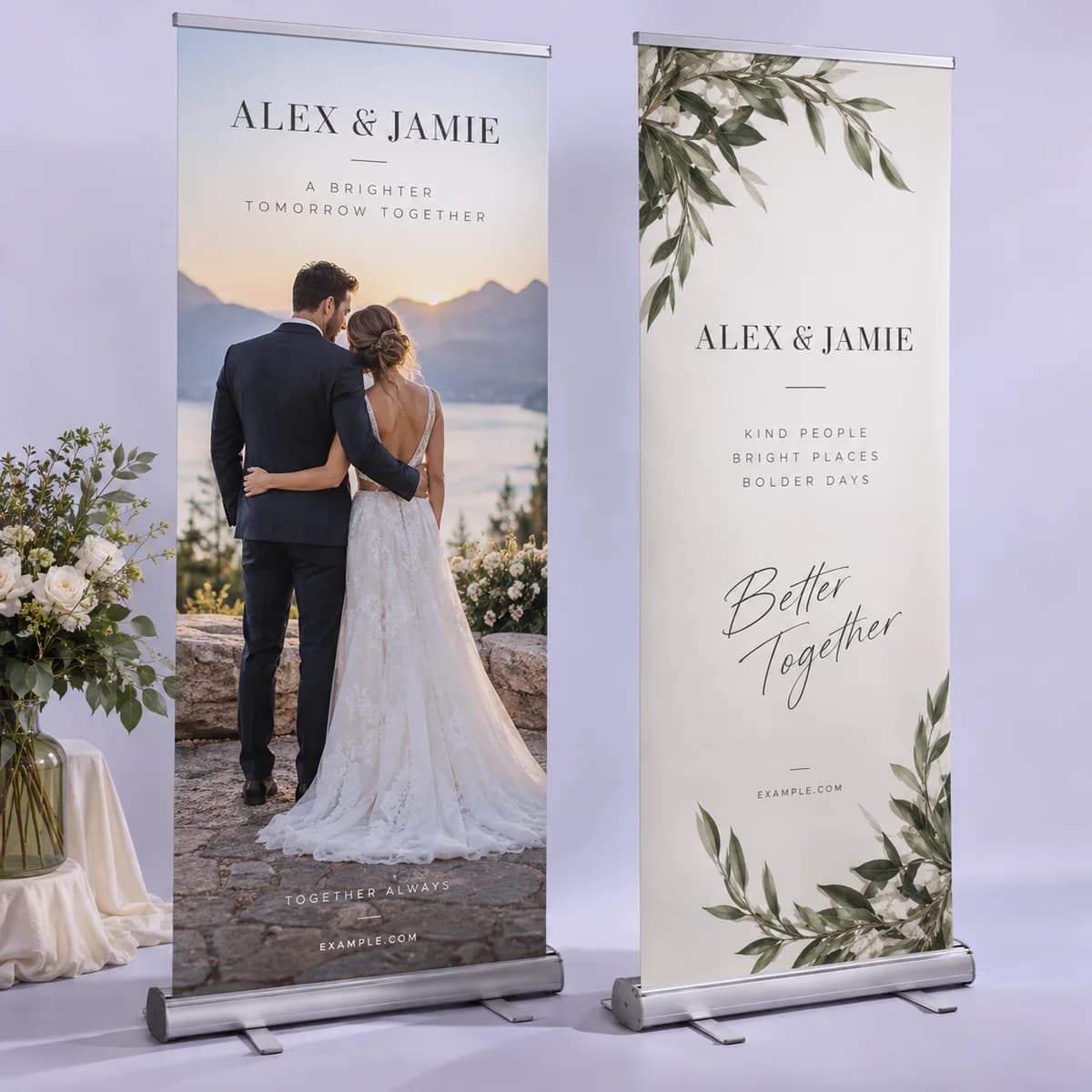
| Banner cluster | Independent roll up stands | Cheapest to change, endlessly reconfigurable | Visible gaps between panels |
| Rigid panel wall | Printed boards hung or clipped | Crisp edges, holds shelves | Heaviest, corners damage in transit |
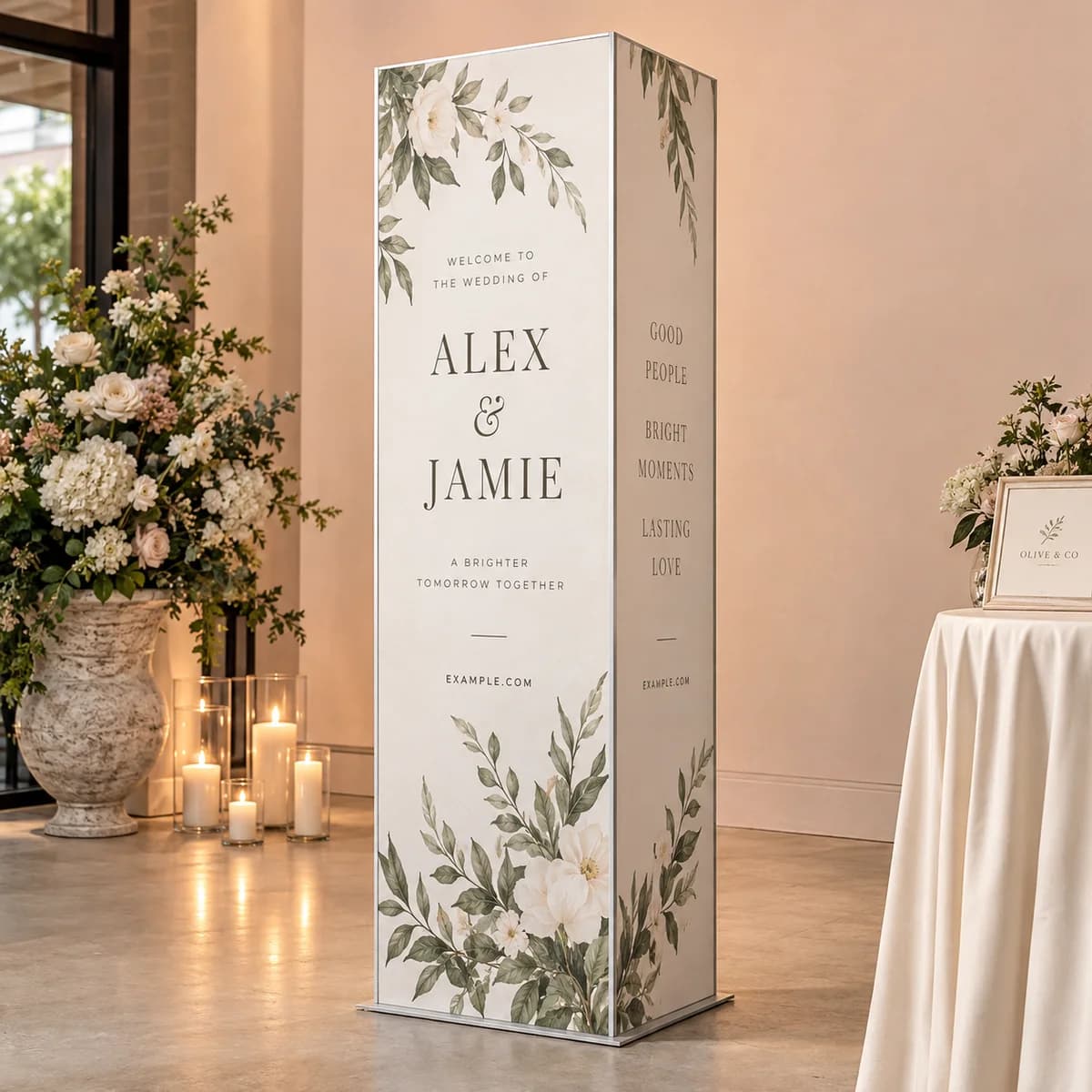
| Tower or multi sided display | Panels on a freestanding structure | Visible from several aisles | Narrow, not a full back wall |
Our curved pop up displays come in two widths, about 89.5 and 116.25 inches, at about 89.5 inches tall, use recycled fabric with hook and loop tool free attachment, weigh roughly 23 to 26 pounds including a wheeled travel bag, and offer optional endcaps. Tower displays come in three sizes up to 79 inches tall in three or four sided versions, on 4 mm honeycomb corrugated plastic, with a different design possible on every panel.
How do you choose between one wall and several banners?
Ask how often your message changes and how many booth sizes you exhibit in.
If you exhibit at the same show each year with a stable message, one fabric wall is the better buy: it looks deliberate and sets up fast. If you exhibit at several shows with different audiences, a cluster of roll up banners lets you bring two of four panels and leave the rest at the office. Many exhibitors end up with both: a wall for identity and one or two banners for the current offer.
Cost behaves differently too. A wall is one larger purchase that ages slowly. Banners are smaller purchases you replace individually, which is easier on a monthly budget and harder to keep visually consistent unless you order them from the same palette at the same time.
Why does the curve matter for artwork?
A curved wall is not a flat canvas. The graphic is printed flat and then bends, so anything near the outer edges turns away from the viewer and a straight horizontal line across the full width reads as an arc.
Design for the centre. Put the logo and headline in the middle 60 percent of the width, use the outer sections for color, texture or photography, and avoid long horizontal rules, tight grids and text set close to the left or right edge. If a design depends on a flat rectangle, choose a straight tension frame instead.
Endcaps, where offered, close the sides of a curved wall and make the booth feel like a room. They also block the view from the neighboring booth's side, so check the show's height and sightline rules before adding them.
How does the graphic attach, and why does it matter?
Attachment decides your setup time and your damage rate.
Hook and loop fabric panels go on in minutes, tolerate being folded and can be washed. Their weakness is visible seams and a slightly soft edge. Channel or silicone edge graphics look flawless because the fabric is pulled taut into a groove, but the graphic and frame must be an exact pair, so a replacement graphic is a size critical reorder. Rigid panels clip or hang, hold a genuinely flat surface, and dent at the corners the first time a case is dropped.
Whatever the system, record the frame model and the exact graphic size in your files. A tension graphic ordered a quarter inch small is unusable, and a year later nobody remembers the number.
What about lighting and shelves?
Most halls light from above, which leaves the lower half of a back wall dimmer than the top. If lighting is offered by the show or available as an accessory for your system, aim it at the band above head height where your name sits.
Hanging anything on a pop up wall needs care. Fabric systems are not shelving: our fabric pop up counters state a 30 pound countertop rating and a 10 pound internal shelf, and those numbers belong to the counter, not the wall. If you need to display product, use a counter, a podium or a tower rather than attaching weight to a collapsible frame.
What is the practical buying order?
Decide in this sequence and the choice usually makes itself.
- Confirm the booth width and the maximum allowed height for your show.
- Decide whether the message is stable or changes per audience.
- Choose fabric for weight and forgiveness, rigid only if you need flat edges.
- Check the packed weight and case count against who is traveling.
- Confirm the exact graphic size and record the frame model.
- Add a counter for product and literature, not shelves on the wall.
- Order banners from the same palette at the same time as the wall.
What is the pop up wall checklist?
- Match the wall width to the booth, not to the widest option available.
- Keep logo and headline in the middle 60 percent of a curved graphic.
- Prefer hook and loop fabric for travel, tension frames for a flat look.
- Record frame model and graphic dimensions with the print file.
- Light the band above head height if lighting is available.
- Put weight on a counter or tower, never on the wall frame.
- Check the packed weight before committing to a system.
Frequently asked questions
What is a pop up display?
A collapsible frame that expands to form the back wall of a booth, with a printed graphic attached to it. Fabric versions use hook and loop or a tension channel and pack into a wheeled bag; rigid versions use printed panels that clip on. Our curved pop up displays come in two widths at about 89.5 inches tall and weigh roughly 23 to 26 pounds packed.
Is a fabric or rigid pop up wall better?
Fabric for most exhibitors. It is lighter, tolerates folding, can be washed and sets up without tools. Rigid panels give crisper edges and a genuinely flat surface, which matters for precise graphics, but they are heavier and their corners are vulnerable in transit. Choose rigid only when the design needs a flat rectangle.
Can I hang shelves on a pop up display wall?
Treat a collapsible frame as a graphic holder, not structure. Use a counter or podium for product and literature: our fabric pop up counters state a 30 pound countertop rating and a 10 pound internal shelf. Hanging weight on a pop up frame risks both the frame and the graphic.
How wide should my back wall be for a 10 foot booth?
Something in the range of 89 to 116 inches, depending on whether you also want a counter or banner beside it. A 116 inch wall fills a 10 foot span almost completely, while an 89 inch wall leaves roughly two feet for a counter or flag at one end.
Sources & specification notes
The references below support the relevant technical or product details in this guide. Examples and checklists are not claims of practical testing or universal supplier requirements. Confirm the current specifications for your chosen product before production.
- IAEE: Guidelines for Display Rules and Regulations, North American update ↗
Back wall height allowances and sightline rules that decide how tall and how enclosed a pop up wall may be.