Why the total has to match
Apparel and bag products in this catalogue are ordered with a size picker rather than a free text note, and the order checks the arithmetic. Enter S 5, M 20, L 20, XL 10 against a quantity of 60 and you will be told the sizes add up to 55. It is a small gate that prevents a much larger problem: a box arriving with fewer shirts than people.
Sized garments use standard US adult sizes from S to 2XL. Caps, hats, aprons and every bag are one size, and they say so explicitly rather than silently having no size at all. If you need something outside the published run, add a production note and the supplier confirms what is available.
The reliable method: ask
Send a one question form a week before you order. Name and size, nothing else. Set a deadline and state what happens to people who miss it, which is usually that they get an L.
- Ask for the size they actually wear in a standard US adult tee, not their usual brand.
- Tell them the fit runs slightly small, so many people will move up one.
- Collect the answers in a single list with names, not a tally.
- Keep the list. It is the starting point for every reorder.
The list matters more than the tally, because next year you will have leavers and joiners rather than a fresh crowd. Adjusting a list of 43 names is quick. Rebuilding a distribution from memory is not.
When you cannot ask
Giveaway shirts for an unknown crowd need a different approach. You are not trying to fit everyone; you are trying to make sure the shirts leave the table.
A workable default for a mixed adult audience is to weight the middle heavily and keep the extremes small. Something in the region of 10 percent S, 25 percent M, 30 percent L, 25 percent XL and 10 percent 2XL distributes without leaving a pile of one size, and it errs upward, which is the safer direction for a tee that runs small.
| Order size | S | M | L | XL | 2XL |
|---|---|---|---|---|---|
| 50 | 5 | 13 | 15 | 12 | 5 |
| 100 | 10 | 25 | 30 | 25 | 10 |
| 250 | 25 | 62 | 75 | 63 | 25 |
Those are starting points, not a rule. A construction crew and a dance school will not share a distribution. If you know your audience skews one way, shift the weight and reduce the tail at the other end.
Why fit runs small matters here
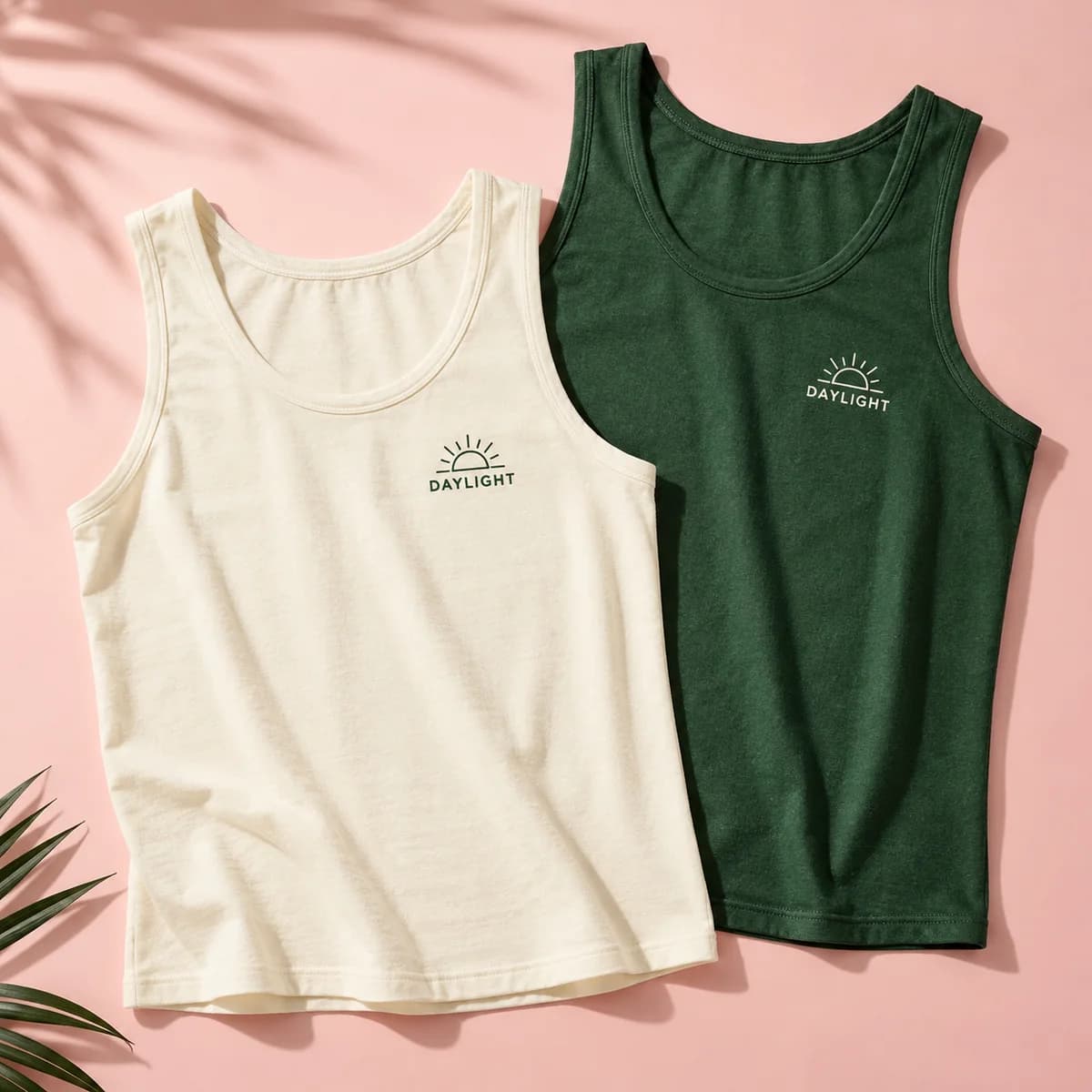
Several garments in this range carry an explicit note that the fit runs slightly small and that wearers between sizes should size up. Tank tops, custom T shirts, long sleeve tees, V neck tees and jackets and vests all carry a fit note of this kind.
That has a practical consequence for a size run. If you collect sizes and take them literally, a portion of your order will be one size too tight for the people who asked for it. Say the fit note in your request form, in plain words, and let people choose with that information. It is far cheaper than a reorder.
Shrinkage is a separate question from fit, and it is measured separately: AATCC TM135 covers dimensional change in fabrics after home laundering across defined wash temperatures, agitation cycles and drying methods. Ask whether a garment is pre washed if the first wash matters to you. Tank tops in this catalogue are pre washed to minimize shrinkage.
Spares, and how many
Order spares. The right number is small but never zero.
For a team of fixed size, two or three extra in the most common sizes covers a late joiner, a spill and a lost shirt. For an event with a giveaway, spares are less useful than a better distribution, because leftovers of any single size are dead stock. For a uniform that will be worn for a year, spares matter most, since a replacement ordered on its own costs more per piece and takes as long as the original order.
Recording the run for next time
Write down four things when the order ships: the garment, the size run, the color and the decoration. Next year that record answers every question in the first five minutes.
It also lets you correct. If six people asked to swap up a size after the shirts arrived, that is not a failure, it is data. Move six units from M to L in next year's run and the same crowd is dressed correctly.
Size run checklist
- Make the size counts total the order quantity exactly.
- Collect sizes by name wherever you can, and keep the list.
- Tell people the fit runs slightly small before they answer.
- Weight the middle sizes and keep the extremes small when you cannot ask.
- Add two or three spares in the most common sizes for a fixed team.
- Record garment, run, color and decoration for the reorder.
Frequently asked questions
What is a typical T shirt size breakdown?
For a mixed adult audience, roughly 10 percent S, 25 percent M, 30 percent L, 25 percent XL and 10 percent 2XL distributes without leaving a pile of one size. Treat it as a starting point and shift the weight if you know your audience. Where you can ask people directly, always do that instead.
Do custom T shirts run small?
Several garments in this range carry an explicit note that the fit runs slightly small and that wearers between sizes should size up. That includes custom T shirts, tank tops, long sleeve tees, V neck tees and jackets and vests. Put that note in your size request form so people choose with the information.
What sizes are available?
Sized garments use standard US adult sizes from S to 2XL. Caps, hats, aprons and all bags are one size. If you need a size outside the published run, add a production note with your order and the supplier confirms what is actually available before anything is printed.
How many spare shirts should I order?
For a fixed team, two or three extras in the most common sizes is usually enough to cover a late joiner or a damaged shirt. For a giveaway, a better distribution beats spares, because leftovers of one size are dead stock. For a uniform worn all year, lean toward more, since single replacements cost more per piece.
Sources & specification notes
The references below support the relevant technical or product details in this guide. Examples and checklists are not claims of practical testing or universal supplier requirements. Confirm the current specifications for your chosen product before production.
- AATCC TM135: Test Method for Dimensional Changes of Fabrics after Home Laundering ↗
Supports the statement that shrinkage is measured as dimensional change across defined wash temperatures, agitation cycles and drying procedures.
- FTC: Threading Your Way Through the Labeling Requirements Under the Textile and Wool Acts ↗
Supports the point that fiber content is disclosed on the garment label, which is where a buyer confirms what the blend actually is.