What each product actually is
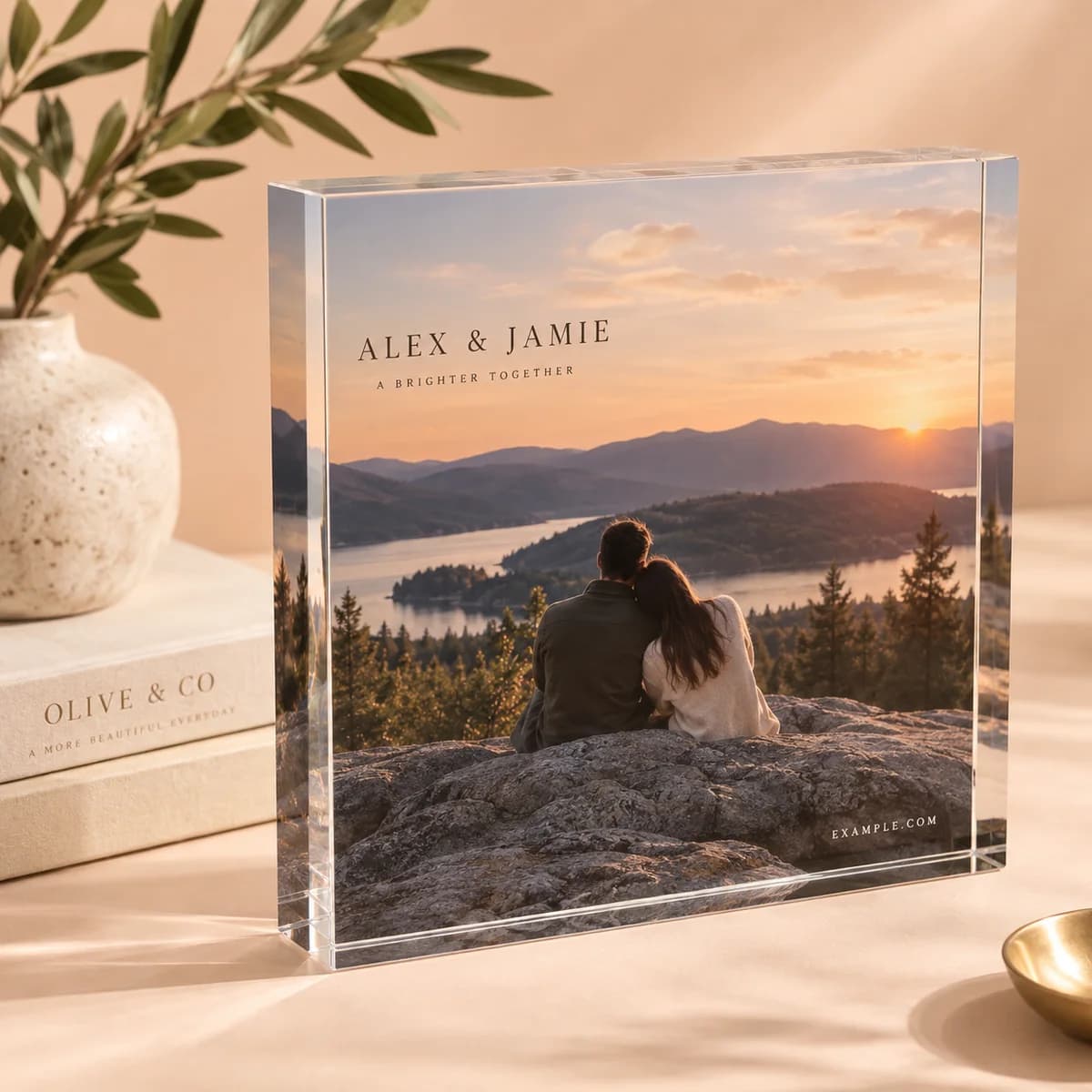
Our acrylic photo blocks are 1 inch thick and self standing, so no stand is needed. They come in multiple sizes in vertical or horizontal display, the image is UV printed and shines through the glossy front, and the surface is glare and scratch resistant. You can add text to the photograph: names, dates or a quotation.
Our framed prints come in five sizes from 8 by 10 up to 24 by 36 inches, with white, black or walnut frames 1.5 inches wide. The print is on matte paper behind an acrylic cover, the frame is MDF with a built in wall hanger, and there is an optional printed white border for a mat like look.
Between them sits a third option. Tabletop photo tiles come on lightweight matte foam board or brushed metal aluminum with a clear acrylic stand, in two sizes including 5 by 7, which is the smallest and lightest of the three.
Object or wall art
This is the decision, and everything else follows from it.
| Factor | Acrylic photo block | Framed print |
|---|---|---|
| Where it lives | Desk, shelf, mantel | Wall |
| Needs a stand | No, self standing | No, built in hanger |
| Depth | 1 inch of acrylic | 1.5 inch frame profile |
| Surface | Glossy, glare and scratch resistant | Matte paper behind acrylic |
| Sizes | Multiple, small format | 8 by 10 up to 24 by 36 |
| Border option | Text can be added to the image | Optional printed white border |
| Reads as | A gift object | A finished picture |
A block is given. A framed print is installed. If the recipient has to find a nail and a level, you have given them a task as well as a gift.
What the surfaces do to an image
Gloss and matte are not interchangeable, and each suits different photographs.
A glossy acrylic front deepens blacks and saturates color, and the thickness of the acrylic adds a sense of depth at the edges. That flatters high contrast images, strong color and anything with a clear subject. It punishes reflections: a glossy surface facing a window shows the window.
A matte paper print behind an acrylic cover is calmer. Matte holds subtle tonal detail in skin, sky and shadow better than gloss, and the acrylic cover protects it without adding the mirror effect of a fully glossy face. That suits portraits, documents, illustrations and anything with fine detail in the midtones.
Crop, edge and the thing people forget
Both products crop, and neither is forgiving about faces near an edge.
On a block, the image runs to the edges of the acrylic, and the thickness means the outermost sliver is seen through a curve of material. Keep faces, text and any essential element clearly in from every edge.
On a framed print, the frame lip covers part of the sheet, so the visible opening is smaller than the print. The optional printed white border solves this elegantly: it gives you a mat like margin that is part of the artwork rather than a physical mat, which means nothing important is ever under the lip.
These are made objects rather than printed sheets, so the design canvas cannot show you where the crop lands. Its edges, thickness, mounting and finish decide what is visible once it is built. Choose the size and orientation in the order, send the highest resolution original you have, keep faces and text well in from every edge, and ask us for the template if the crop is tight.
Resolution, plainly
Divide the pixel width of your image by the printed width in inches to get the effective resolution. A photograph 3,000 pixels wide printed 10 inches wide gives 300 pixels per inch, which is comfortable for something held at arm's length like a block. For a 24 by 36 framed print viewed from a few feet away, 150 pixels per inch at final size is a sensible floor, which means about 3,600 by 5,400 pixels.
Start from the largest original file you have. A social media download is usually too small for anything above the smallest sizes.
Light, and how long the gift looks new
Both products are prints, and prints respond to light. The Library of Congress guidance on the care of works on paper recommends minimal exposure to all kinds of light and no exposure to direct or intense light for material you want to keep.
For a gift that is the practical advice worth passing on. A framed print on a wall opposite a south facing window will change over years. An acrylic block on a sunny desk will too. Suggesting a spot out of direct sun is a small, credible piece of care advice that makes the gift feel considered.
Choosing in one line
- Desk gift, one strong image, no installation: acrylic photo block.
- Wall gift, larger scale, calmer surface: framed print.
- Lightest and cheapest of the three, sits on a shelf: tabletop photo tile.
- Canvas texture rather than glass or paper: canvas prints or framed canvas prints.
- Many images rather than one: a photo book.
Photo gift checklist
- Decide desk or wall before comparing prices.
- Match the surface to the image: gloss for contrast, matte for midtone detail.
- Keep faces and text well in from every edge.
- Use the printed white border on a framed print to protect the composition.
- Aim for 300 pixels per inch on small formats and at least 150 on large ones.
- Send the highest resolution original rather than a download.
- Suggest a display spot out of direct sunlight.
Frequently asked questions
Is an acrylic photo block better than a framed print?
They do different jobs. An acrylic block is 1 inch thick, self standing and glossy, which suits a desk or shelf and a high contrast image. A framed print is matte paper behind an acrylic cover in a 1.5 inch frame with a built in hanger, which suits a wall and holds subtle midtone detail better.
What sizes do acrylic photo blocks and framed prints come in?
Acrylic photo blocks come in multiple sizes with vertical or horizontal display. Framed prints come in five sizes from 8 by 10 up to 24 by 36 inches, in white, black or walnut frames. Tabletop photo tiles sit below both, in two sizes including 5 by 7, with a clear acrylic stand included.
How much resolution does a photo gift need?
Divide your image width in pixels by the printed width in inches. Around 300 pixels per inch is comfortable for a small object held at arm's length, and 150 pixels per inch at final size is a sensible floor for a large framed print, which is about 3,600 by 5,400 pixels at 24 by 36 inches.
Will a printed photo gift fade?
Light is the main factor. Library of Congress preservation guidance recommends minimal exposure to all kinds of light and no exposure to direct or intense light for material you want to keep. Passing that on as a display suggestion, out of direct sun, makes the gift feel considered and genuinely extends how long it looks new.
Sources & specification notes
The references below support the relevant technical or product details in this guide. Examples and checklists are not claims of practical testing or universal supplier requirements. Confirm the current specifications for your chosen product before production.
- Library of Congress: Care, Handling and Storage of Works on Paper ↗
Preservation guidance recommending minimal light exposure and no direct or intense light for printed material intended to be kept.
- PPAI: New PPAI Research Shows Why Consumers Take And Keep Promo Products ↗
Research on retention of branded items, cited for the point that a gift requiring no installation is more likely to be used.