What the object is
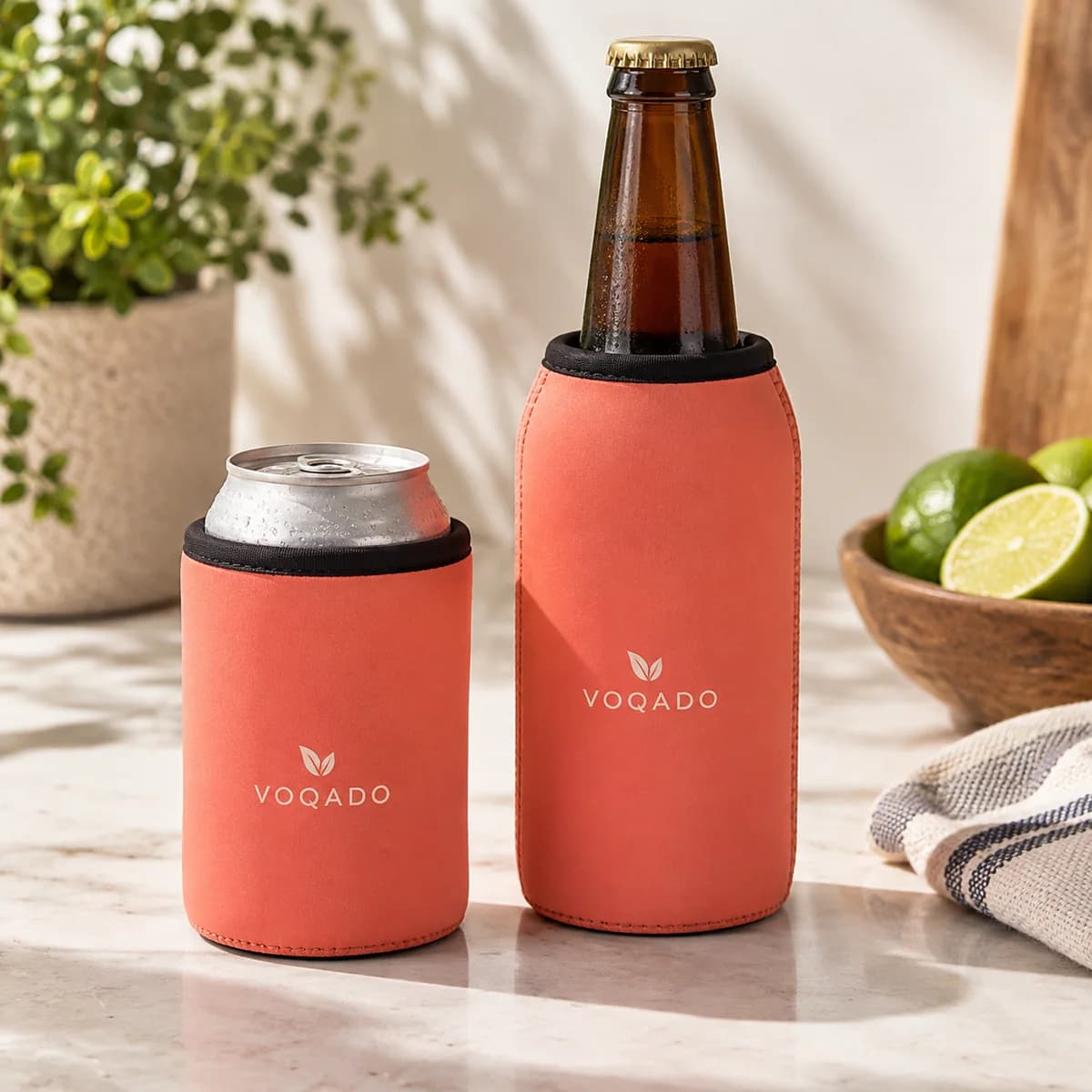
Ours is polyester with a gray foam backing, sized for canned beverages, and it folds flat so it fits a pocket and stores without volume. The foam is what keeps a drink cold and hands dry, and the collapsibility is what makes it easy to hand out at scale.
Beyond that single stocked model, the wider range covers neoprene, polyester, recycled polyester, stainless steel, vinyl and ripstop. Those materials behave differently under print and under weather, so name the material in your brief rather than assuming the default.
The arithmetic of a small cylinder
Circumference is pi multiplied by the diameter, so 2.75 inches across gives about 8.64 inches around. The height is 3.87 inches.
That is the ceiling and never the imprint. Subtract a seam allowance, then subtract the top and bottom edges, then remember that a cylinder shows slightly less than half of itself at once. What a person actually reads from a normal distance is roughly the middle third of the visible arc, which on an object this small is a few inches wide.
The design consequence is blunt. A can cooler holds one idea. A logo and four lines of text is two ideas too many.
Why we do not give you a rectangle
We hold no imprint sheet for this product. The size recorded against it in the catalog is a layout default, and the dimensions in its specification describe the object rather than a printable area, so the design canvas draws no trim, bleed or safe area for it.
That is a measured decision rather than an unfinished feature. A drawn line looks exactly like a real trim, and a can cooler's real constraint is an arc with a seam in it. So the canvas is presented as a visual concept, and the two honest routes to a correct file are the product's own template or your print ready artwork with placement confirmed by our team before production.
Designing for the seam
Every sleeve has a join, and on an object this small the join is close to whatever you put on it.
Designs that cope: a single centered mark, a short word in a heavy weight, a color field, an irregular texture. Designs that expose the seam: continuous horizontal rules, a repeating stripe, a long word set edge to edge, a photograph with a strong horizon.
If you want the same mark visible from any angle, the strongest brief is one mark, repeated, with the repeat spacing chosen so the seam falls between instances rather than through one.
Material choices and what they change
Neoprene is the familiar stretchy option, thick and forgiving, and it hugs a can well. Polyester with foam backing is lighter and the surface is smoother. Recycled polyester is the same construction with a different fiber source. Vinyl and ripstop are thinner and shinier. Stainless steel is a different product entirely: a rigid insulated holder rather than a sleeve.
If you intend to say anything about recycled content on the product or in the campaign, keep the claim specific. The FTC Green Guides caution against broad, unqualified environmental claims and require a reasonable basis for any claim you make, so recycled polyester is a material fact and eco friendly is not a claim worth printing.
Why they work as giveaways
Can coolers survive the two tests that kill most promotional items: they are useful in the moment they are received, and they are small enough to keep.
PPAI research on why consumers take and keep promotional products points to usefulness and quality as the main reasons branded items are retained rather than discarded, and its related work on the things people do not throw away tells the same story. A cooler is used the instant it is handed over at an outdoor event, which is why it outperforms items that ask the recipient to find a use later.
They are also the right tier for an open giveaway. Keep the better gift for the conversations that earn it, and let the cooler be the thing anyone can take.
Where they belong in an event plan
- Outdoor events, tailgates, beach activations, festival booths: the obvious fit.
- Indoor conferences: weaker, because nobody is holding a can.
- Bar and venue promotions: strong, and they stay in circulation on site.
- Employee summer gifts: good as part of a set rather than alone.
- Anything mailed: excellent, because they fold flat and weigh almost nothing.
The product page advises ordering the smallest quantity before a full run, which on a printed textile is worth doing. Color on fabric reads differently than color on paper, and a single sample answers that in a day.
Can cooler brief checklist
- Name the material: neoprene, polyester, recycled polyester, vinyl, ripstop or steel.
- Treat about 8.6 inches of circumference as a ceiling, not an imprint.
- Commit to one idea, and cut the second one.
- Decide what happens at the seam before you design.
- Keep essential content in the middle third of the visible arc.
- Keep environmental claims specific to the material.
- Order the smallest quantity and look at the color in daylight.
Frequently asked questions
How big is the print area on a can cooler?
We publish no imprint rectangle, because we hold no imprint sheet for this product. You can estimate the ceiling from the stated 3.87 inch height and 2.75 inch diameter, which gives about 8.6 inches around, then subtract the seam and the edges. Ask us for the product template and our team sets the placement with you before production.
Can a design wrap right around a can cooler?
It can, but the sleeve has a seam and the object is small, so the join sits close to whatever you place. Continuous horizontal rules, regular stripes and long single words all reveal it. A single centered mark, or one mark repeated with the spacing chosen so the seam falls between instances, is far more reliable.
What material should a custom can cooler be?
Neoprene is thick and forgiving, polyester with foam backing is lighter with a smoother print surface, and recycled polyester is the same construction with a different fiber source. Vinyl and ripstop are thinner, and stainless steel is a rigid insulated holder rather than a sleeve. Name the material in your brief.
Are can coolers a good promotional giveaway?
At outdoor events, yes. PPAI research points to usefulness and quality as the main reasons people keep branded items, and a cooler is used the moment it is handed over rather than needing a use found for it later. They also fold flat, so they mail cheaply and store without taking space.
Sources & specification notes
The references below support the relevant technical or product details in this guide. Examples and checklists are not claims of practical testing or universal supplier requirements. Confirm the current specifications for your chosen product before production.
- PPAI: New PPAI Research Shows Why Consumers Take And Keep Promo Products ↗
Trade association research finding that usefulness is the main reason consumers keep promotional products, supporting the case for items used at the moment of handover.
- Federal Trade Commission: Green Guides ↗
FTC guidance requiring a reasonable basis for environmental claims and cautioning against broad, unqualified claims such as eco friendly.