Why a coaster punches above its price
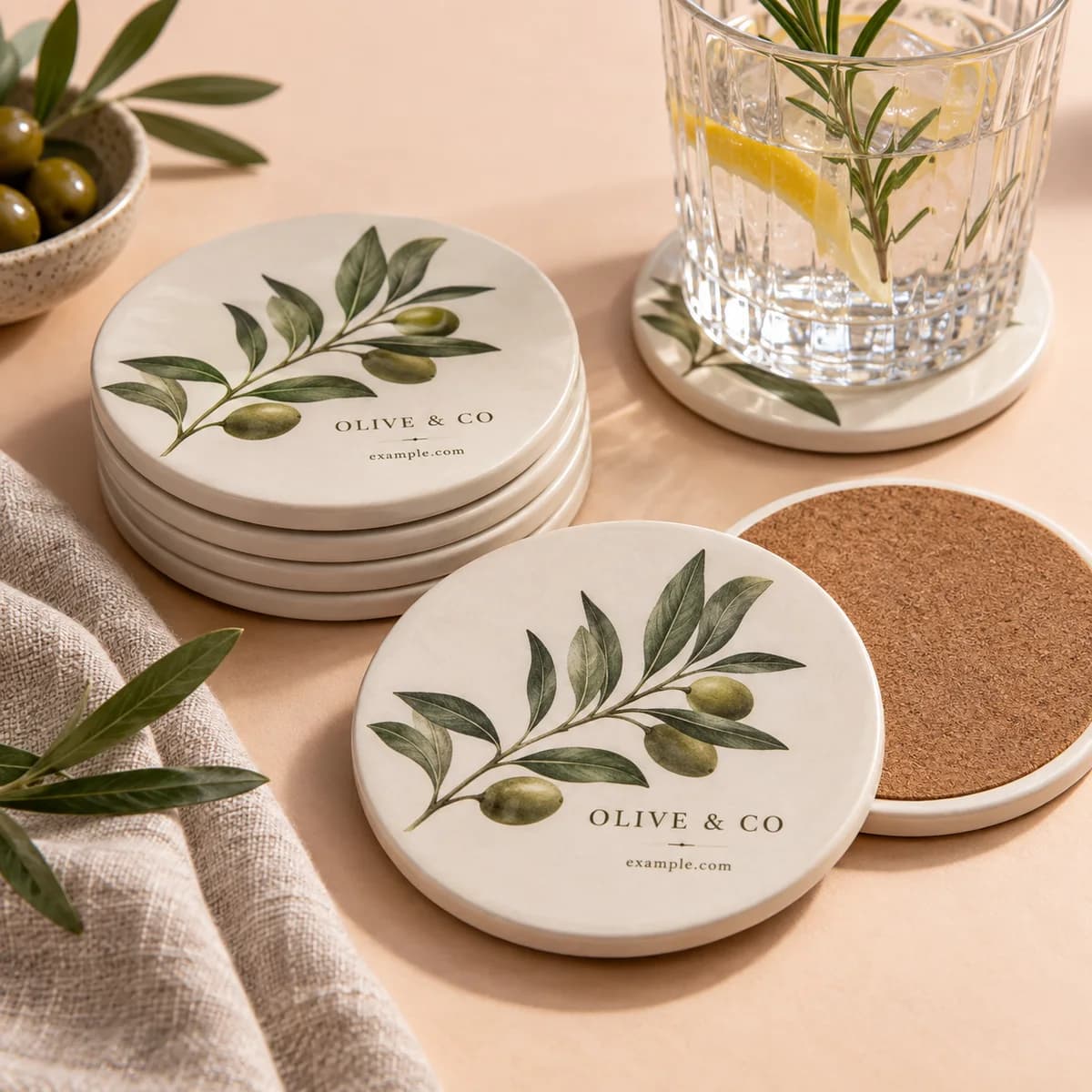
A coaster is one of the few small promotional objects that gains from weight. Heavyweight ceramic stone has a density in the hand that no printed card can imitate, and the cork backing signals that someone thought about the table underneath.
That combination is why a coaster reads as a gift rather than as a handout. It also sits at a useful point in a tier structure: substantial enough to give after a real conversation, cheap enough not to hurt at four hundred units.
Ceramic or paper, chosen properly
We make both, and they are not competing for the same job.
| Factor | Ceramic coasters | Paper coasters |
|---|---|---|
| Size | 4.1 in circle or 3.9 in square | 4 by 4 in |
| Material | Heavyweight ceramic stone, cork backing | 56 pt matte coaster board |
| Life | Kept and reused | Single event, then recycled |
| Quantity | 2 to 400 | 20 to 500 |
| High definition on an absorbent surface | Full color on matte board | |
| Use | Home, office, gift sets | Bars, weddings, table details |
If the coaster is meant to be taken home, choose ceramic. If it is meant to sit under two hundred drinks at one event and then go in the recycling, choose paper. Our paper coasters are also listed as handling hot and cold drinks, durable and recyclable, with a free PDF proof before you order.
What the absorbent surface does to artwork
Ceramic stone is absorbent, which is the property that makes it useful under a cold glass and also the property your artwork has to respect.
An absorbent surface takes ink slightly into itself rather than holding it entirely on top. In practice that means very fine hairlines soften a little, dense dark areas can look slightly less glossy than on a coated card, and delicate reversed out type is the first thing to suffer. The print is described as high definition, so photographs and detailed artwork work well, but they work best when the smallest meaningful element is larger than you would allow on a business card.
Design to a circle, not to a square that happens to be round. On a 4.1 inch circle, a centered composition with a clear margin looks intentional and an edge to edge crop of a face does not.
Four coasters as one gift
The strongest use of a coaster is in a set, because four related images read as a collection rather than four copies of an advertisement.
Sensible set structures: four photographs of the same place in different seasons, four rooms, four products, or one mark on all four with four different background colors. Avoid four different logos, which looks like a sample pack.
Coasters also pair. Our 11 oz ceramic mug product notes that matching photo coasters are available for gift sets, which gives you a mug and a coaster from the same artwork with no extra design work.
Decoration and safety, briefly
A coaster is not a food contact surface: nothing is eaten off it and nothing is drunk from it. That distinguishes it from a mug or a glass, where the FDA guidance on lead in foodwares and the ASTM test methods for lead and cadmium extracted from glazed ceramic surfaces are genuinely relevant.
One piece of regulation is worth knowing for decorated consumer goods generally. The CPSC ban on lead containing paint under 16 CFR part 1303 covers surface coating materials, and it is explicit that printing inks which become part of the substrate, electroplating and ceramic glazing do not meet that definition. That is a useful distinction when a client asks whether a printed ceramic object falls under the paint rule.
Care, and what to tell recipients
Absorbent ceramic wants to be wiped rather than soaked, and cork does not enjoy standing water. That is worth a line on the packaging or the accompanying card: wipe clean, do not submerge.
If you are giving a set as a keepsake, add the same advice you would give for any printed keepsake on display. The Library of Congress guidance on care of works on paper recommends minimal exposure to light and no exposure to direct or intense light, and while a coaster is not paper, a printed image left in a sunny window will fade whatever it is printed on.
Where coasters belong
- Earned tier at an event, handed over after a real conversation.
- Client thank you gifts, four in a set with a short note.
- Venue branding that goes home with regulars.
- Wedding and anniversary keepsakes with a date, since these are meant to be souvenirs.
- Paired with a mug from the same artwork for a two item gift.
Ceramic coaster checklist
- Pick the shape first: a 4.1 inch circle or a 3.9 inch square.
- Design a set of four related images rather than four identical ones.
- Compose for a circle with a clear margin, not an edge to edge crop.
- Keep the smallest meaningful detail larger than card sized type.
- Use paper coasters instead when the item is for one event only.
- Add wipe clean, do not submerge to the packaging.
- Order two units first, since the minimum allows it.
Frequently asked questions
What size are custom ceramic coasters?
Two shapes are offered: a circle of 4.1 inches diameter and a square of 3.9 by 3.9 inches. Both are heavyweight ceramic stone with a cork backing and are safe for hot and cold drinks. Our paper coasters are a separate product at 4 by 4 inches on 56 pt matte coaster board.
Can you print photographs on ceramic coasters?
Yes. The print is described as high definition and photographs work well, with the caveat that ceramic stone is absorbent, so very fine hairlines soften slightly and delicate reversed out type is the first thing to suffer. Keep the smallest meaningful element larger than you would allow on a business card.
How many ceramic coasters can you order?
From 2 up to 400. That range is unusually wide for a hard good, which is why coasters work both as a personal gift of a single set and as an earned tier giveaway at a show. Paper coasters run from 20 to 500 and include a free PDF proof before you order.
Are ceramic coasters dishwasher safe?
Treat them as wipe clean rather than washable. The ceramic is absorbent and the backing is cork, and neither benefits from soaking or from a hot cycle. Put wipe clean, do not submerge on the packaging or the card so the recipient knows, and keep printed sets out of direct sunlight.
Sources & specification notes
The references below support the relevant technical or product details in this guide. Examples and checklists are not claims of practical testing or universal supplier requirements. Confirm the current specifications for your chosen product before production.
- U.S. Consumer Product Safety Commission: Lead in Paint ↗
CPSC guidance on 16 CFR part 1303, which bans lead containing surface coatings and excludes printing inks that become part of the substrate and ceramic glazing from that definition.
- Library of Congress: Care, Handling and Storage of Works on Paper ↗
Preservation guidance recommending minimal light exposure and no direct or intense light, cited for keeping printed keepsakes out of sunlight.