Work out your own grams per box
Guessing by handfuls produces wildly different results between packers. The fix takes five minutes.
Pack one box the way you want every box to look. Then unpack it, put the crinkle paper on a kitchen scale and write the number down. That is your standard. Tape the figure to the packing bench and weigh the first few boxes of each shift until people calibrate by eye.
Crinkle paper here is sold in 10 pound cartons, which is about 4,536 grams. At 25 grams per box that carton fills roughly 180 boxes. At 60 grams it fills about 75. Those two numbers are very different purchasing decisions, which is exactly why the grams figure is worth measuring.
| Box size | Nest depth | Grams per box, approximate | Boxes per 10 lb carton |
|---|---|---|---|
| 8 x 6 x 2 in | 0.5 in | 10 to 15 | 300 to 450 |
| 10 x 8 x 3 in | 1 in | 15 to 25 | 180 to 300 |
| 12 x 9 x 4 in | 1.5 in | 30 to 50 | 90 to 150 |
| 14 x 10 x 5 in | 2 in | 60 to 100 | 45 to 75 |
Those are starting points to calibrate against, not specifications. Strand density varies with how much you fluff the paper.
Compress for shipping, fluff for display
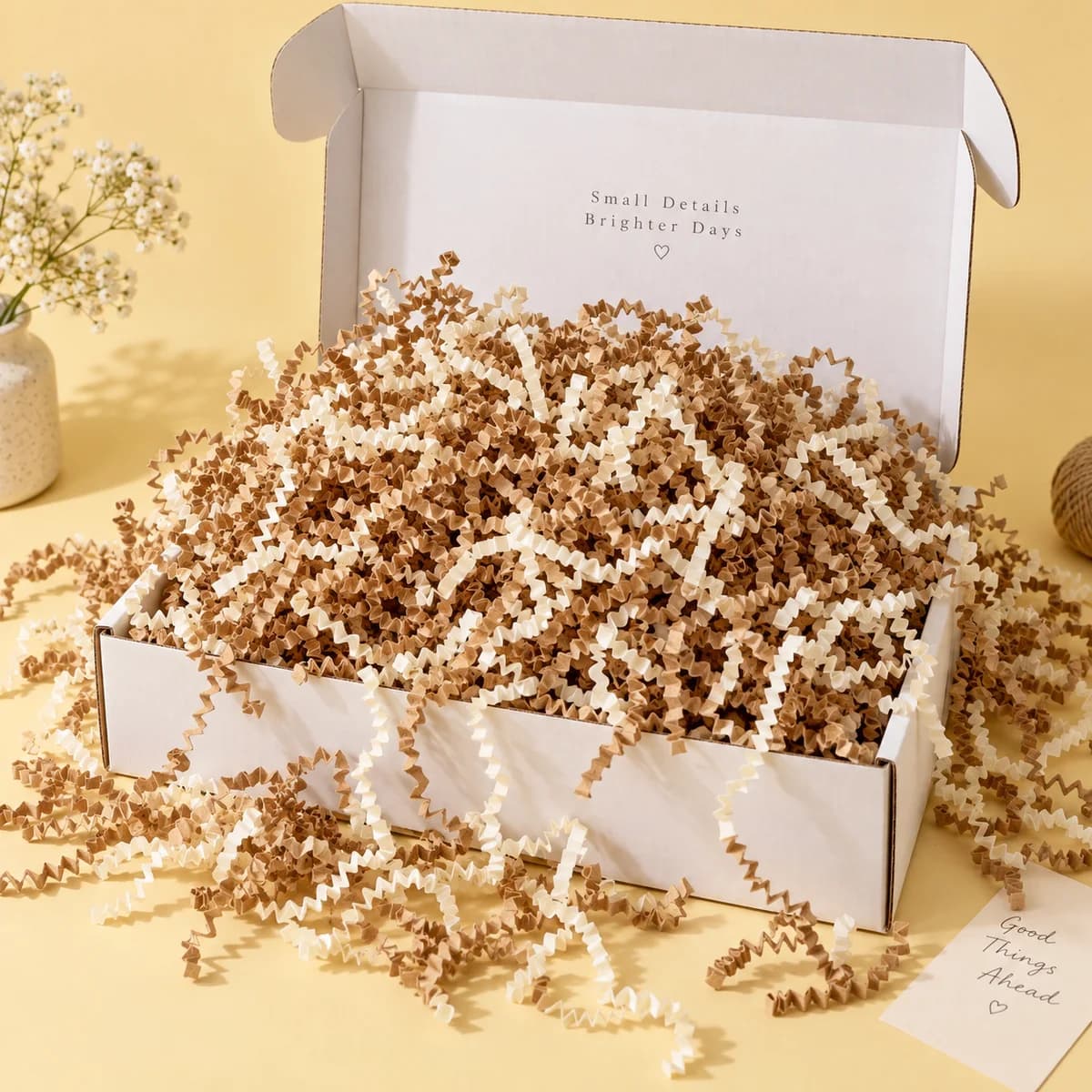
Crinkle paper arrives compressed in the carton so it does not cost a fortune to ship. It expands when you pull it apart, and the strands, around 3 mm wide in a zig zag cut, lock together once fluffed.
That means two people can use the same weight of paper and get very different looking boxes. Fluffed paper occupies far more volume and cushions better. Compressed paper looks flat and does little. Show packers what fluffed looks like rather than describing it.
The paper is reusable, which is part of its appeal. Customers who keep the paper for their own gift wrapping remember where it came from.
When void fill is the right answer
Fill earns its place in three situations.
First, when an item genuinely needs to be held away from the box walls. A glass jar, a ceramic mug, a bottle: those need a nest under them and a cushion around them, and crinkle paper does that job well at low weight.
Second, when several items would otherwise rattle against each other. Paper between items stops abrasion and stops a metal item marking a printed one.
Third, when the presentation is the product. A gift box, a hamper, a curated set: the nest is part of what the customer bought.
When void fill is the wrong answer
Fill is the wrong answer when the only reason it is there is that the box is too big. That is worth saying plainly, because it is the most common packaging mistake in small ecommerce.
Carriers bill on the greater of actual weight and dimensional weight, which is length times width times height divided by a published divisor. FedEx states 139 for United States shipments; UPS publishes 139 for daily rates and 166 for retail rates. Paper stuffed into an oversized box adds scale weight and removes none of the billed volume. You pay twice: once for the paper, once for the air.
It is also the wrong answer when it substitutes for a structural solution. If a product is fragile enough that a drop would break it, a nest of paper is unlikely to be the protection it needs. Transit performance for a shipping unit is evaluated with a sequence of tests representing real distribution hazards, including handling drops, stacking and vibration, and a package that only passes because someone packed it generously on a good day is not a reliable package.
Alternatives, compared
| Fill | Cushioning | Looks | Best for |
|---|---|---|---|
| Crinkle paper | Good for its weight | Excellent | Gifts, jars, curated sets |
| Tissue paper | Minimal | Excellent | The visible layer, wrapping |
| Corrugated inserts | Best, product specific | Neutral | Fragile, repeat products |
| Belly band around items | None | Good | Keeping a bundle together |
| Smaller box | None needed | Best | Almost everything else |
The last row is the one most brands skip. A box that fits removes the need for fill, reduces the billed volume and packs faster.
Color and brand fit
Crinkle paper comes in kraft, white and black, colored with nontoxic water based dyes and made from post consumer recycled paper. Kraft reads natural and hides nothing. White reads clean and shows dirt. Black makes a product pop and shows every speck of dust and every pale fiber.
Pick the color that flatters your product, then check it in a photograph. Black paper behind a dark product loses the product. White paper behind a white product does the same. Contrast is the point.
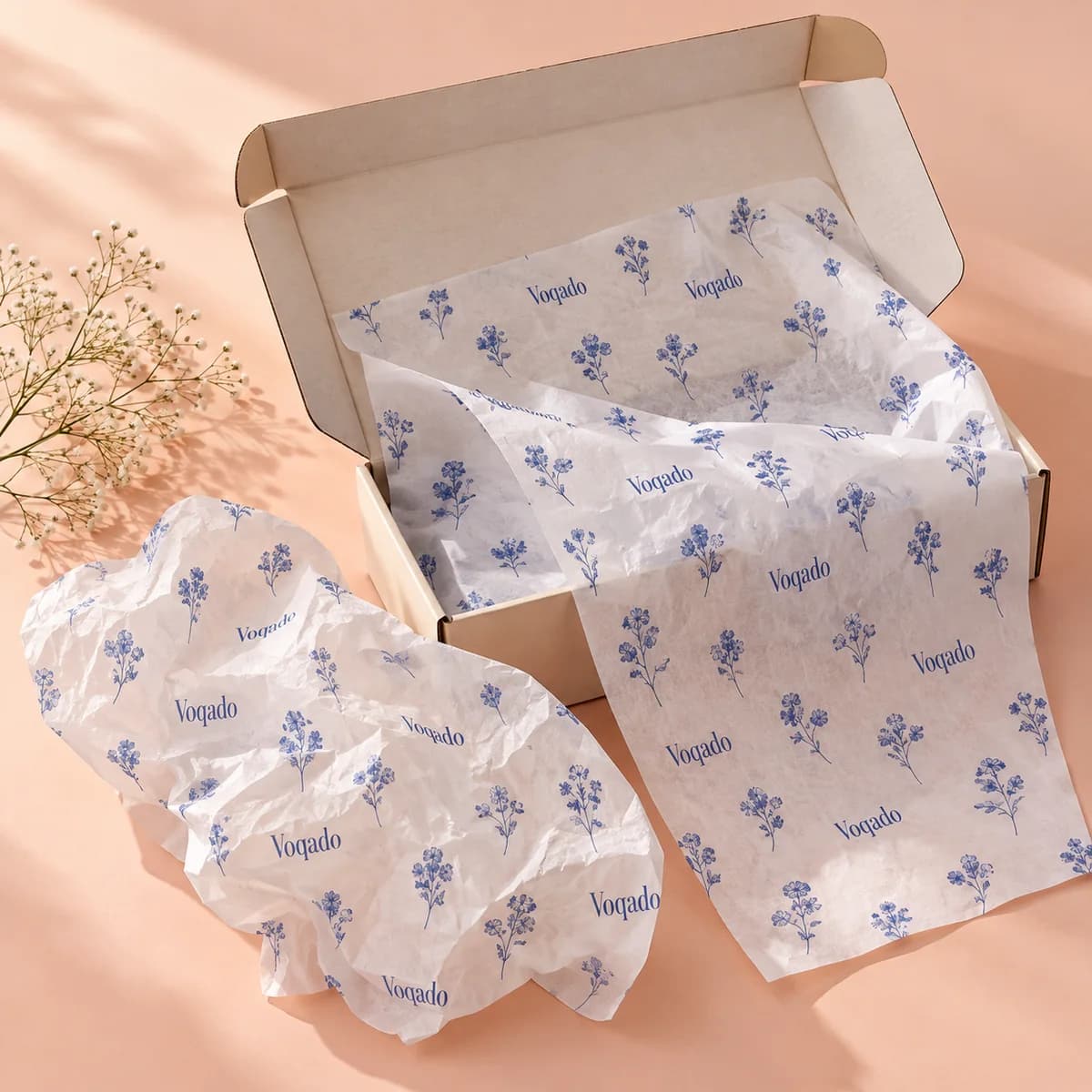
If you also use printed tissue, keep the crinkle paper underneath so the tissue stays the visible layer. Two decorative layers competing at the same level looks busy rather than generous.
Fill checklist
- Pack one ideal box, weigh the paper and make that figure your standard.
- Divide 4,536 grams by your grams per box to get boxes per carton.
- Show packers what fluffed paper looks like rather than describing it.
- Use fill to hold, separate or present, never to occupy an oversized box.
- Check whether a smaller box removes the need for fill entirely.
- Use a fitted corrugated insert for genuinely fragile repeat products.
- Choose the paper color that contrasts with the product, then photograph it.
- Keep crinkle paper beneath printed tissue, not on top of it.
Frequently asked questions
How much crinkle paper do I need per box?
Roughly 15 to 25 grams for a small mailer box with a 1 in nest, 30 to 50 grams for a medium box and 60 to 100 grams for a large gift box. Pack one box the way you want it, weigh the paper, and use that figure as your standard.
How many boxes will a 10 pound carton of crinkle paper fill?
A 10 pound carton is about 4,536 grams. At 25 grams per box that is roughly 180 boxes, and at 60 grams per box roughly 75. Measuring your own grams per box is the only way to forecast reliably.
Does crinkle paper protect fragile items?
It cushions well for its weight and is good for holding a jar or bottle away from the box wall. It is not a substitute for a fitted insert on genuinely fragile products, and it will not rescue an item from a drop the packaging was never designed to survive.
What color crinkle paper should I choose?
The one that contrasts with your product. Kraft reads natural, white reads clean but shows dirt, and black makes color pop while showing dust and pale fibers. Photograph your product on each before committing, because the goal is the product standing out.
Sources & specification notes
The references below support the relevant technical or product details in this guide. Examples and checklists are not claims of practical testing or universal supplier requirements. Confirm the current specifications for your chosen product before production.
- FedEx: What is dimensional weight? ↗
States the volume based billed weight calculation and the 139 divisor for United States shipments.
- UPS: Shipping Dimensions and Weight ↗
Publishes the UPS dimensional weight divisors of 139 for daily rates and 166 for retail rates.
- ASTM D4169: Performance Testing of Shipping Containers and Systems ↗
Sets out a sequence of distribution tests, including handling drops, stacking and vibration, for evaluating a shipping unit.