How many sheets per order
Start from what you want the tissue to do. There are only three jobs, and each one uses a predictable amount.
| Use | Sheets per order | Notes |
|---|---|---|
| Wrap one item | 1 | Fold around the product, seal with a sticker |
| Line the box and wrap | 2 | One lining the base, one wrapping |
| Wrap two or three items separately | 2 to 3 | One per item, for a curated feel |
| Line a large box for a bulky item | 2 | Two sheets overlapped to cover the base |
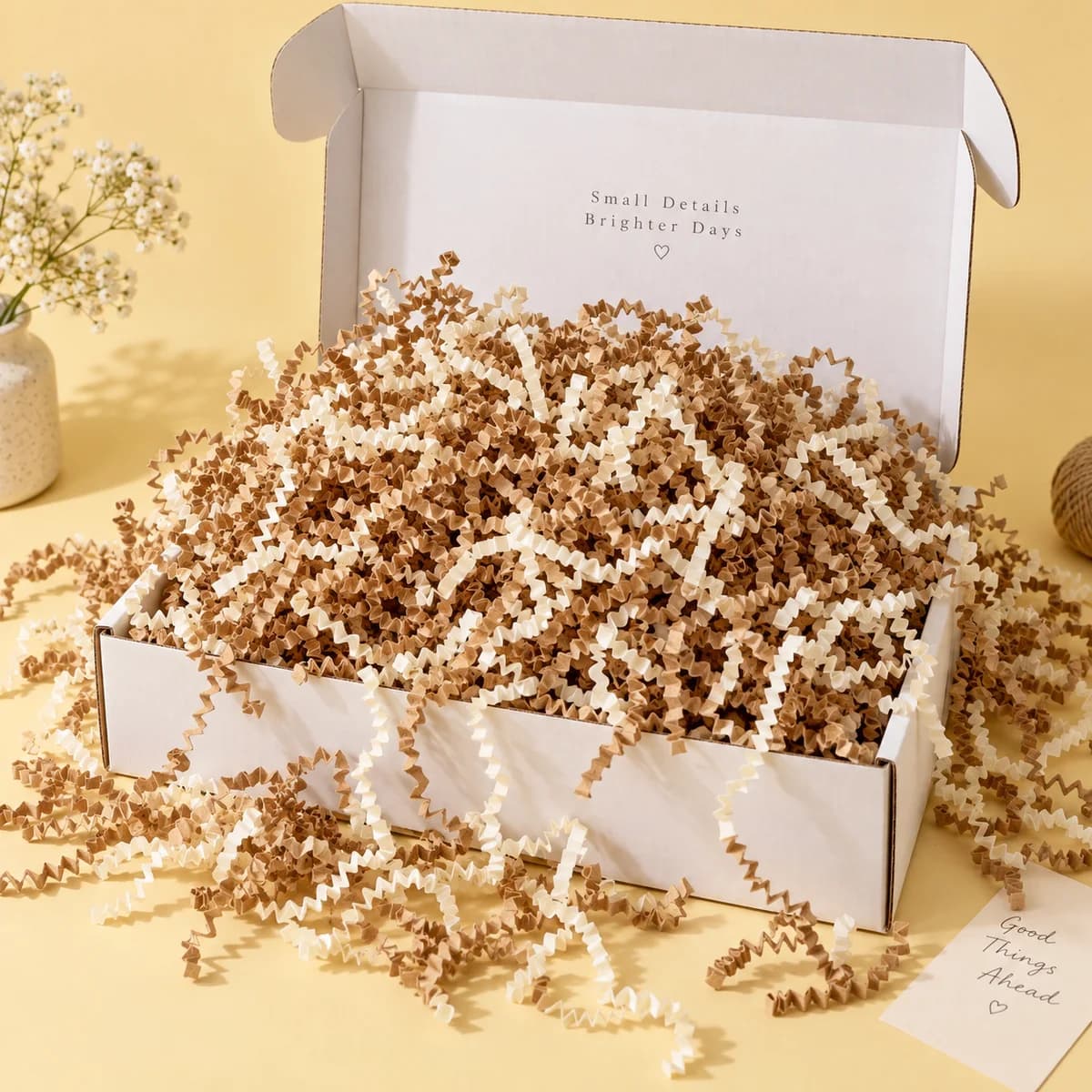
| Nest a fragile item with crinkle paper | 1 | Tissue for looks, crinkle for cushioning |
The minimum order here is 100 sheets, in three paper weights, printed on one side with a seamless repeating logo or pattern. If you ship 150 orders a month and use two sheets each, that is 300 sheets a month, so plan quantity from monthly orders times sheets per order rather than from a round number that feels right.
Choose the paper weight by what it has to do
The three weights are 10 pound, 18 pound and 30 pound. The number is a basis weight, and in practice it tells you how opaque and how forgiving the sheet is.
A 10 pound sheet is light and translucent. It drapes beautifully and is the classic retail tissue, but it tears if a packer is rough and it lets the product color show through.
An 18 pound sheet is the general purpose choice. It holds a crease, hides the product, survives handling and takes print well.
A 30 pound sheet feels substantial, closer to a light wrapping paper. It suits heavier items, a premium gift feel and any wrap that has to stay folded without a seal.
If you are undecided, 18 pound is the safe default. If your product is dark and your tissue is white, go heavier, because a dark item behind thin white tissue reads as gray rather than white.
How the seamless repeat works
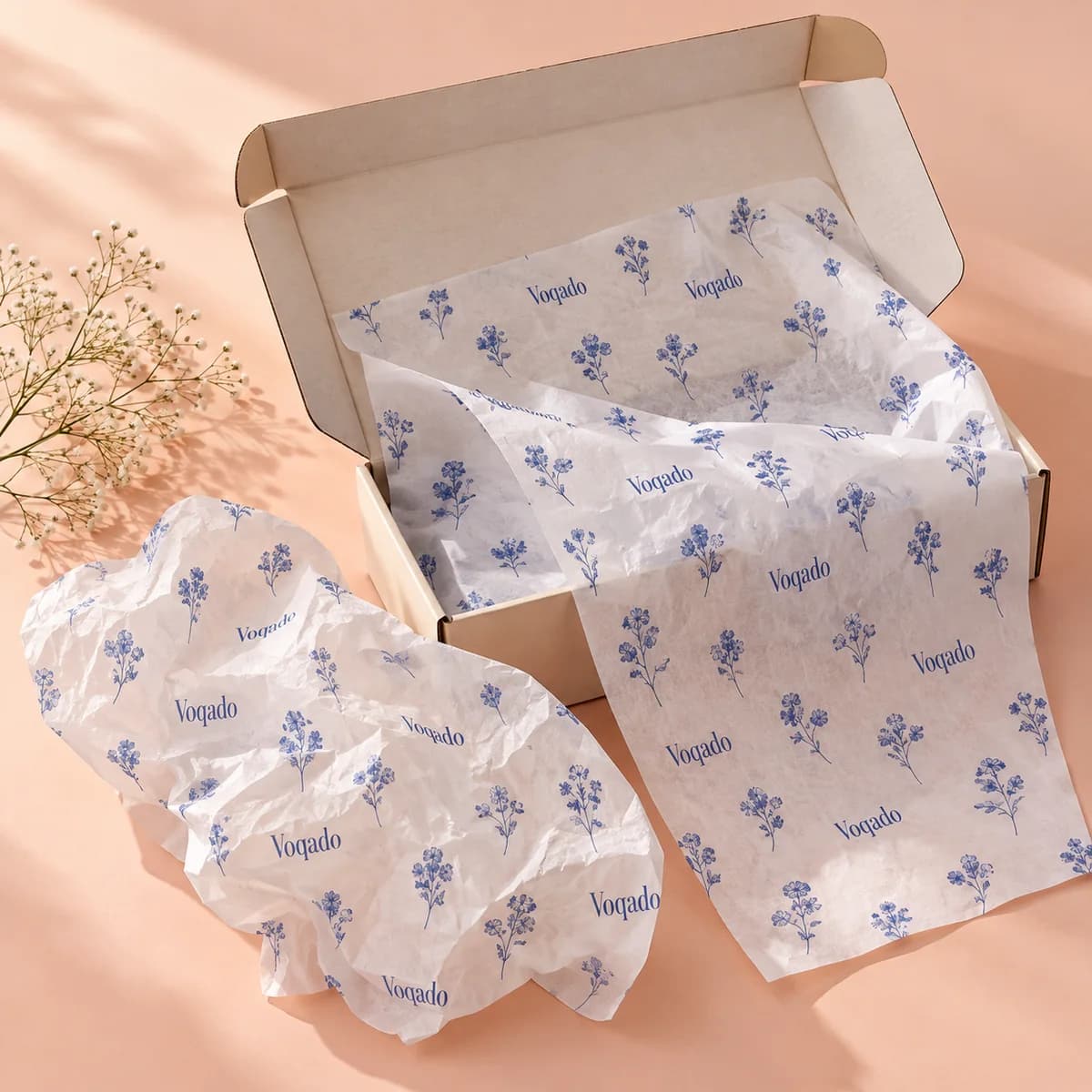
Tissue is printed with a repeating design, and the repeat has to tile: the right edge must continue into the left edge and the bottom into the top, so there is no visible join where the pattern restarts across the sheet.
That changes how you design. A single centered logo does not tile. A logo laid out on a grid, rotated or offset in alternating rows, does. Build the artwork as one tile and test it by duplicating the tile in a three by three block and looking for lines, gaps or accidental shapes forming between motifs.
- Keep the motif well inside the tile or deliberately bleeding across the tile edge, never accidentally touching it.
- Offset alternate rows so the eye does not read vertical stripes.
- Use one ink color if you want a clean, restrained look, since printing is one sided.
- Avoid very fine hairlines, because tissue is absorbent and thin strokes spread.
- Check the tile at the real printed scale, not zoomed in.
Tissue ships flat to prevent creases, so plan somewhere to store sheets flat too. Folded tissue arrives with a crease that shows through the wrap.
Where tissue does not help
Tissue is not cushioning. It does not absorb a drop, it does not stop a glass jar hitting a box wall, and it does not fill space in any structural sense. If a product needs protection, that is a separate decision: crinkle paper, a molded insert or a smaller box.
It also does not reduce shipping cost. Carriers bill on the greater of scale weight and volume divided by a published divisor, so tissue used to fill an oversized box adds weight without reducing the volume being billed. If tissue is in the box because the box is too big, the tissue is a symptom.
Making tissue feel considered rather than added
The difference between tissue that works and tissue that reads as filler is sequence. Decide what the customer sees in what order: the outside of the box, the inside of the lid, then tissue as a closed layer, then a card or sticker, then the product.
That means the tissue should be closed when the box opens. A sheet crumpled on top of a visible product does nothing. A sheet folded over the product and sealed with a sticker creates a second opening, which is the whole point.
- Fold the same way every time, so every customer gets the same package.
- Seal with a packaging sticker or a belly band rather than tape.
- Keep the color palette to the tissue, the sticker and the box, not four colors.
- If you use crinkle paper as well, keep it under the tissue, not on top of it.
- Photograph your own wrap and look at it the way a customer will.
Recyclability claims
Custom tissue here is 100 percent paper pulp and widely recyclable. If you want to say so on the box or in the insert card, keep the claim specific and qualified where needed. Environmental marketing claims should be truthful and substantiated, and a claim that a whole package is recyclable when only part of it is can mislead. Say what is recyclable rather than implying everything is.
Tissue paper checklist
- Decide the job: wrap, line or both, and set sheets per order from that.
- Multiply monthly orders by sheets per order and add a margin.
- Pick 18 pound as the default, 10 pound for drape, 30 pound for a premium feel.
- Build the artwork as a tile and test it in a three by three block.
- Use one ink color and avoid hairline strokes.
- Store sheets flat, because creases show through the wrap.
- Seal the wrap with a sticker or belly band so the tissue reads as a second layer.
- Keep recyclability claims specific to the material they describe.
Frequently asked questions
How many sheets of tissue paper do I need per order?
One sheet for a single wrapped item, two when you also line the base of the box, and two or three when several items are wrapped separately. Multiply your monthly order count by sheets per order and add a margin rather than ordering a round number.
What weight of tissue paper should I use?
18 pound is the general purpose choice: opaque enough to hide the product, strong enough for handling and good for print. 10 pound is lighter and translucent for a classic retail drape, and 30 pound feels closer to wrapping paper for heavier or premium items.
Does custom tissue paper have to be a repeating pattern?
It is printed as a seamless repeat, so a single centered logo is not the right artwork. Lay the motif out on a grid with offset rows, then duplicate the tile in a three by three block to check that no lines, gaps or unintended shapes appear at the joins.
Does tissue paper protect the product?
No. It is a presentation layer. It will not absorb a drop or stop an item hitting the box wall. If the product needs protection, use crinkle paper, a fitted insert or a smaller box, and keep tissue for the layer the customer sees.
Sources & specification notes
The references below support the relevant technical or product details in this guide. Examples and checklists are not claims of practical testing or universal supplier requirements. Confirm the current specifications for your chosen product before production.
- Federal Trade Commission: Green Guides ↗
Guidance on substantiating and qualifying environmental marketing claims such as recyclability on packaging.
- FedEx: What is dimensional weight? ↗
Supports the point that billed weight is derived from package volume, so filler does not reduce shipping cost.