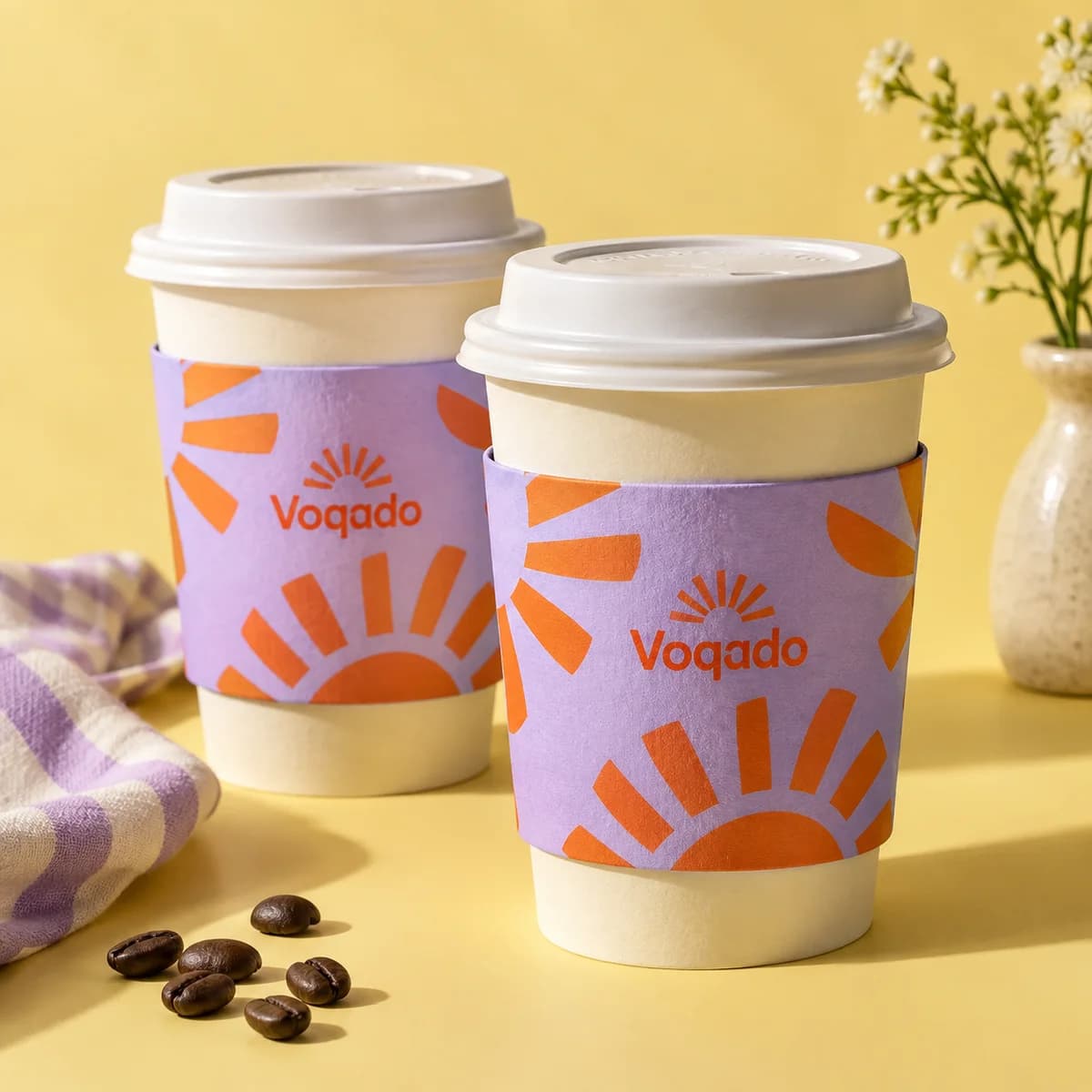
One size, and why that works
A sleeve is a tapered ring, not a tube. It grips by friction against the cup wall, so a small amount of size mismatch is absorbed by the taper and by the flex of the board. That is why a single sleeve works across 12, 16, 20 and 24 oz cups from most suppliers.
What it will not do is fit a cup it was never designed for. A 10 oz cup has a noticeably narrower body, and a double wall cup already has its own insulating layer and a larger outside diameter. If you serve 10 oz, test a sleeve on it before assuming, and if you serve double wall cups you probably do not need sleeves at all.
The practical rule is simple: order a small quantity, put a sleeve on every cup size you actually serve, and check that it neither slides down nor has to be forced.
Two materials, two different products
| Factor | Embossed paperboard | Corrugated kraft |
|---|---|---|
| Board | 18 pt SBS, embossed | E flute corrugated |
| Full surface | Front print | |
| Finishes | Matte, gloss, soft touch | None specified |
| Feel | Premium, textured | Familiar, utilitarian |
| Weight | 190 gsm white | 190 gsm white or 135 gsm natural kraft |
| Minimum | From 250 | From 25 |
| Suits | Speciality cafes, brand led | Everyday service, small runs, events |
The embossed paperboard sleeve is the one to choose when the cup is part of your brand presentation and you want a finish. Full surface printing means the whole visible band is available, and soft touch in particular reads as premium the moment a customer picks up the cup.
The corrugated kraft sleeve is the everyday workhorse. The fluted layer is what does the insulating, the front print area is enough for a logo and a line, and a 25 unit minimum makes it realistic for a pop up, a market stall or a one off event.
Designing for a curve and a seam
A sleeve is flat when printed and curved when used, and it has a glued seam. That changes the layout.
The front is the area facing a customer holding the cup. Because the sleeve wraps, only about a third of the circumference is visible from any one angle, so a wordmark that spans the full length is readable from nowhere. Keep the primary mark compact and centered in one face.
- Keep the logo within the central third of the printed band.
- Repeat a small mark rather than stretching one large mark around the wrap.
- Keep type clear of the seam, because the overlap distorts anything crossing it.
- Allow for the slight loss at the top and bottom edges where the sleeve flexes.
- Remember corrugated kraft is front print only, so plan one face, not a wrap.
On the corrugated option, the fluted surface produces faint banding across large flat areas of solid color. Bold, simple artwork survives it; fine gradients and hairline rules do not.
Hot and cold, and what the sleeve does not do
Sleeves suit hot and cold drinks: they keep heat in on a hot cup and keep condensation off the hand on a cold one. They are an insulating band, not a lid and not a seal, and they do not make a single wall cup leak proof or improve its liquid barrier.
If you serve very hot drinks in single wall cups, the sleeve is the insulation. If you already use double wall cups with built in insulation, a sleeve is a branding choice rather than a functional one, and a printed cup is usually the better spend.
Sleeves as small format packaging
A sleeve is a cheap way to brand something you did not have printed. That logic extends beyond cups. A printed band around a soap, a candle, a folded shirt or a bundle of cards does the same job: it makes an unbranded item recognizably yours without redesigning the packaging.
For that use the right product is a belly band rather than a cup sleeve, because widths from 2 to 7 in and lengths from 4 to 18 in cover far more objects, and a peel and seal adhesive strip closes it without extra glue. Think of the cup sleeve as the version tuned to one specific object.
Quantity and reordering
Sleeves are consumed one per drink, so quantity follows cup volume rather than order count. Count the single wall hot cups you go through in a month, assume a sleeve on most of them, and add a margin for waste and for customers who take two.
That also makes sleeves a good place to run a seasonal design, because the stock turns over fast enough that a dated design does not sit in a cupboard for a year. Keep the base design constant and change one element, so regulars still recognize the cup.
Coffee sleeve checklist
- Confirm the sleeve fits every cup size you actually serve, including the smallest.
- Skip sleeves entirely if you use double wall cups, and print the cup instead.
- Choose embossed paperboard for finish and full surface print, corrugated kraft for cost and small runs.
- Keep the primary mark inside the central third of the band.
- Keep type clear of the glued seam.
- Use bold simple artwork on corrugated, not gradients or hairlines.
- Forecast quantity from monthly single wall cup usage, not from order count.
- Consider a belly band when the object is not a cup.
Frequently asked questions
What size are custom coffee sleeves?
One size fits most 12 to 24 oz cups. A sleeve is a tapered ring that grips by friction, so the flex of the board absorbs the small differences between cup sizes. Test a sample on every cup you serve, especially anything smaller than 12 oz.
Which coffee sleeve material should I choose?
Choose 18 pt embossed paperboard when the cup is part of your brand presentation, because it allows full surface printing and matte, gloss or soft touch finishes. Choose E flute corrugated kraft for everyday service and small runs, with a front print area and a 25 unit minimum.
Do I need sleeves if I use double wall cups?
Usually not. Double wall cups have built in insulation, so a sleeve becomes a branding layer rather than a functional one. If the cup is already printed, the sleeve adds cost and waste without adding much.
Can I print a design all the way around a coffee sleeve?
On the embossed paperboard option you can print the full surface, but only about a third of the wrap faces a customer at any moment, so a mark stretched around the circumference reads from nowhere. Keep the primary mark compact and repeat smaller elements.
Sources & specification notes
The references below support the relevant technical or product details in this guide. Examples and checklists are not claims of practical testing or universal supplier requirements. Confirm the current specifications for your chosen product before production.
- TAPPI T 811: Edgewise compressive strength of corrugated fiberboard ↗
Defines the edge crush test for corrugated board, cited for the properties of the E flute used in corrugated sleeves.
- Federal Trade Commission: Green Guides ↗
Guidance on making truthful and substantiated recyclability claims on single use paper packaging.