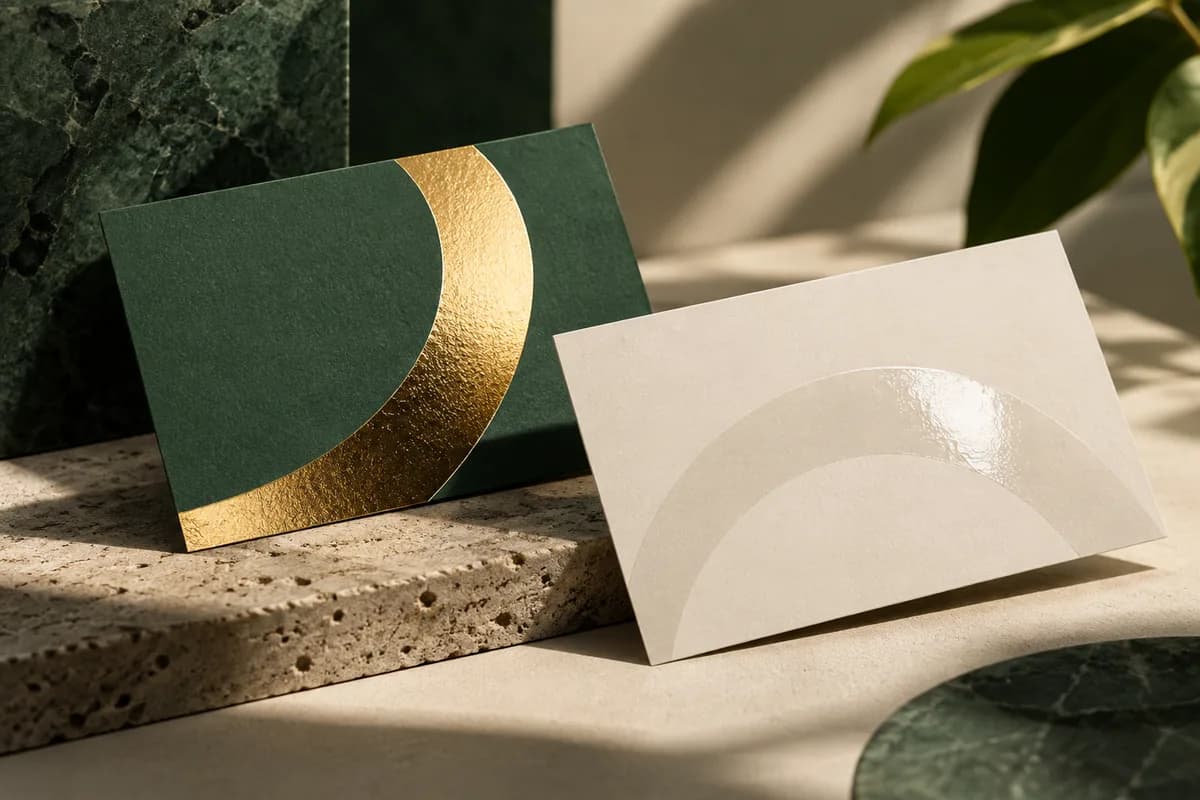
How does foil stamping work?
In hot foil stamping, a roll of foil sits between a heated metal die and the card. The die presses down, and where it touches, the decorative layers release from the foil's carrier film and bond to the card through heat and a defined contact pressure. KURZ, a foil manufacturer, notes that contact time and temperature together control how firmly the foil sticks and how crisp its edges are.
Foil can be gold, silver, copper, colored or holographic, and it covers whatever is underneath, so it reads as a solid metal shape. Some digital processes apply foil to toner instead of using a die, which is quicker to set up for short runs but can give a slightly different edge and texture.
How does spot UV work?
Spot UV uses a clear coating made of monomers and oligomers mixed with a photoinitiator. It is printed only where you want shine, then passed under UV lamps. RadTech explains that the photoinitiator absorbs the light and starts crosslinking, which turns the liquid into a hard film, usually in less than a second of exposure and without solvents. Applied thickly, it stands slightly proud of the surface, which is why some printers sell it as raised or embossed gloss.
Because the coating is transparent, the printed color shows through. Its impact comes from contrast: glossy shapes over a matte or soft touch background.
Foil vs spot UV: how do they compare?
| Feature | Foil stamping | Spot UV |
|---|---|---|
| What it adds | Metallic or colored layer | Clear gloss layer |
| Color | Replaces the ink beneath | Shows the ink beneath |
| Feel | Smooth, slightly pressed in | Smooth, slightly raised |
| Best background | Dark or matte stock | Matte or soft touch stock |
| Artwork | Separate foil mask | Separate gloss mask |
| Minimum effect text (catalog spec) | 10pt | 10pt |
| Listed start price, 100 cards | $29.99 foil accent | $28.99 embossed gloss |
Prices come from the current Voqado price list and change with quantity and options. In that catalog, spot UV is sold as embossed gloss, and raised foil, which adds height to the metallic layer, starts at $34.99 for 100.
The two finishes also age differently. Foil can scuff on high points if cards rub together in a pocket, while cured UV coating is hard but can crack if the card is bent sharply. Both hold up well in a normal wallet or holder. Lead time can differ too, because foil needs a die or a dedicated foiling pass and spot UV needs its own coating pass, so allow for an extra production step when you plan an event or launch date.
Which finish looks more premium?
Neither wins by default. Foil reads instantly as luxury because metal catches light from any angle, which suits jewelry, hospitality, law and finance brands. Spot UV is quieter: it can be seen best when the card is tilted, which suits minimalist, photographic and design led brands. Choose foil when you want the logo to be a different color from the print. Choose spot UV when you want the print itself to look richer.
How do you set up artwork for foil or spot UV?
Both finishes need a separate mask file or layer that shows exactly where the effect goes, usually as solid 100 percent black vector shapes on a white background, aligned to the print file. Keep effect text at or above the minimum size, 10pt on the foil accent business cards and embossed gloss business cards sold here, and avoid hairlines that may break up. Keep effects inside the safety margin and away from trimmed edges, where spot gloss can peel.
Small registration shifts between print and finish are normal, so avoid designs that depend on a foil edge meeting a printed edge perfectly. The guide to setting up spot gloss artwork walks through masks step by step, and exporting a print ready PDF covers the file handoff.
What about raised foil and embossing?
Raised foil combines metallic color with a tactile lift, and blind embossing adds relief with no color at all. Each has different artwork limits and costs. For a side by side view, read embossed versus raised foil.
Where on the card should the effect go?
Use one effect on one focal element. A foil logo on the front with plain print on the back is a classic layout, and it keeps the contact block in ordinary, high contrast ink that stays readable when light hits the card. Spot UV works well on a logo, a pattern or a photo that you want to pop off a matte background. Covering most of the card in an effect usually weakens it, because the contrast that makes it special disappears. Many foil and gloss products apply the effect to the front only, so check before you design the back.
How do you choose between foil and spot UV?
- Want a metallic color: choose foil
- Want the print to shine through: choose spot UV
- Using a matte or soft touch base: either gives strong contrast
- Fine text or detail: check the minimum size first
- Tight budget: compare the full configured price
- Always approve a proof of the effect area before production
Frequently asked questions
Is spot UV cheaper than foil?
Often slightly, but it depends on the printer, quantity and setup. On the current price list, embossed gloss, the catalog name for spot UV, starts at $28.99 for 100 cards and foil accent starts at $29.99 for 100. Raised foil costs more. Compare fully configured quotes, because paper, sides and corners also change the total.
Can you combine foil and spot UV on one card?
Some printers offer both effects on one card, using separate masks for each, but it adds setup, cost and registration risk. Many designs work better with one effect used on one focal element. If you want both, ask the printer whether the combination is supported on your chosen stock and approve a proof that shows each effect area clearly.
What is the minimum text size for foil or spot UV?
It depends on the process. The foil accent and embossed gloss cards in this catalog ask for effect text of 10pt or larger so it stays readable in the reflective finish. Very thin lines and small counters can fill in or break up, so keep strokes generous and confirm the supplier's minimum line weight before finalizing artwork.
Does spot UV peel or crack?
Cured UV coating is hard and durable on a flat card, but it can crack or peel where the card is folded, scored or trimmed through the coating. That is why printers ask you to keep spot gloss inside the safety margin and away from edges. Placing gloss on a smooth coated or laminated base also helps it bond well.
Sources & specification notes
The references below support the relevant technical or product details in this guide. Examples and checklists are not claims of practical testing or universal supplier requirements. Confirm the current specifications for your chosen product before production.
- KURZ: Hot stamping FAQ ↗
Foil manufacturer description of hot stamping: layers released from a carrier and bonded to the substrate by a heated die and defined contact pressure.
- RadTech: The UV and EB curing process ↗
Industry association explanation of UV curing: monomers, oligomers and a photoinitiator that, exposed to light, starts crosslinking, with most systems solvent free and curing in under a second.