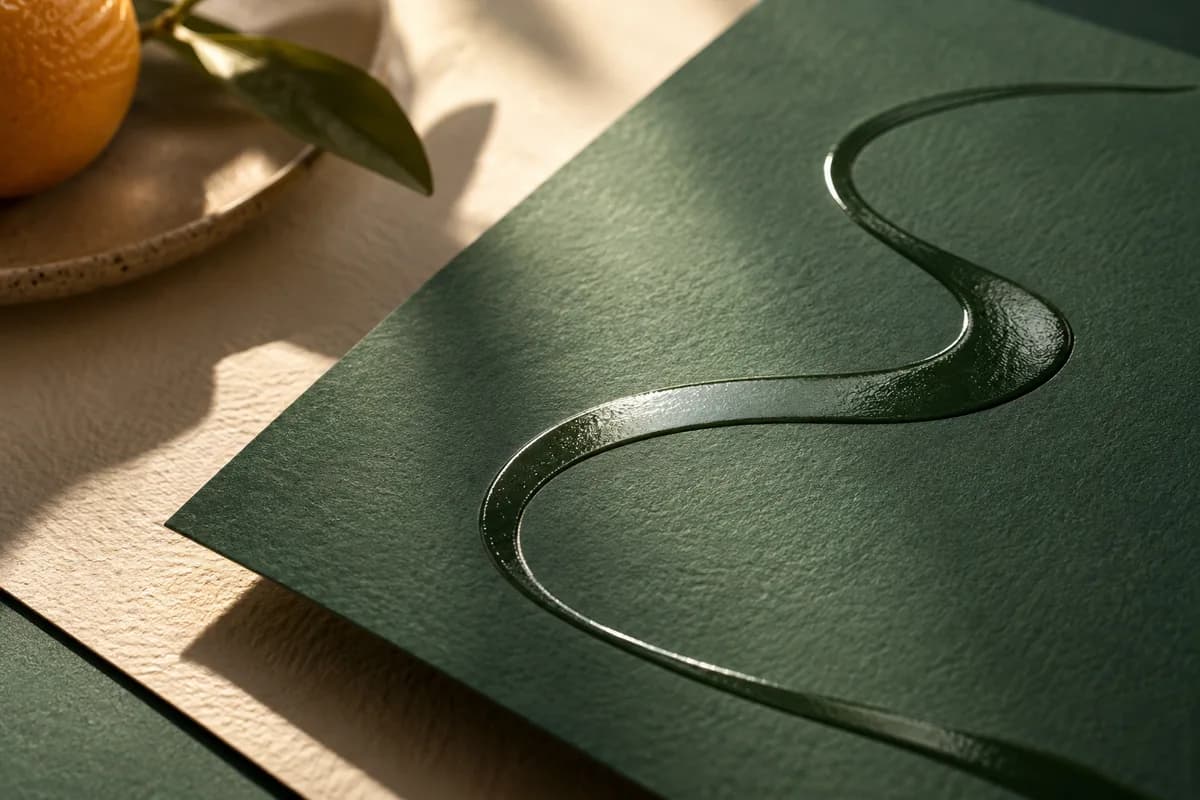
What is spot gloss on a business card?
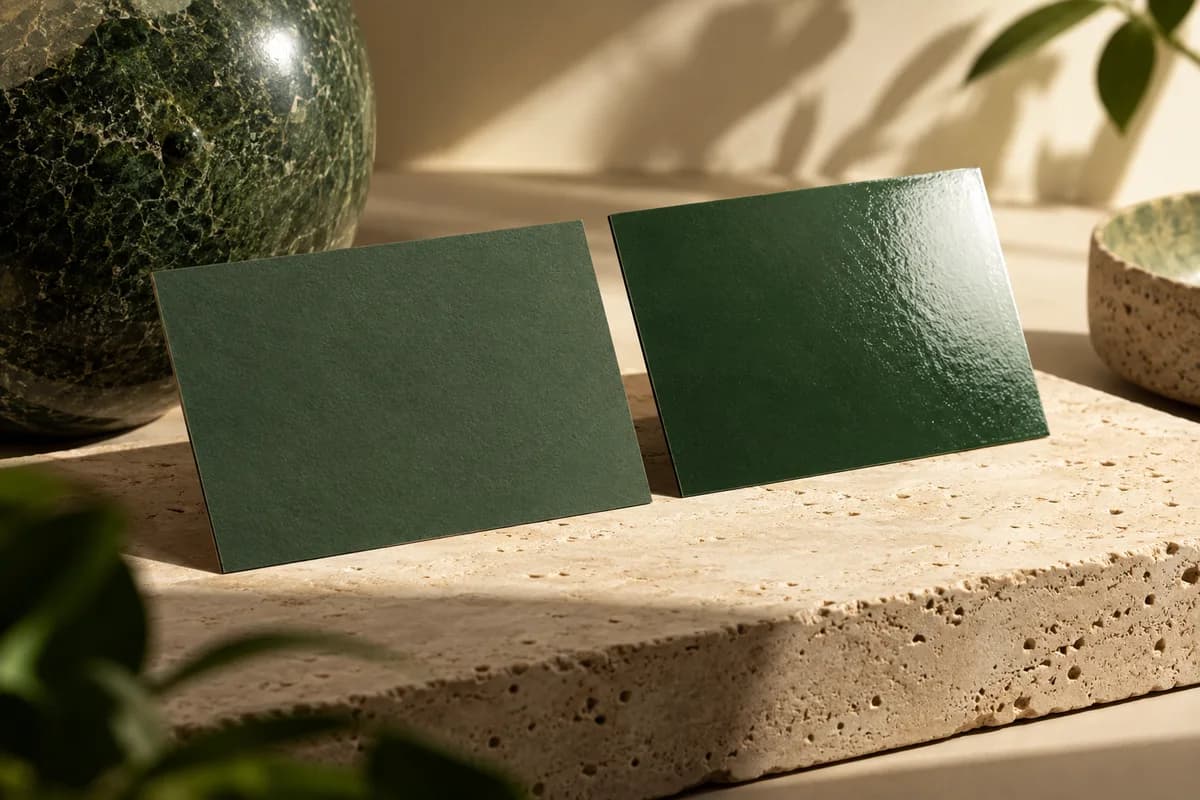
Spot gloss, also called spot UV, is a transparent coating printed over chosen parts of the design after the ink. The coated areas look wet and catch the light, while the rest of the card stays flat. When the coating is built up thick enough to feel raised, printers often call it embossed gloss or raised spot UV.
The effect works because of contrast between surfaces. It is strongest on a matte or soft touch base and weakest on a glossy base, where there is little difference in sheen. It can highlight a logo, a pattern or a single word, but it does not add color. Whatever sits under the gloss is still printed in ordinary ink.
How do you set up a spot gloss mask file?
Printers need two pieces of artwork: the normal full color design and a separate mask that shows where the coating goes. The mask is usually built as solid black shapes on white, or as a named spot color layer, aligned exactly with the color artwork at the same size and bleed. Your printer's template will say which method it expects.
The Ghent Workgroup, which publishes best practice specifications for print files, developed the Processing Steps approach for nonprinting objects such as varnish and cut lines in a PDF, later published as ISO 19593 part 1. Whatever method your printer uses, follow its naming rules so the finishing layer is never mistaken for printing ink.
| File element | What it contains | Common requirement |
|---|---|---|
| Color artwork | Full design in CMYK | Same size, bleed and position as the mask |
| Gloss mask | Solid shapes where coating goes | 100 percent black or a named spot layer, no tints |
| Reference preview | Flattened image of intended result | For discussion only, not for production |
| Trim and safe area | Template guides | Keep gloss inside the safe area |
Keep the mask free of gradients, soft shadows and transparency. A coating is either on or off at any point, so a 40 percent gray in the mask has no clear meaning to the press.
How small can spot gloss detail be?
Fine detail is the hardest part of spot gloss. The coating spreads slightly and has to register with the ink below, so hairlines and tight gaps may fill in or shift. Limits vary by process and printer, which is why the supplier specification is the one to follow.
One published product rule is useful as a reference. The specifications for embossed gloss business cards say glossy text should be 10pt or larger, the gloss should stay inside the safety margin away from edges, and the finish is applied to the front only. For comparison, MOO's general business card guidelines ask for printed text at 8pt or higher and lines of 0.5pt or thicker, which suggests a finishing layer can need more room than ordinary ink. Check the exact limits with your own printer.
Should essential information be in spot gloss?
No. Spot gloss is visible mainly when light hits the card at an angle. Under flat lighting, or in a photo taken straight on, a gloss only element can almost disappear. Put the name, phone number, email and web address in printed ink with strong contrast, and use gloss to reinforce something that is already visible.
A good test is to view the color artwork with the gloss preview switched off. If the card still works as a contact card, the gloss is decoration. If something important vanishes, move it into the printed layer.
Where does spot gloss work best on a card?
Spot gloss works best on one clear focal point: a logo, a monogram, a simple pattern or a single short word. It suits dark or saturated matte backgrounds, where the shine reads strongly. It is less effective across large areas, because a fully glossed card loses the contrast that makes the effect interesting.
Consider handling as well. The gloss is a surface layer, so plan it away from folds, edges and areas where a card will be written on. The guide to foil vs spot UV business cards compares gloss with metallic foil, and the matte vs gloss business cards guide explains how each base surface changes the look.
What belongs on a spot gloss artwork checklist?
- Choose one focal element for the gloss.
- Build the mask as solid shapes in 100 percent black or a named spot layer.
- Align the mask and color artwork at the same size and bleed.
- Keep glossy text at the printer's minimum size or larger.
- Keep gloss inside the safe area and away from edges.
- Keep every contact detail readable with no gloss at all.
- Label files clearly and remove old mask versions.
How do you review a spot gloss proof?
A screen proof can show position but not shine. Check alignment by overlaying the mask on the color artwork at actual size, then compare it with the printer's proof. Confirm which side receives the coating, and confirm that no stray shapes remain in the mask from earlier versions.
When the design changes, update both files together and repeat the alignment check. A physical sample of a similar finish is the best way to judge how the effect will look in normal light, and the business card proof checklist covers the rest of the approval.
Frequently asked questions
Is spot gloss the same as spot UV?
In everyday print buying the terms are used interchangeably. Spot UV refers to a varnish cured with ultraviolet light, which is the most common way to apply spot gloss. Some printers also offer a raised version, called embossed gloss or raised spot UV, where a thicker coating creates texture you can feel. Ask which process your printer uses and how thick the layer is.
What color should a spot gloss mask be?
Most printers want solid 100 percent black shapes on a white background, or a named spot color layer, marking exactly where the coating goes. Avoid tints, gradients, drop shadows and transparency, because the coating is either applied or not at each point. Always follow the template or file guide from your printer, since naming and color conventions vary.
Can spot gloss go on both sides of a business card?
Some processes allow it, but many products apply the finish to the front only. The published specification for one embossed gloss card, for example, lists a front only finish with ordinary printing available on the back. Check the product specification before you design a two sided gloss layout, and ask the printer if you need it on both faces.
Does spot gloss work on glossy paper?
It usually looks weak on glossy paper, because the difference in shine between the coated and uncoated areas is small. The effect is strongest on matte or soft touch stock, where the flat surface makes the glossy areas stand out. If you want visible contrast, pair spot gloss with a matte base and a darker or saturated background.
Sources & specification notes
The references below support the relevant technical or product details in this guide. Examples and checklists are not claims of practical testing or universal supplier requirements. Confirm the current specifications for your chosen product before production.
- Ghent Workgroup: Processing Steps ↗
Describes a standard way to store nonprinting objects such as varnish and cut lines in PDF files, published as ISO 19593 part 1.
- MOO: business card design guidelines ↗
Product example: text at 8pt or higher and lines of 0.5pt or thicker; not a universal requirement.