What does GSM measure on business card stock?
GSM stands for grams per square meter. It tells you how much one square meter of the paper weighs, whatever the size of the finished piece. A 350 GSM stock means one square meter of that sheet weighs 350 grams. The number describes mass per area, which makes it useful for comparing how much material is in a sheet and for estimating shipping weight.
GSM does not tell you how thick the card is, how stiff it feels or how well a pen writes on it. Two stocks at the same grammage can feel quite different because one is dense and compact and the other is bulky and airy.
What does pt mean for business cards?
Pt means points, and in North American paper specifications one point equals one thousandth of an inch. Neenah Paper defines caliper as the thickness of a sheet in thousandths of an inch, also called points or mils. So 14 pt is 0.014 inch, 16 pt is 0.016 inch and 32 pt is 0.032 inch.
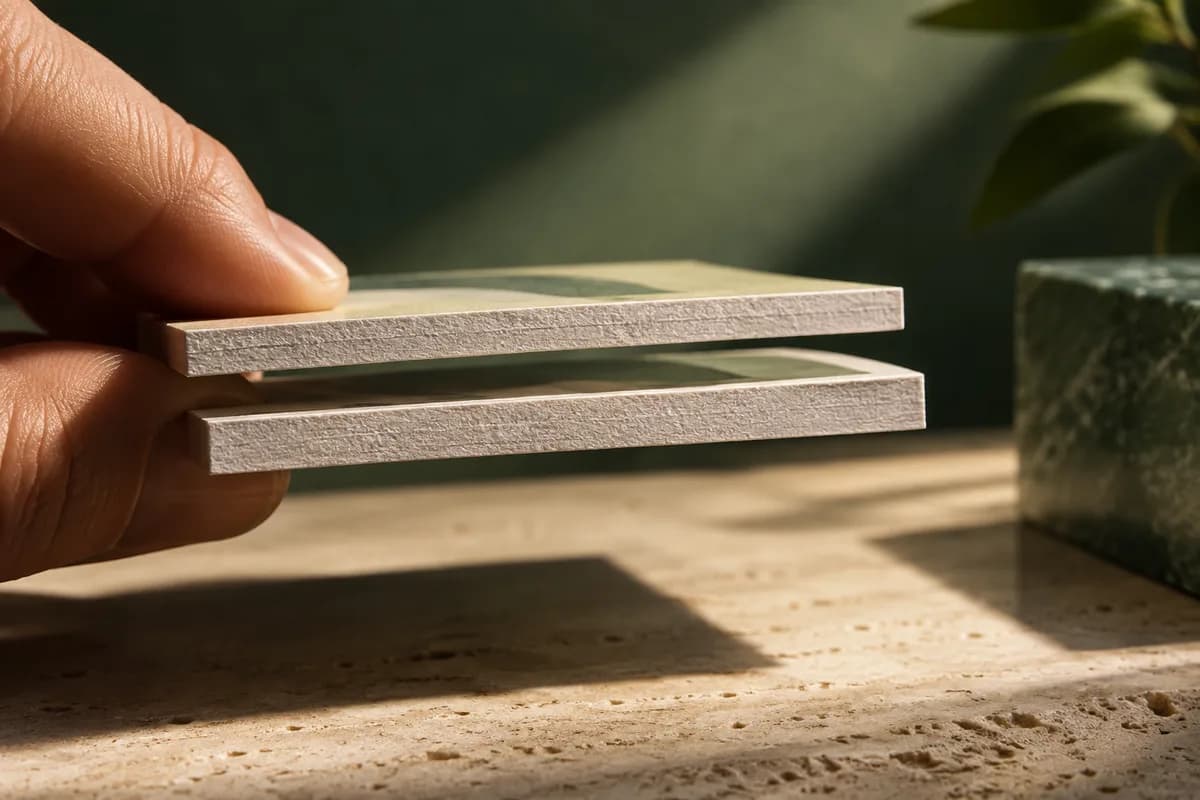
Caliper is what you feel when you pinch a card between your fingers. It is the number that matters most when people describe a card as thin, sturdy or thick. The guide to 14pt vs 16pt business cards compares the two most common thicknesses in more detail.
Why is there no universal GSM to pt conversion?
Thickness depends on grammage and density together. Paper made from compressed fibers packs more mass into less thickness, while bulky or textured paper spreads the same mass over a thicker sheet. Coatings and laminates add to both mass and caliper, and pasted or duplexed stocks add more again.
The table shows why a single conversion fails. The pt and GSM columns come from different kinds of source, so read them as separate facts, not as equivalents.
| Measure | What it describes | Unit | Where it helps |
|---|---|---|---|
| GSM (grammage) | Mass per area | Grams per square meter | Shipping weight, material comparison |
| Pt (caliper) | Sheet thickness | Thousandths of an inch | Feel, rigidity, holder fit |
| Basis weight (lb) | Mass of a 500 sheet ream at the grade basic size, 20 x 26 inches for cover | Pounds | Comparing within one US grade |
| Finish | Surface treatment | Named process | Writing, glare, color |
A chart that maps 350 GSM to 16 pt may be accurate for one mill's stock family and wrong for another. Treat any conversion as a product fact for a named stock, never as a rule.
How thick are common business card stocks?
Many printers describe their everyday card as 14 pt, and premium stocks run thicker. Within a single catalog, the pt figures give a fair comparison. Standard business cards use 14pt cardstock, Premium Plus cards are 18pt and ultra thick cards are 32pt. Multiply by 0.001 to get inches: a 32pt card is 0.032 inch, a little more than twice the 14pt figure.
When a supplier lists only GSM, ask for the caliper of the finished card. When a supplier lists only pt, ask for the GSM and the stock name. That way the comparison uses the same measure on both sides.
How do you estimate the weight of 500 cards from GSM?
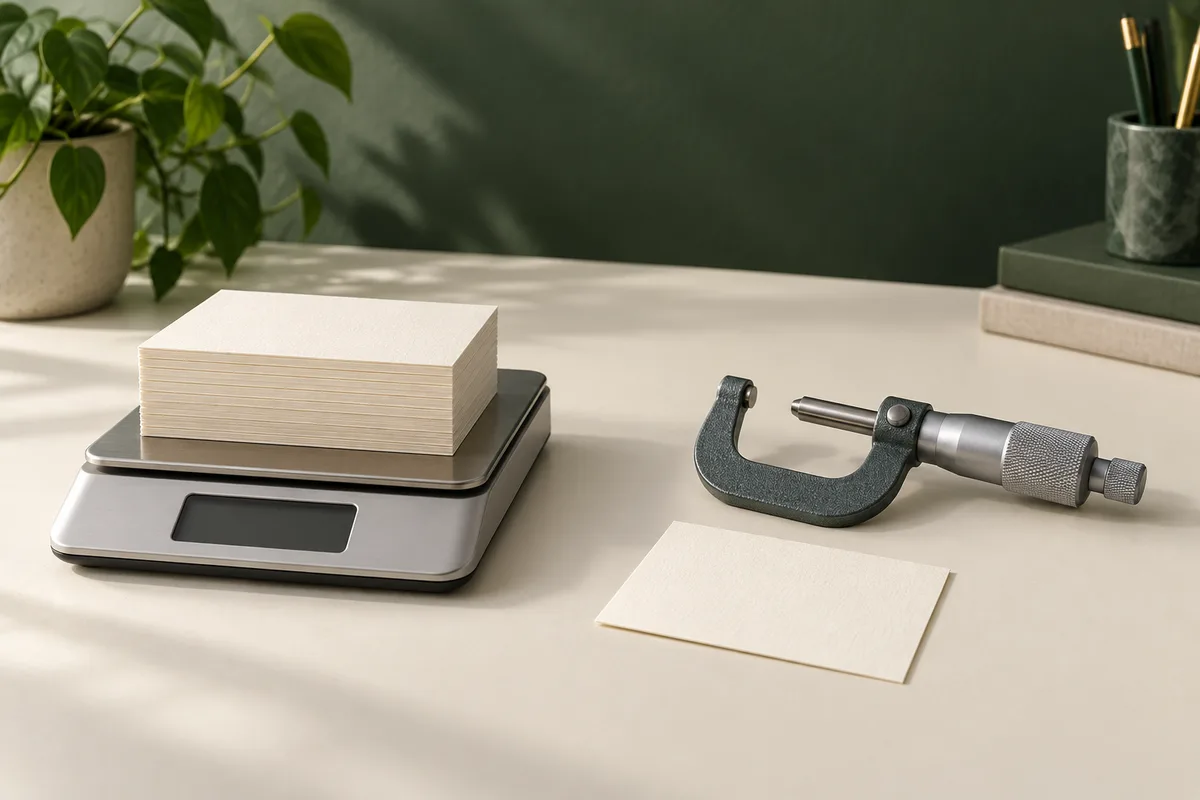
GSM is the right number for weight. Convert the card dimensions to meters, multiply them to get the area, then multiply by the GSM. For an illustrative 3.5 x 2 inch card, which is 88.9 x 50.8 mm, on a stated 350 GSM stock:
- Area per card: 0.0889 x 0.0508 = 0.00451612 square meters.
- Mass per card: 0.00451612 x 350 = about 1.58 grams.
- Mass for 500 cards: about 790 grams, or roughly 0.79 kg.
- With a separately weighed 120 gram box: about 910 grams.
This estimate covers the paper only. It leaves out trim waste, ink, coatings and laminate unless the stated GSM already includes them, and rounded corners reduce the area slightly. The paper weight calculator repeats this math for any size, grammage and quantity. The result still says nothing about thickness, so you cannot call that 350 GSM stock 16 pt without a caliper specification for the same stock.
How should you compare two quotes that use different units?
Imagine one quote lists 350 GSM uncoated and another lists 16 pt matte for the same size and quantity. Neither is automatically thicker. Ask each supplier for the missing figure, the exact stock name and whether the finish adds to the stated caliper. Record the answers next to price so the comparison is fair.
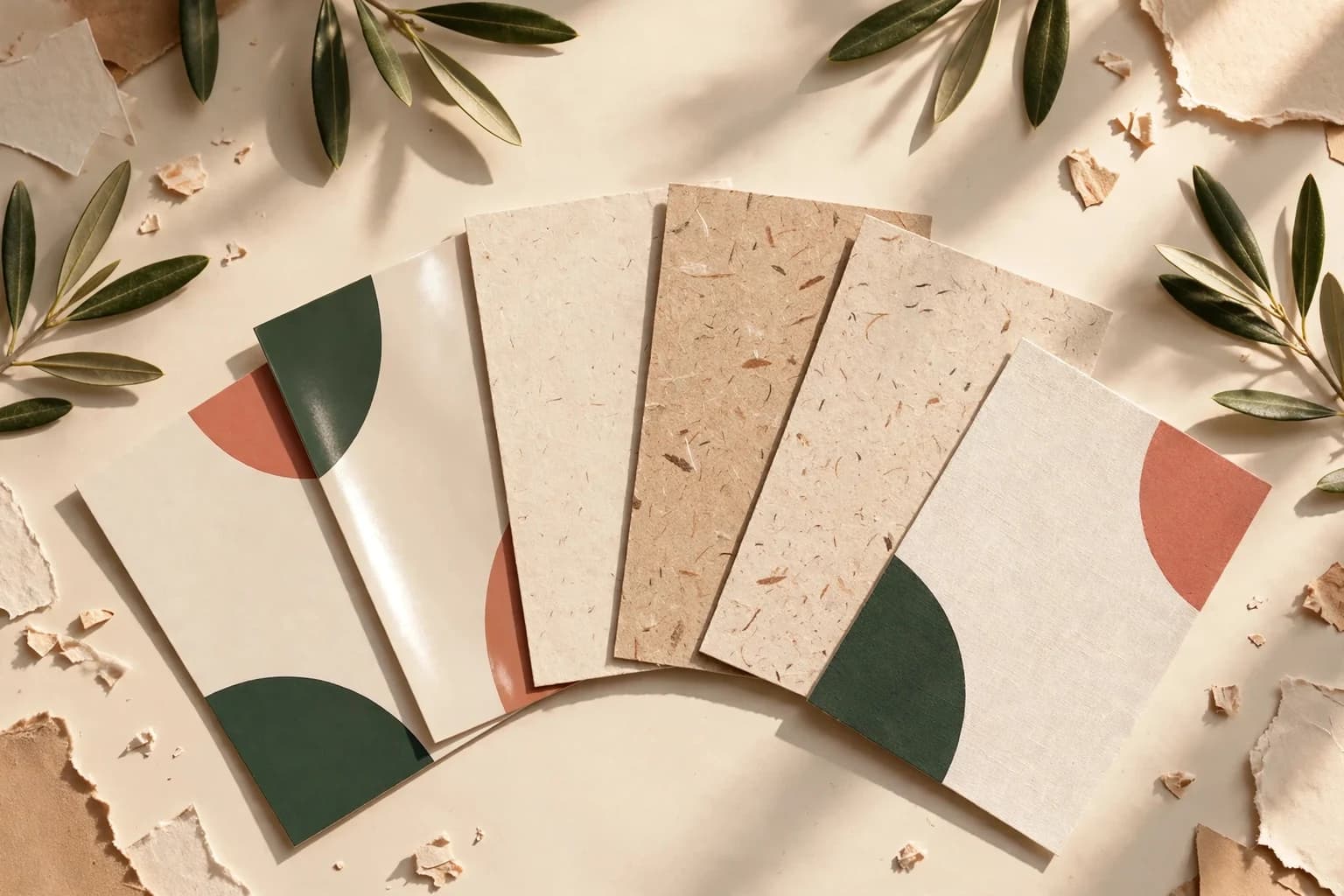
A physical sample settles what numbers cannot. The business card sample kit puts 16 papers, finishes and shapes side by side so you can feel the difference between thicknesses before ordering.
How do you compare paper weight and thickness quickly?
- Read GSM as mass per area, not thickness.
- Read pt as caliper, one thousandth of an inch per point.
- Ask for both figures and the exact stock name on every quote.
- Ask whether coatings or laminate are included in the stated caliper.
- Use GSM for shipping estimates and pt for feel and holder fit.
- Check a finished sample before choosing a thicker stock.
Does a thicker card always feel better?
Not always. A thicker card feels more substantial and resists bending, but it can be harder to fit in some holders and wallets, and very thick stocks may limit finishes or shapes. Choose thickness for the way the card will be used. For frequent handouts a sturdy everyday stock works well, while a card meant to make a strong first impression can justify a heavier option. The broader paper stock guide explains how thickness combines with finish and texture.
Frequently asked questions
Is 350 GSM the same as 16 pt?
Not reliably. Some stock families land near that pairing, but the relationship depends on density, coating and construction. A bulky uncoated 350 GSM sheet can be thicker than a dense coated one at the same grammage. Ask the supplier for the caliper of the exact finished card rather than trusting a general conversion chart found online.
How thick is a 14 pt business card in inches and millimeters?
A point is one thousandth of an inch, so a 14 pt card is 0.014 inch thick. That works out to about 0.36 mm, because one inch equals 25.4 mm. A 16 pt card is 0.016 inch, or about 0.41 mm, and a 32 pt card is 0.032 inch, or about 0.81 mm. Finishes can add slightly to the measured caliper.
Why do US printers use pt while other countries use GSM?
North American paper trade practice describes cover stock by basis weight and caliper, so card thickness is often quoted in points. Much of the rest of the world describes paper by grammage in grams per square meter. Many suppliers now list both. When they do not, ask for the missing figure so you compare like with like.
Does a higher GSM mean a stiffer business card?
Usually a higher grammage within the same stock family means a thicker, stiffer card, but across different papers it is not guaranteed. Stiffness depends on fiber, density, coating and caliper together. Laminated or pasted cards can feel far more rigid than their grammage suggests. A physical sample is the most dependable way to judge stiffness.
Sources & specification notes
The references below support the relevant technical or product details in this guide. Examples and checklists are not claims of practical testing or universal supplier requirements. Confirm the current specifications for your chosen product before production.
- Neenah Paper: caliper definition on a product specification page ↗
Defines caliper as sheet thickness in thousandths of an inch (points or mils). Product values are not Voqado specifications.
- Neenah Paper: basis weights reference ↗
Defines basis weight as the weight of a 500 sheet ream at a standard size, with 20 x 26 inch as the cover basic size, and lists g/m2 equivalents.
- NIST: SI units ↗
Lists the kilogram and meter as SI base units and area (m2) as a derived unit, the basis of grams per square meter.