Three units, three questions
| Unit | What it measures | Where you see it at Voqado |
|---|---|---|
| pt (points, caliper) | Thickness, in thousandths of an inch | Business cards 14 pt to 32 pt, bookmarks 16 pt, boxes 19 pt, coasters 56 pt |
| gsm (g/m²) | Mass of one square meter | Kraft mailers 100 gsm, paper shopping bags about 120 gsm, a 16 pt glossy save the date at 265 gsm |
| lb text and lb cover | Weight of a 500 sheet ream at the family basis size | Booklet pages 60 lb to 100 lb text, booklet covers 80 lb to 130 lb cover |
The 80 lb trap
Pounds are where buyers get caught. Text paper is weighed as a ream of 25 × 38 inch sheets, and cover paper as a ream of 20 × 26 inch sheets. A smaller basis sheet means fewer square inches per pound, so the same number means a much heavier sheet on the cover scale. That is why 80 lb cover is almost twice as heavy as 80 lb text. Converting each basis size to grams per square meter gives the multipliers below.
| Booklet stock as listed | Paper family | Approximate gsm |
|---|---|---|
| Budget Uncoated, 60 lb text | Text | 89 |
| Budget Glossy or Matte, 70 lb text | Text | 104 |
| Standard Matte, Glossy, Uncoated or Recycled, 80 lb text | Text | 118 |
| Standard Plus, 100 lb text | Text | 148 |
| Premium Matte or Glossy, 80 lb cover | Cover | 216 |
| Premium Plus, 100 lb cover | Cover | 270 |
| Deluxe Glossy, 130 lb cover | Cover | 352 |
The arithmetic: one pound per text ream works out to about 1.48 gsm, and one pound per cover ream to about 2.70 gsm. Never compare a text weight with a cover weight by the pound number alone. The saddle stitch booklets offer every text weight above for the inside pages and add the cover weights for a separate cover; self cover booklets use the same text stock throughout.
Why 16 pt can be 265 gsm or 350 gsm
Thickness and mass do not convert. Two stocks on our own listings prove it. The glossy option on save the date cards is listed as 265 gsm at 16 pt, coated on one side. The pearl option on itinerary cards is listed as 350 gsm, also at 16 pt. Same thickness, about a third more mass, because fiber, coating and how tightly the sheet is pressed all differ. If a printer quotes only gsm, you still do not know how thick the card will feel. Ask for the caliper.
The thickness ladder
| Thickness | Inches | Voqado products specified at it | How it behaves |
|---|---|---|---|
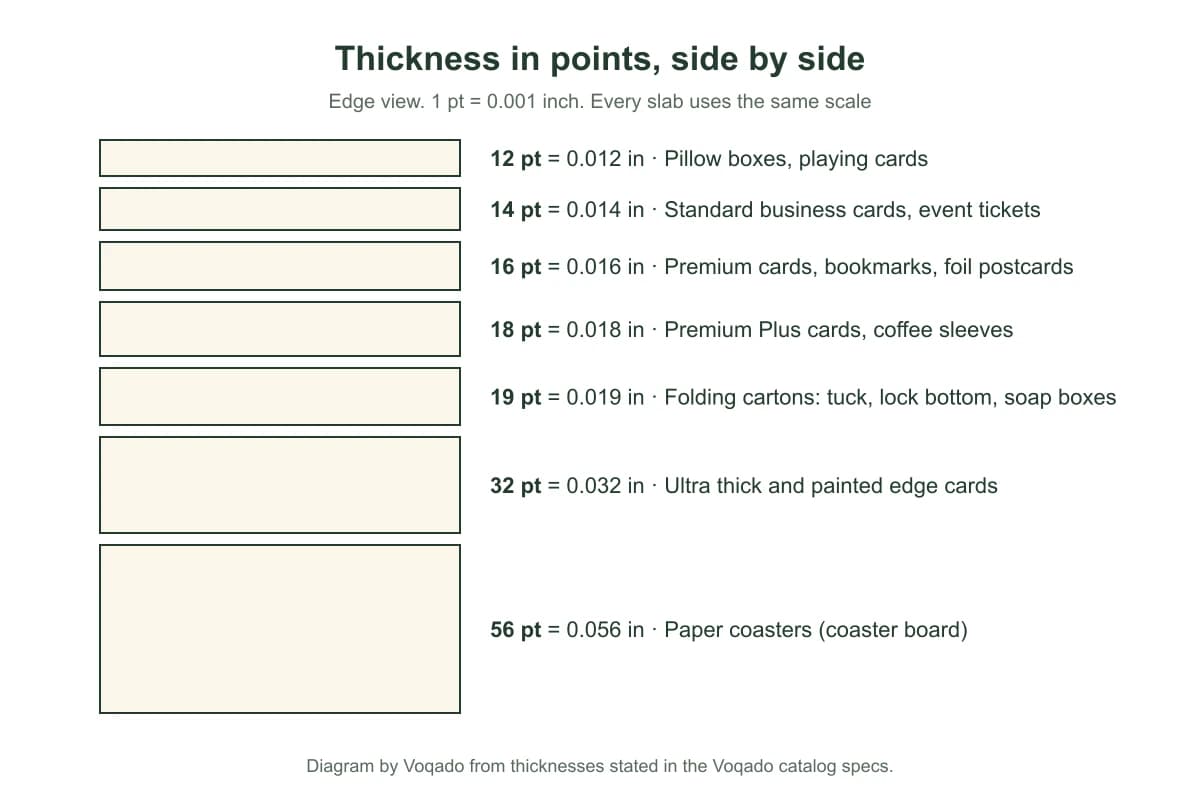
| 12 pt | 0.012 | Pillow boxes, playing cards, some gift card holders | Folds and curves easily |
| 14 pt | 0.014 | Standard business cards, event tickets, some hang tags | The everyday card; bends if you flex it |
| 16 pt | 0.016 | Premium thickness business cards, bookmarks, raised foil postcards, gift card boxes | Noticeably stiffer in the hand |
| 18 pt | 0.018 | Premium Plus business cards, embossed coffee sleeves | Stiff; resists bending in a wallet |
| 19 pt | 0.019 | Reverse tuck, lock bottom, slide open, soap and chocolate bar boxes | Folding carton board that holds a crease |
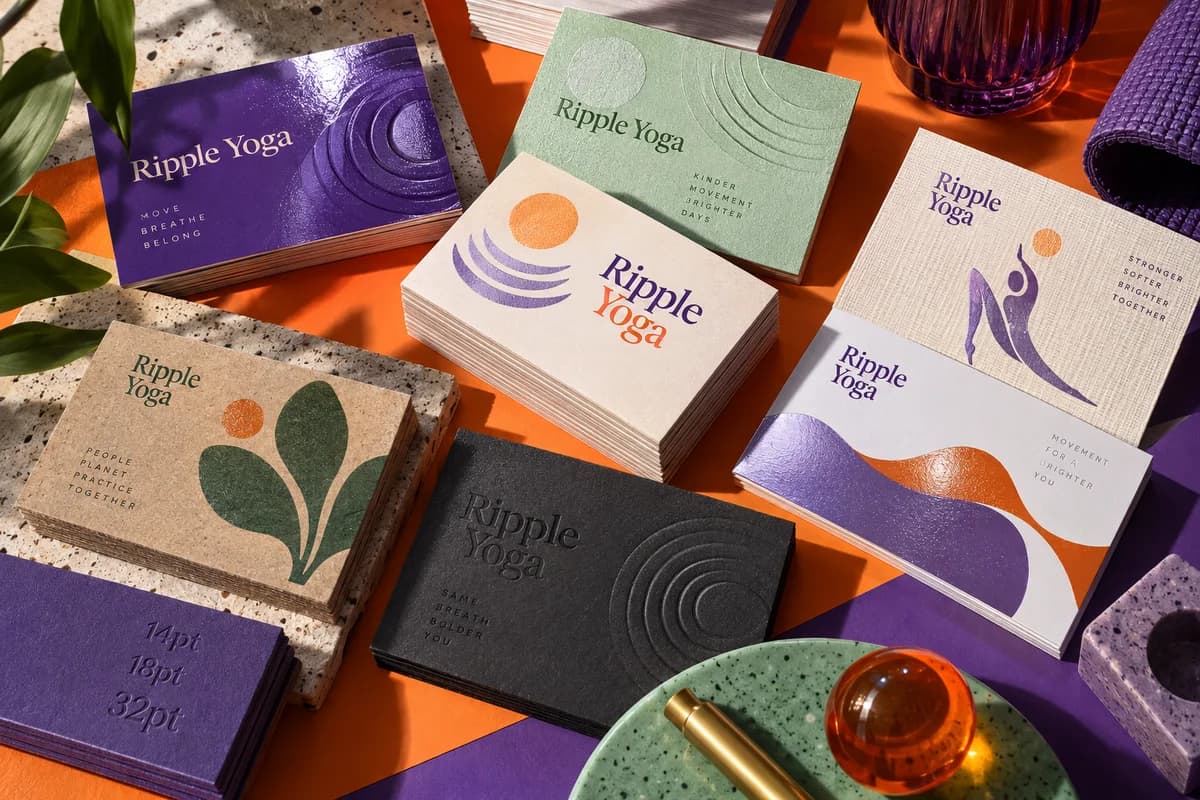
| 32 pt | 0.032 | Ultra thick and painted edge business cards, painted edge invitations | About the thickness of a credit card, per the listing |
| 56 pt | 0.056 | Paper coasters on matte coaster board | Rigid board made to absorb |
Plastic cards are specified differently: white, clear and frosted plastic business cards come flexible at 0.02 inch or rigid at 0.03 inch.
Thickness also decides postage. USPS postcard prices need a card between 0.007 and 0.016 inch thick, so a 16 pt card is at the limit and anything thicker mails at letter prices.
Standard, Premium and Premium Plus
Many listings name a thickness tier instead of a number. On business cards the specs pin the tiers down: standard cards are 14 pt, foil accent and embossed gloss cards offer 14 pt standard or 16 pt premium, and Premium Plus cards are 18 pt. Postcards, flyers, rack cards, menus and insert cards use the same tier names, and flyers add Budget and Deluxe, but those listings do not publish a point value per tier. We will not guess one here. Order the smallest quantity in the tier you are considering, or for cards, compare stocks in the $1 business card sample kit, which holds 16 samples across papers and finishes.
Surfaces matter as much as weight
- Matte and glossy are coated. Glossy keeps photos bright; matte cuts glare and takes most pens.
- Uncoated absorbs ink, so colors soften, but it is the best surface to write on.
- Pearl, linen, cotton, kraft, bamboo, hemp blend and fine grit are texture and character choices. Recycled matte is offered too; the printer does not publish its recycled content percentage, so do not print a percentage claim.
- Soft touch is a velvety laminate over the print.
- Synthetic is the water and tear resistant choice on restaurant menus and rack cards.
- Letterhead comes in standard white, premium linen and premium cotton. Only standard white is listed as working in laser and inkjet printers.
Choose by job, not by number
- Handed out by the hundred: 14 pt standard cards or Standard tier postcards.
- Kept in a wallet or handed to key clients: 18 pt Premium Plus or 32 pt ultra thick.
- Written on: uncoated, matte or linen.
- Mailed as a postcard: 16 pt or less.
- Booklet pages: 80 lb text for most, 100 lb text when images show through.
- Booklet covers: a cover weight, never the same text weight, unless you want a self cover.
- Handled with wet hands or outdoors: synthetic.
For the card side of this subject, read GSM vs pt and the business card paper stock guide. For flyers, see the best paper for flyers, and for mail, the best cardstock for postcards. The free paper weight calculator turns gsm and sheet size into the weight of a stack.
Delivery
Standard delivery as soon as 6 business days from your order, production included. Your cart shows the estimated day for your quantity, and any faster delivery the item offers with its exact charge. The stock you choose does not change the promise.
Frequently asked questions
Is 80 lb paper thick?
It depends on which 80 lb. 80 lb text is about 118 gsm, a solid page for booklet interiors. 80 lb cover is about 216 gsm, a light card used for booklet covers. The cover scale uses a smaller basis sheet, so the same pound number means a heavier sheet.
How do I convert pt to gsm?
You cannot do it reliably. Points measure thickness and gsm measures mass, and density varies by fiber and coating. Two Voqado stocks show it: a 16 pt glossy save the date stock at 265 gsm and a 16 pt pearl stock at 350 gsm.
What thickness are Voqado business cards?
Standard business cards are 14 pt. Foil accent and embossed gloss cards offer 14 pt or 16 pt. Premium Plus cards are 18 pt. Ultra thick and painted edge cards are 32 pt, which the listing describes as about credit card thickness.
What does Premium thickness mean on postcards and flyers?
It is a tier name. Those listings do not publish a point value per tier, so we do not state one. Order the smallest quantity in the tier first, or use the $1 business card sample kit to feel 14 pt to 32 pt card stocks.
Can a thick postcard still go at the postcard rate?
Only up to 0.016 inch, which is 16 pt. USPS postcard prices also need the card to be between 3.5 × 5 and 4.25 × 6 inches. A thicker or larger card mails at letter prices.
Sources & specification notes
The references below support the relevant technical or product details in this guide. Examples and checklists are not claims of practical testing or universal production requirements. Confirm the current specifications for your chosen product before production.
- Neenah Paper: basis weights reference
Defines basis weight as the weight of a 500 sheet ream at a standard size, with different basic sizes for text and cover. The gsm figures in the booklet table are arithmetic from those sizes.
- Neenah Paper: caliper definition on a product specification page
Defines caliper as sheet thickness in thousandths of an inch (points or mils). Product values there are not Voqado specifications.
- NIST: SI units
The kilogram and the square meter, the basis of grams per square meter.
- USPS DMM 101: physical standards for retail mail
Postcard prices require 3.5 to 4.25 inches high, 5 to 6 inches long and 0.007 to 0.016 inch thick.
- Voqado catalog specifications
Thickness, gsm and pound values in this guide are quoted from Voqado product listings.