How thick should postcard cardstock be?
USPS Domestic Mail Manual section 101 sets the rules for retail postcards: at least 0.007 inch and no more than 0.016 inch thick, with a size from 3.5 x 5 inches up to 4.25 x 6 inches. A card outside those limits pays letter size prices instead. For presorted commercial mail, DMM section 201 allows postcards up to 6 x 9 inches at card prices, with the same 0.016 inch maximum, and cards larger than 4.25 x 6 inches must be at least 0.009 inch thick.
| Thickness | In inches | USPS postcard pricing | Feel and best use |
|---|---|---|---|
| 0.18 mm | about 0.007 | Minimum allowed | Very thin, rarely used |
| 0.3 mm | about 0.012 | Within limits | Light card, budget mailers |
| 0.4 mm | about 0.0157 | Within limits, near the top | Sturdy, standard mailed postcards |
| 0.6 mm | about 0.024 | Over the limit, letter prices | Premium handouts and envelope mail |
Standard postcards here come in a 0.4 mm standard thickness and a 0.6 mm premium thickness. Choose the premium stock when the card is handed out, packed in orders or mailed in an envelope, where the postcard rate does not apply.
What do points and GSM mean for postcards?
Paper is described in three ways, and they are not interchangeable. That is why two quotes for the same postcard can list very different numbers for what is really a similar stock. Points measure thickness in thousandths of an inch, so 14pt is 0.014 inch. GSM measures weight as grams per square meter. Pound ratings, such as 100 lb cover, depend on the paper's basis sheet size. Two stocks with the same GSM can differ in thickness and stiffness because coatings and fibers vary.
For mailing, thickness is what USPS measures, so ask for the caliper in inches or millimeters. The paper weight converter translates between points, GSM and pounds. The guide to GSM vs pt explains the difference with business card examples.
Should postcard stock be glossy, matte or uncoated?
Choose by what the card must do. Gloss makes photos and saturated color look brighter. Matte reduces glare and reads well under shop lighting. Uncoated takes a pen easily, which matters when people write on the card.
| Stock | Photos | Writing | Good for |
|---|---|---|---|
| Glossy, front only | Bright and punchy | Writable back | Mailers with an address side |
| Glossy, both sides | Bright on both sides | Hard to write on | Handouts and inserts |
| Matte | Soft, low glare | Usually writable with ballpoint | Menus, event cards |
| Uncoated | Muted color | Writes and stamps well | Thank you notes, handwritten cards |
| Soft touch, linen, kraft, cotton | Varies by stock | Test first | Premium brand pieces |
If the card will be addressed by hand or run through a printer for addresses, test the back surface. The postcard writing surface guide covers pens, stamps and labels.
Which stock is best for mailed postcards?
For bare mail at postcard rates, use a sturdy stock at or under 0.016 inch, with a writable or printable back. Glossy on the front only is a common choice, because the photo side shines and the address side still takes ink. Keep the address area clear of heavy coatings, varnishes and dark backgrounds, since sorting machines read that area.
Special finishes such as foil or embossing add thickness and can raise a card past the limit. Ask for the thickness of the finished piece, not just the base stock, before you mail.
Which stock is best for handouts and inserts?
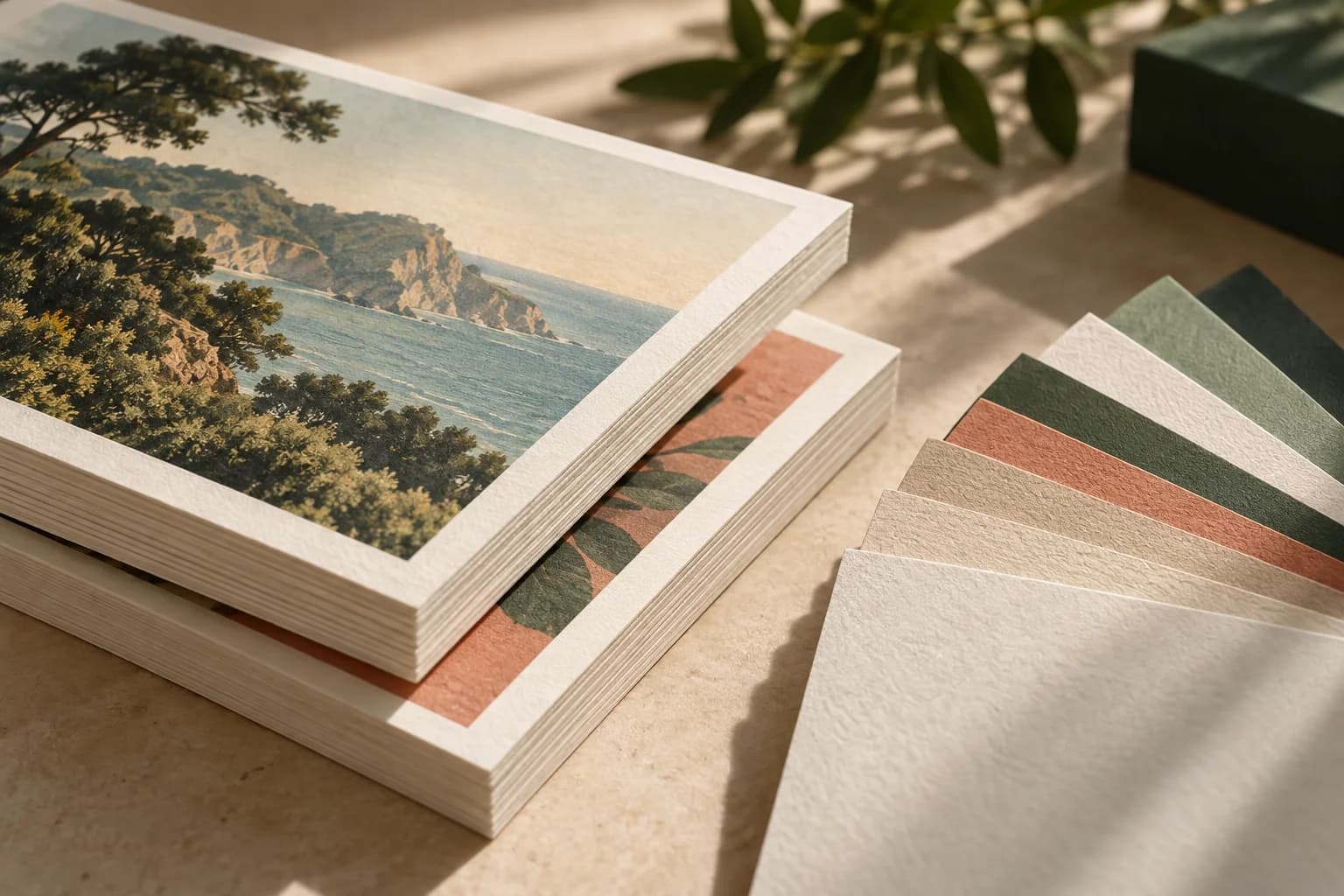
When a card never touches the postal stream, you can choose freely. Thicker 0.6 mm stock feels premium in the hand and resists bending in a bag or box. Soft touch and textured papers signal quality for product inserts and thank you cards.
Match the paper to the brand as well as the task. Kraft and recycled stocks suit natural and handmade products, while pearl and soft touch suit beauty, jewelry and gift brands. If the card carries a recycled claim, make sure it is accurate for the exact stock, and keep the supplier specification on file.
Does coating affect how a postcard survives the mail?
Yes. Mailed postcards travel without an envelope, so they rub against other mail and pass through sorting equipment. A coated surface resists scuffs on dark or saturated designs better than a bare uncoated sheet, where heavy ink can show wear at the edges. A clear margin of light color around the address block also helps, because scuffs are less visible there. If the design uses large areas of dark ink, ask for a coated front and test a sample by rubbing it against another card.
How do you choose without guessing?
Hold the real stock. Print or request a sample, bend it gently, write on it with the pen your customers will use, and check how the photo looks in the light where the card will be read. Standard postcards start at $21.99 for 100, and the product page lets you compare matte, recycled, soft touch, uncoated, linen, pearl, cotton and other papers.
Checklist before you order
- Decide whether the card is mailed bare, mailed in an envelope or handed out.
- For bare mail, keep the finished piece between 0.007 and 0.016 inch.
- Ask for the caliper, not only GSM or pound weight.
- Choose a back surface that takes the pens or printer you use.
- Keep the address area free of heavy coatings.
- Recheck mailing limits after adding foil, embossing or a thicker stock.
Frequently asked questions
What is the best thickness for a postcard?
For postcards mailed at USPS postcard prices, choose a stock between 0.007 and 0.016 inch thick. A stock of about 0.4 mm, or 0.0157 inch, sits near the top of that range and feels sturdy. Thicker stock, such as 0.6 mm, feels premium but is charged letter size prices when mailed bare, so use it for handouts or envelope mail.
Is 14pt cardstock good for postcards?
Yes. A 14pt stock measures 0.014 inch, which is inside the USPS postcard thickness range of 0.007 to 0.016 inch. It is stiff enough to survive mail handling and feels substantial in hand. If you add foil, embossing or lamination, ask for the thickness of the finished card, because finishes can push it past the limit.
Can you write on glossy postcards?
Writing on gloss is unreliable, because many pens skip or smear on the coating. If people will write on the card or address it by hand, choose glossy on the front only, so the back stays writable, or use matte or uncoated stock. Test the actual pen on a sample before ordering a full run.
What GSM is postcard cardstock?
Postcard stock is often described in GSM, but USPS measures thickness, not weight. Two papers with the same GSM can differ in thickness because of coatings and fibers. Ask for the caliper in inches or millimeters, then check it against the 0.007 to 0.016 inch postcard range. A paper weight converter helps compare points, GSM and pounds.
Sources & specification notes
The references below support the relevant technical or product details in this guide. Examples and checklists are not claims of practical testing or universal supplier requirements. Confirm the current specifications for your chosen product before production.
- USPS DMM 101: physical standards for retail mail ↗
Postcards must be 3.5 to 4.25 inches high, 5 to 6 inches long and 0.007 to 0.016 inch thick; larger cards pay letter prices.
- USPS DMM 201: physical standards for commercial mail ↗
Commercial First Class postcards may be up to 6 by 9 inches and 0.016 inch thick at card prices; cards larger than 4.25 by 6 inches need at least 0.009 inch thickness.