Why does ink smear on glossy postcards?
Gloss stock carries a smooth coating that seals the paper fibers so photos print with sharp detail and saturated color. That same seal is what makes handwriting difficult. Ink from a ballpoint relies on a slightly rough surface to pull paste from the ball, and water based ink relies on fibers to absorb it. On a sealed coating, ink sits on top, dries slowly and can transfer to the next card in a stack or to a hand that brushes across it.
Uncoated stock does the opposite. The open fibers take ink quickly, so a pen glides and the writing dries fast. Matte coatings fall in between: many matte cards accept ballpoint well, but the finish name alone does not guarantee it, because two suppliers can use the same label for different coatings.
Which pens work on glossy, matte and uncoated cards?
The table gives a general starting point. Treat it as a shortlist for your own test, not a guarantee, because ink formulas and coatings vary by brand.
| Surface | How ink behaves | Pens to try first | Watch for |
|---|---|---|---|
| Gloss coated | Ink sits on top and dries slowly | Permanent markers, some gel pens | Smudging, skipping ballpoints |
| Matte coated | Moderate absorption | Ballpoint, gel, fine markers | Varies by coating |
| Uncoated | Fast absorption | Ballpoint, gel, fountain pen, pencil | Feathering with very wet inks |
| Textured, linen, kraft | Absorbent with surface texture | Ballpoint, felt tip | Broken lines on deep texture |
Pencil works well on uncoated and many matte surfaces but barely marks gloss. Rubber stamps with standard pads behave like water based ink: fine on uncoated stock and slow to dry on gloss.
Which postcard stocks are easiest to write on?
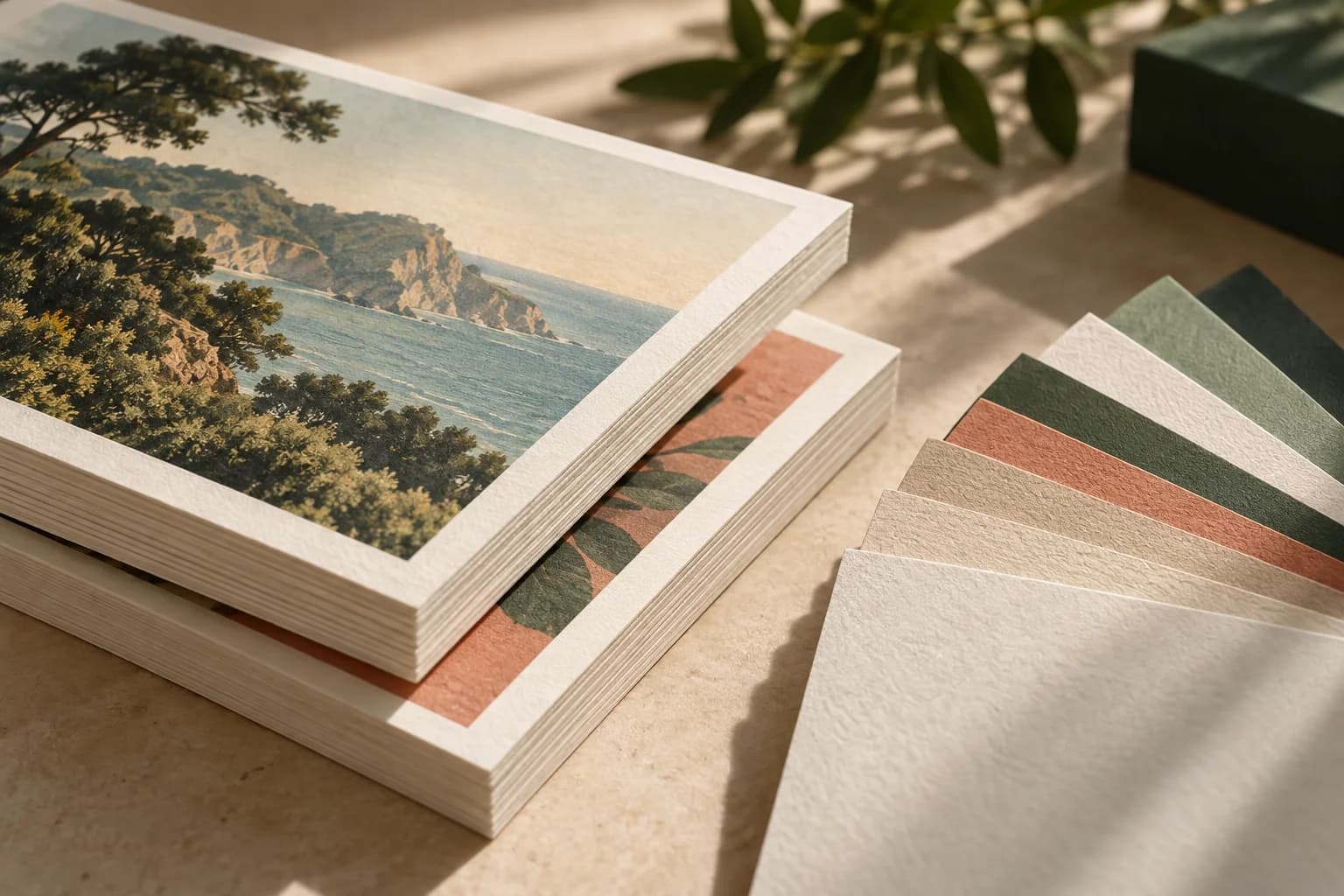
If the card will be handwritten, the writing side matters more than the front. The postcard options in the Voqado catalog include a glossy stock coated on the front only, as well as matte, uncoated, recycled, linen, cotton, kraft and natural textured stocks. Ordering postcards with a glossy front only keeps the photo side bright without putting the gloss coating on the back; confirm the back surface on a sample before you commit. For thank you notes and appointment details written at a counter, fully uncoated or textured stocks give the most forgiving surface. The postcard cardstock guide compares weight and feel in more detail.
How do you run a simple pen test before ordering?
A small sample test answers the question faster than any finish description. Use the pens and the pace your team will really use.
- Order or request a sample of the exact stock and finish, front and back.
- Write a full line with each pen at your normal speed.
- Wait the same time you would before stacking or bagging, then rub the line with a dry finger.
- Stack a second card on top and press lightly to check for transfer.
- Check the address side with the pen you will use for addresses.
- Repeat the test whenever you change stock, finish or supplier.
Where should the writing area go on a mailed postcard?
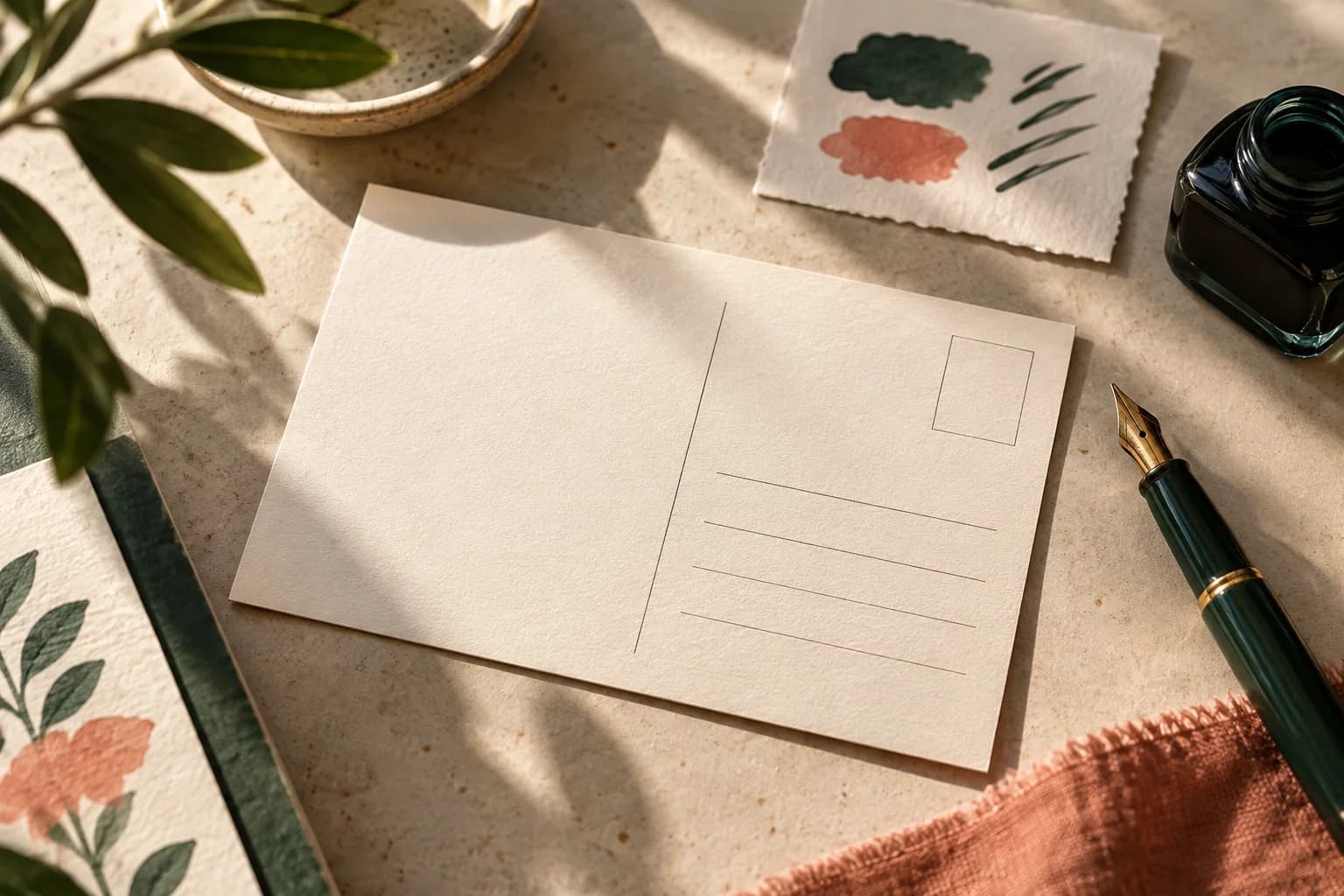
On the address side, USPS reserves a barcode clear zone in the lower right corner, 4.75 inches from the right edge and 0.625 inch from the bottom. Keep handwriting, ink stamps and artwork out of that area. The delivery address belongs above it, within the read area that runs from 0.5 inch inside each side edge and from 0.625 inch up to 2.75 inches above the bottom. Put the handwritten message on the left portion of the back and leave the right portion for the address and postage. Our guide to lay out the address side shows the zones on a 4 x 6 card.
The USPS type standard asks for printed addresses of at least 8 points. If you handwrite addresses instead, write them clearly in dark ink and at least that large, because mail processing has to read them.
Does a writable finish change mailing rules?
The finish itself does not change the postage category, but the construction can. USPS requires a card to be of uniform thickness and made of unfolded, uncreased paper or cardstock, between 0.007 and 0.016 inch thick for postcard pricing. Stickers, magnets or other attachments can disqualify a card from postcard prices. A writable coating on a standard paper stock stays within those rules; a laminated or plastic surface may not, so check before mailing.
How much space should you leave for a handwritten note?
Handwriting takes far more room than typeset text. Plan the writing area in lines rather than words, allowing roughly a quarter inch per handwritten line, and measure how many lines fit once margins are removed. Keep that area free of heavy ink coverage and patterned backgrounds, which make writing harder to read. If you want guide lines, print them in a very light tint. You can draft the layout in the free postcard maker, then check the proof at actual size. For short notes such as dates and times, printed appointment cards on uncoated stock are another option.
What should you order if you are not sure?
Choose a stock with an uncoated back or a front only gloss coating, and order a small first run. That keeps the photo side vivid while protecting the writing side, and the small run confirms the pen, the drying time and the stacking behavior in your real workflow before you commit to a large quantity.
Frequently asked questions
Can you write on glossy postcards with a ballpoint pen?
Sometimes, but it is unreliable. Gloss coatings seal the paper, so ballpoint ink can skip, sit on the surface and smear when cards are stacked. Permanent markers and some gel pens usually perform better. If the card will be handwritten, choose stock with an uncoated or matte back and test the exact pen on a sample before ordering a full quantity.
What is the best postcard paper for writing on?
Uncoated stock is the most forgiving, because the open fibers absorb ink quickly and accept ballpoint, gel, fountain pen and pencil. Linen, cotton and kraft stocks also take ink well, though deep texture can break fine lines. Matte coated stock often works but varies by coating, so test the exact product rather than relying on the finish name.
How do I stop ink smudging on postcards?
Choose an uncoated or matte writing side, use a quick drying pen, and give each card time to dry before stacking. Test by writing a line, waiting your normal time, rubbing it and pressing a second card on top. If ink transfers, switch pens or stock. On gloss, a permanent marker is usually the most dependable option.
Can I handwrite the address on a postcard?
Yes, many people handwrite postcard addresses. Write clearly in dark ink, at least as large as the 8 point minimum USPS sets for printed addresses, and keep it above the barcode clear zone, which covers the lower right corner 4.75 inches from the right edge and 0.625 inch from the bottom. Keep the address on the right portion of the back and your message on the left.
Sources & specification notes
The references below support the relevant technical or product details in this guide. Examples and checklists are not claims of practical testing or universal supplier requirements. Confirm the current specifications for your chosen product before production.
- USPS DMM 101: physical standards for retail mail ↗
Card price limits: 3.5 x 5 to 4.25 x 6 inches, 0.007 to 0.016 inch thick, uniform, unfolded paper or cardstock; letter size limit 6.125 x 11.5 x 0.25 inches.
- USPS DMM 202: elements on the face of a mailpiece ↗
Barcode clear zone 4.75 inches from the right edge and 0.625 inch from the bottom; OCR read area; addresses in at least 8 point type.
- USPS Postal Explorer: Business Mail 101, postcards ↗
Plain language postcard size and thickness rules, and the warning that attachments can disqualify postcard pricing.