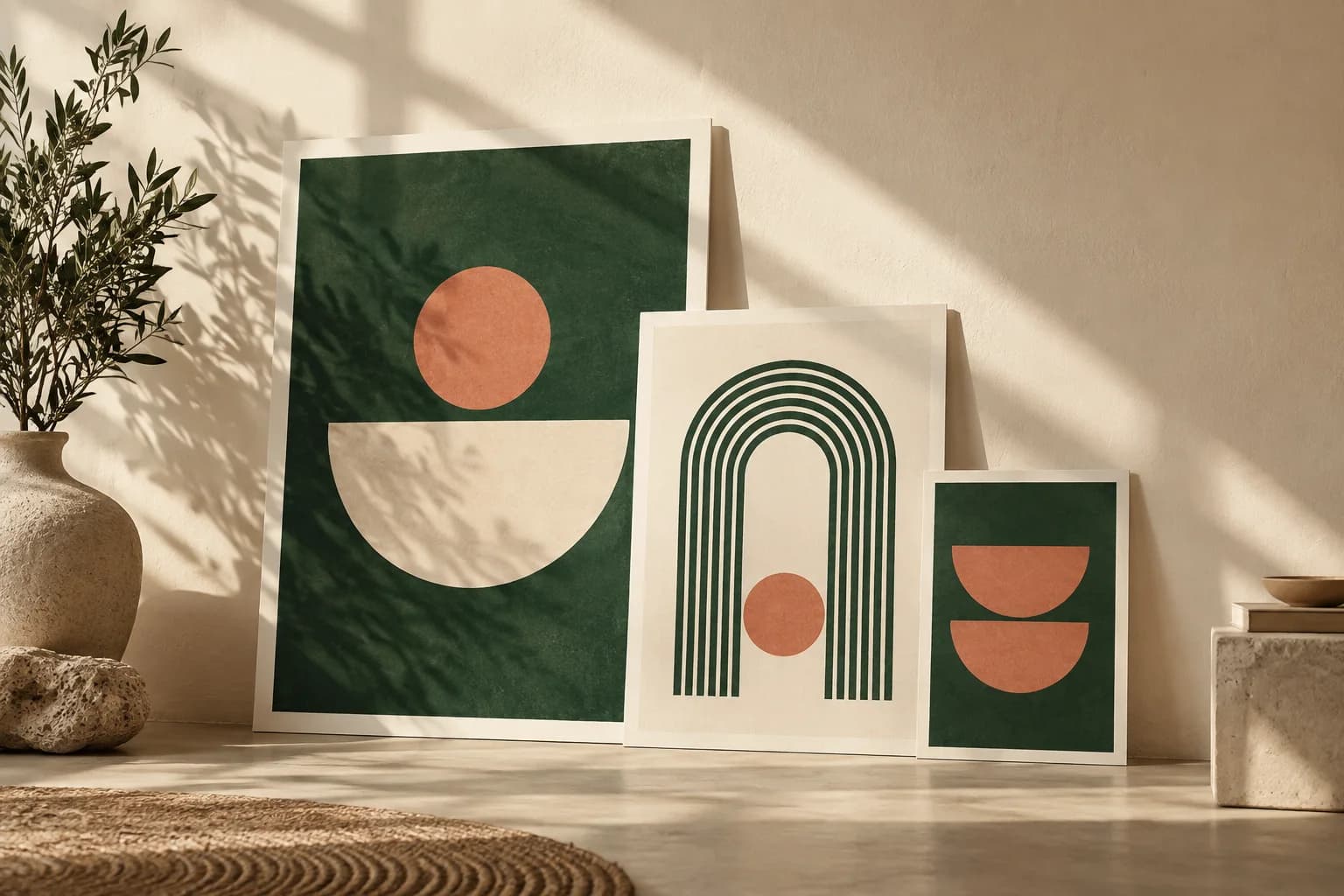
What are the main ways to mount a poster?
Each method trades off cost, appearance, protection and how easily the artwork can be swapped. The right choice depends on where the poster hangs and how long it stays up.
| Method | Best for | Visible area | Changing artwork | Watch for |
|---|---|---|---|---|
| Snap frame | Lobbies, retail and recurring promotions | Frame edges cover a strip on every side | Fast, the edges open on the wall | Protective film can soften colors slightly |
| Poster rails | Vertical posters in cafes, studios and offices | Rails grip the top and bottom edges | Slide the poster out of the tabs | Vertical posters only |
| Removable adhesive strips | Short displays on smooth painted walls | The whole poster | Remove and replace the poster | Surface texture and fresh paint |
| Foam board | Events, easels and counters | The whole board | Replace the board | Warping in damp or hot spaces |
| Picture frame with mat | Keepsake prints and art | The mat window | Slow, needs the frame opened | Mat and frame lip coverage |
Tape and thumbtacks are the options to avoid. The Library of Congress advises against self adhesive tape and glue on paper, and pins leave holes in both the print and the wall.
How do you measure a frame for a poster?
The outside size of a frame is not the size of the visible artwork. Frames have a lip, formed by the rabbet in the molding, that overlaps the edge of the print to hold it in place, and a mat covers even more. Measure the visible opening and write it next to the poster's finished size.
A simple example shows why this matters. If a frame lip covers 0.25 inch on each side, an 18 x 24 inch poster shows only 17.5 x 23.5 inches. Text placed just inside the trim can disappear behind the frame even though it was safe for cutting. Keep important content inside both the safe area and the covered edge. Poster snap frames list their sizes so you can match the frame to the poster before designing.
How do you mount a poster without damaging the wall?
Match the method to the surface. Removable adhesive strips work best on smooth, clean, painted walls and less well on textured plaster, wallpaper, brick or paint that has not fully cured. Follow the manufacturer's instructions for weight and surface, and test one strip in an inconspicuous place first.
Mechanical fixings avoid adhesive altogether. Snap frames mount with screws, and rails hang from hooks, cord or suction cups, so the only mark on the wall is a small fixing point. For spaces where drilling is not allowed, rails on a picture hook or a freestanding foam board on an easel are the gentlest options.
How do you protect a poster print from fading and damage?
Light is the main enemy of any print on display. The Library of Congress recommends minimal exposure to light and no direct or intense light for works on paper. Keep posters that must last away from windows and strong spotlights, and rotate them rather than leaving them up permanently.
For prints you want to keep, the Northeast Document Conservation Center recommends a window mat so the artwork never touches the glazing, glazing that filters at least 99 percent of ultraviolet light, and reversible hinges or photo corners instead of permanent adhesive. Stable temperature and relative humidity matter too. A promotional poster replaced every month needs none of this, but a framed wall print does.
Should you laminate a poster before mounting?
Lamination adds durability and protects against smudges, moisture and wear, which makes it useful for high traffic spaces and posters handled often. It also adds thickness, so confirm the laminated poster still fits the frame channel or rail tabs. A gloss laminate can add glare under bright lights, so consider matte where lighting is strong.
How do you mount posters outdoors or in windows?
Outdoor posters face rain, sun and wind, so they need a tear and water resistant material and fixings that hold in weather, such as rails or strips rated for the surface. The guide to outdoor poster materials covers what to ask about before printing. Window posters raise different problems: glare, backlighting and which side of the glass the print faces. Decide whether the poster is read from the street or from inside the room before you choose the orientation of the artwork, and remember that sunlight behind the glass can make a thin paper look washed out or show the back of the print through the front.
For quick indoor promotions, self adhesive sticky posters, printed on flexible plastic, use a dot pattern adhesive designed to peel off without damaging paint.
How do you check the installed poster?
Step back once the poster is up and review it from the reader's position, not from a ladder.
- Check that the poster is level and aligned with nearby objects.
- Look for bowing, bubbles or trapped debris behind the surface.
- Confirm no text, logos or QR codes are hidden by the hardware.
- Look for glare from windows and ceiling lights.
- Read the headline from the normal approach distance.
- Record the hardware and visible opening sizes for the next replacement.
Once you know the visible area, choose from the standard poster sizes, then pair the print with poster rails, a snap frame or a foam board mount. Print your artwork as custom posters sized to the hardware.
Frequently asked questions
What is the best way to mount a poster without damaging it?
Use a method that holds the poster by its edges or from behind without adhesive on the print, such as a snap frame, poster rails or a frame with a mat. The Library of Congress advises against self adhesive tape and glue on paper. For prints you want to keep, add UV filtering glazing and keep them out of direct light.
How do I hang a poster without nails or tape?
Removable adhesive strips work on smooth painted walls when used within the manufacturer's weight limits. Poster rails can hang from a single hook, cord or suction cups, and a foam board mount can stand on an easel or a counter. Self adhesive posters with a removable adhesive are another option for short indoor displays on smooth walls.
Should a poster be smaller than its frame opening?
The poster should match the frame size so the lip can hold it, but the visible opening will be slightly smaller than the print because the lip overlaps the edges. If a lip covers 0.25 inch per side, an 18 x 24 inch poster shows 17.5 x 23.5 inches. Keep important content well inside that visible area.
Does lamination make a poster easier to mount?
Lamination makes a poster stiffer and more resistant to smudges, moisture and wear, which helps with frequent handling and busy spaces. It also adds thickness, so check that the laminated poster still fits the frame channel or rail tabs. Gloss laminate can add glare under bright lights, so matte is often easier to read in strong lighting.
Sources & specification notes
The references below support the relevant technical or product details in this guide. Examples and checklists are not claims of practical testing or universal supplier requirements. Confirm the current specifications for your chosen product before production.
- Library of Congress: Care, handling and storage of works on paper ↗
Advises against rubber bands, self adhesive tape and glue on paper, and recommends minimal exposure to light and no direct or intense light.
- Northeast Document Conservation Center: Matting and framing for works on paper and photographs ↗
Recommends a window mat so the work never touches the glazing, UV filtering glazing that blocks at least 99 percent of ultraviolet light, and reversible hinges or corners instead of permanent adhesive.