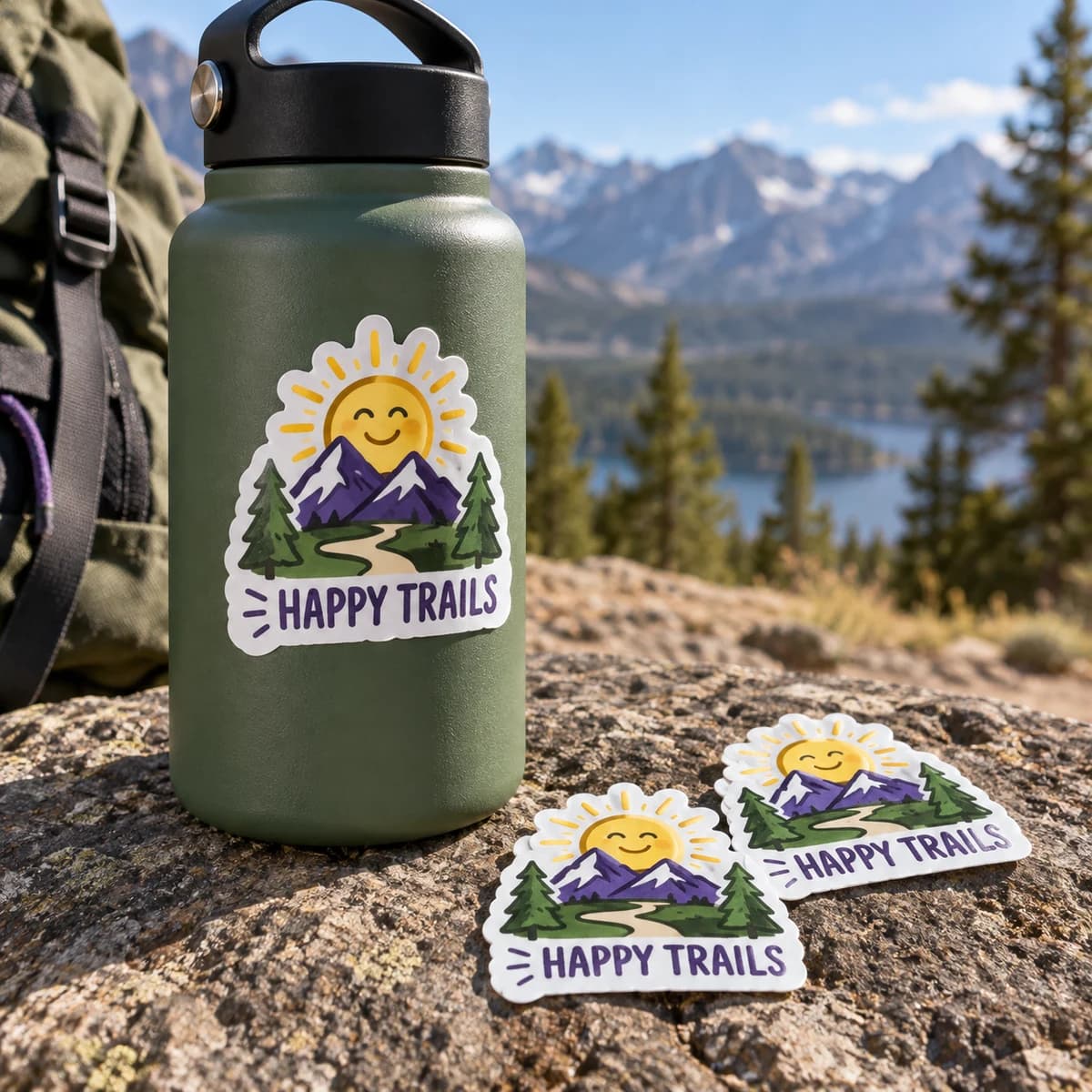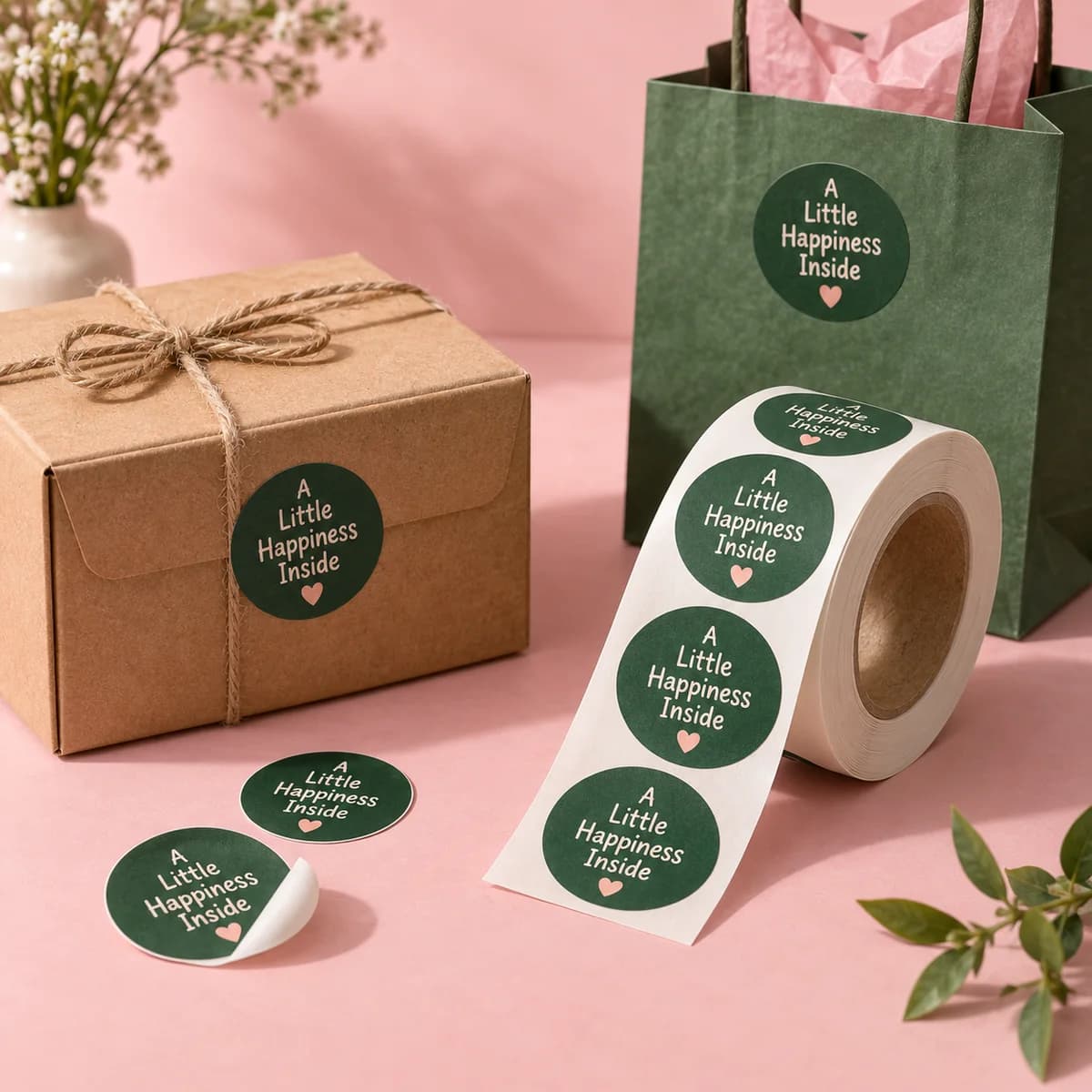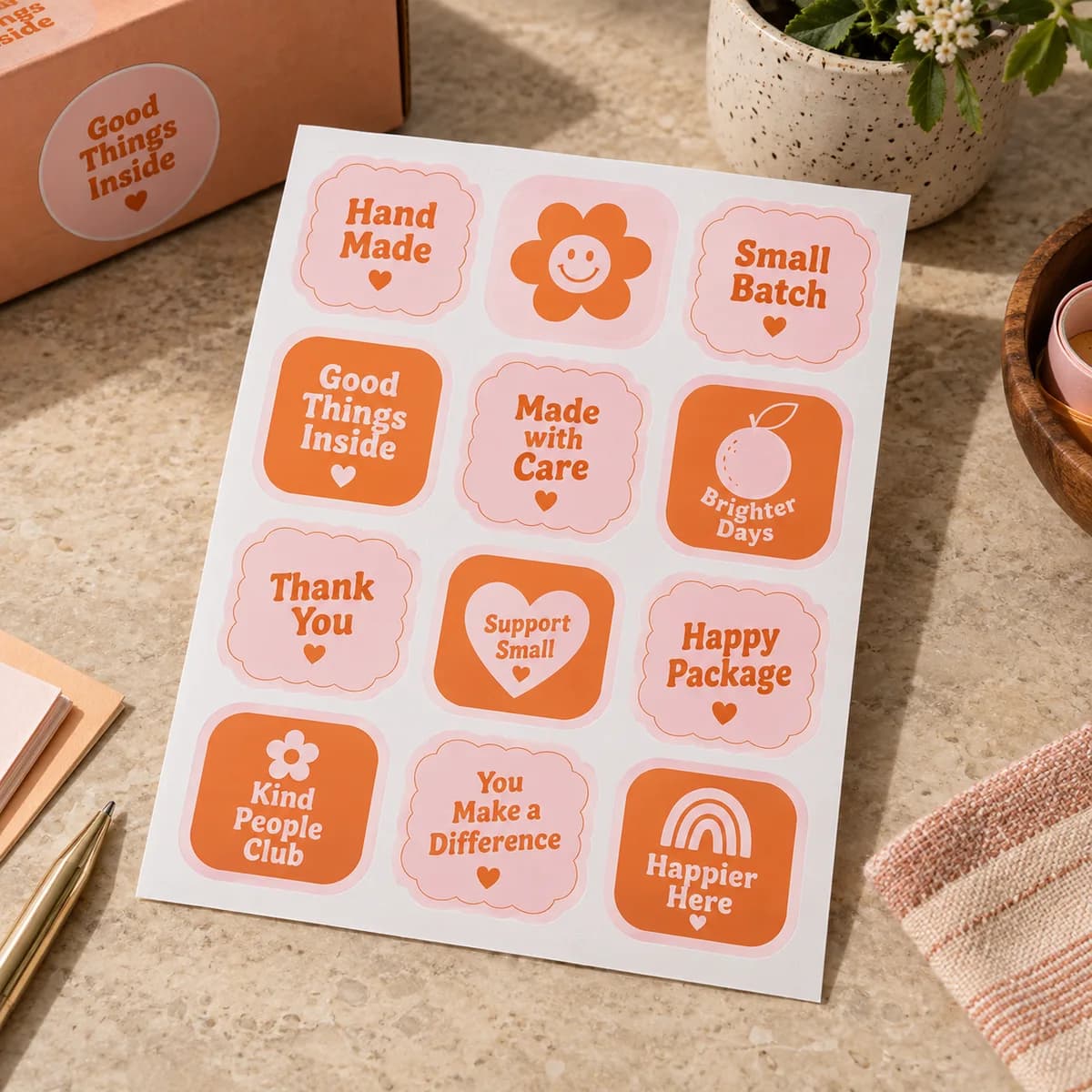
What is the difference between a sticker and a label?
The short answer is that the difference is the job, not the glue. A label exists to identify, inform, organize or ship something. A sticker exists to promote, decorate or express something, and it usually travels loose until someone decides where to put it.
Physically, the two are close cousins. Both are pressure sensitive: a printed face stock, an adhesive layer, and a release liner you peel away. That shared construction is why the words get swapped so often, and why the useful question is not what to call it but what it has to do once it leaves your hands.
How do stickers and labels compare side by side?
The table below is the fastest way to sort your project. If most of your answers land in one column, that is the product family to shop.
| Question | Stickers | Labels |
|---|---|---|
| Main job | Promote, decorate, build awareness | Identify, inform, organize, ship |
| Where it ends up | Unknown, the recipient chooses | A known jar, box, bottle or shelf |
| Typical format | Singles or kiss cut sheets | Sheets or rolls |
| Typical cut | Cut to the outline of the design | Standard shapes on a shared liner |
| Who applies it | The end user, by hand | Your team, by hand or with a dispenser |
| Text load | Little text, strong graphics | Product name, contents, required lines |
| Quantity pattern | Batches for handouts and orders | Matches your production runs |
A few products sit in the middle. A logo seal on a gift box is technically a label because it lives on your packaging, but it is designed like a sticker. A QR sticker on a counter is a sticker that does a label's job of pointing people somewhere. When a piece does both jobs, let the harder requirement lead: if it must survive a fridge or carry legal text, spec it like a label.
What are stickers and labels made of?
Both use the same three material choices for the printed face: paper, film (polypropylene or polyester), and vinyl. Adhesives come in permanent and removable versions, and the liner is usually a coated paper, with PET film as an alternative on some label rolls. A clear or matte laminate can be added on top to protect the print from scuffing.
| Face material | Strengths | Watch out for | Good fit |
|---|---|---|---|
| Paper | Lowest cost, natural look, easy to write on | Smudges or tears when wet | Box seals, shipping labels, dry indoor packaging |
| Film | Resists moisture and oils, conforms to curves | Costs more than paper | Bottles, cosmetics, refrigerated food |
| Vinyl | Waterproof, resists tearing and fading | More than most dry packaging needs | Laptops, water bottles, outdoor gear |
The material decision usually follows the environment. A sticker that will ride on a water bottle has different needs from a seal on a paper bag. For a deeper comparison, including laminate and what water resistant really means, read our guide to choosing vinyl or paper for your stickers.
Which formats do stickers and labels come in?
Format is where the two families split most clearly, because it controls how the pieces are handled after printing.
- Die cut singles: each sticker is cut through the face and the backing to the shape of the design, so it can be handed out one at a time.
- Kiss cut stickers: the blade cuts the face only, leaving a larger backing around the design that protects it and makes peeling easier.
- Sheet stickers and sheet labels: several pieces share one liner, which suits small runs, variety packs and labeling by hand.
- Roll labels: many labels on a continuous liner wound around a cardboard core, commonly 1 inch or 3 inches in diameter, which suits higher volume and dispensers or applicators.
If the cut is the part you are unsure about, our explainer on kiss cut and die cut stickers covers backing, border and artwork prep. If you already know you need labels and are choosing between formats, the guide to roll labels or sheet labels walks through volume, application method and core size.
When should you order stickers instead of labels?
Use this checklist before you add anything to a cart.
- Order stickers if the piece will be given away, sold as merch, or tucked into orders.
- Order stickers if the recipient chooses the surface, such as a laptop, notebook or bottle.
- Order labels if the piece goes on your own product or packaging in a fixed spot.
- Order labels if the piece must carry a product name, net contents, ingredients or an address.
- Order labels on rolls if you apply hundreds at a time or plan to use a dispenser.
- Choose film or vinyl for either family if the item will see water, ice, oils or outdoor light.
- Choose paper for either family if the item stays dry, indoors, and only needs to last a short time.
What must a product label say that a sticker does not?
A decorative sticker has no required wording. A product label often does. For packaged food sold in the United States, the FDA Food Labeling Guide describes a principal display panel with the statement of identity and the net quantity in the bottom 30 percent of that panel, plus an ingredient list, allergen declaration and the name and place of business of the manufacturer, packer or distributor. Cosmetics have their own set of rules from the FDA.
Those rules shape the label's size as much as its design, because required type has minimum heights. Rules also vary by product category and sometimes by state, so confirm your specific case with the FDA or your state agency. Our checklist of what goes on a product label breaks the requirements down by product type.
How do you pick the right size?
Start from the surface, not the artwork. Measure the flat area where the piece will sit, then subtract a margin so the edges do not ride onto a curve or seam. For giveaway stickers, 2, 3 and 4 inch sizes cover most uses, with 3 inches a common default for laptops and bottles.
Labels follow the container. A round jar with a 2 inch flat face needs something smaller than that face, and a wraparound bottle label needs the circumference minus a small gap. The guide on choosing custom sticker sizes has a table by use, and the sticker size tool in the Print Lab lets you test dimensions before you commit.
How do you order stickers or labels without surprises?
A clean order comes down to five decisions made in order: job, surface, material, format, quantity. Settle each one before you open a design tool, then send a vector or high resolution PDF with bleed so the cut lands cleanly.
When you are ready, browse the stickers and labels collection to match your answers to a product. Voqado ships within the United States, with free standard shipping on orders of $60 or more, and if a print arrives damaged, misprinted or different from the proof you approved, we reprint or refund it within 30 days, with nothing to ship back. Order ahead of any deadline, since standard delivery allows 2 to 4 business days of handling plus 5 to 8 business days in transit.
Frequently asked questions
Is a sticker the same as a label?
Not quite. Both are adhesive printed pieces with a peel away liner, but a label identifies or informs about a specific item, while a sticker promotes or decorates and is usually applied by whoever receives it. The same material can be used for either. What changes is the format, the cut, the text load and whether rules about required wording apply.
Can I use stickers as product labels?
Yes, as long as the piece carries everything the product needs and survives its environment. A die cut sticker can work as a jar label for a small batch run. If the product must list net quantity, ingredients or a business address, check that the size leaves room for legible type, and choose film or vinyl if the container will be chilled, washed or handled often.
Are labels cheaper than stickers?
Per piece, labels on rolls are often cheaper at high quantities because many labels share one liner and are cut in a continuous run. Individually cut stickers cost more to produce per unit at small quantities. Compare quotes at the quantity you will really use, and include material and laminate choices, since those move the price more than the name of the product.
What is the backing on a sticker called?
The backing is called the liner or release liner. It is usually a coated paper, sometimes a PET film on label rolls, with a surface the adhesive does not bond to, so the sticker peels off cleanly. On kiss cut stickers the liner is left larger than the design; on die cut stickers it is trimmed to the same outline.
Sources & specification notes
The references below support the relevant technical or product details in this guide. Examples and checklists are not claims of practical testing or universal supplier requirements. Confirm the current specifications for your chosen product before production.
- Avery: Labels vs. Stickers, the easy way to tell the difference ↗
Supports the purpose based definitions of labels and stickers and the shared materials and adhesives.
- Resource Label Group: Understanding pressure sensitive label components and roll configurations ↗
Supports face stock, adhesive, liner and the common 1 inch and 3 inch core sizes.
- Avery: Should you use film, paper or vinyl labels? ↗
Supports the strengths and limits of paper, film and vinyl face materials.
- FDA: Guidance for Industry, Food Labeling Guide ↗
Supports the required elements of a packaged food label, including net quantity placement in the bottom 30 percent of the principal display panel.