Measure the fold, not the garment
A flat T shirt is about 20 x 28 in. Nobody ships it that way. What matters is the folded stack, so fold three or four of your actual garments the way your packing table will fold them, press them gently, then measure length, width and depth with a ruler.
Fold method changes the answer. A retail fold, sleeves in and then folded in thirds, gives a compact rectangle. A quick fold in half twice gives a wider, thinner shape. Pick one method, write it down, and size the box to that method rather than to an average.
Fabric weight matters just as much. A 4.5 oz ringspun cotton tee folds thinner than a 6.5 oz heavyweight. Size the box on your heaviest product, not your lightest, so one box works across the range.
Starting sizes by order type
These are working starting points to check against your own folded measurements, not fixed specifications.
| Order | Folded stack, approximate | Mailer box starting size |
|---|---|---|
| One T shirt | 9 x 7 x 1.25 in | 10 x 8 x 2 in |
| Two T shirts | 9 x 7 x 2.25 in | 10 x 8 x 3 in |
| Three T shirts | 10 x 8 x 3 in | 12 x 9 x 3 in |
| One hoodie | 12 x 9 x 3.5 in | 14 x 10 x 4 in |
| Tee plus cap plus tissue | 10 x 8 x 3.5 in | 12 x 9 x 4 in |
| Tee plus mug, boxed | 10 x 8 x 4.5 in | 12 x 9 x 5 in |
Leave about 0.5 to 1 in of clearance on length and width. Less than that and the garment fights the tuck flap during packing, which slows your table down and creases the shirt. Much more than that and the contents slide, which is the main cause of a package that arrives looking sad even though nothing broke.
Why depth is the expensive dimension
Carriers bill on the greater of actual weight and dimensional weight, and dimensional weight is volume divided by a published divisor. FedEx states a divisor of 139 for United States shipments, and UPS publishes 139 for daily rates and 166 for retail rates.
That makes depth the dimension to fight for. A 12 x 9 x 3 in box is 324 cubic inches, which is about 2.33 lb of dimensional weight at 139. Take the same box to 12 x 9 x 5 in and it becomes 540 cubic inches, about 3.89 lb, without adding a single gram of product. Apparel is light, so apparel shipments are almost always billed on dimensional weight rather than scale weight.
The practical move is to choose the shallowest box the folded stack will actually sit in, then compress the stack with the tuck flap rather than filling the extra air with void fill. If you sell single tees and three packs, two shallow box sizes usually beat one deep box that covers both.
Is a box the right format at all?
Soft goods that cannot be crushed do not need a rigid box. Poly mailers are lighter, cost less to ship and take up less storage, and a self sealing flap with a second adhesive strip lets the customer reuse the mailer for a return. Kraft mailers add a bottom gusset that expands for bulkier items and still ships as a flat rather than a parcel in many cases.
A mailer box earns its cost when the opening matters: a gift, a launch drop, a subscription, a first order you want photographed. A front tuck closure opens cleanly in one motion, which is the moment an unboxing video is made of. If your customer is a wholesale buyer receiving twenty units, the plain shipping box is the honest choice.
Board, print and the sample you should order
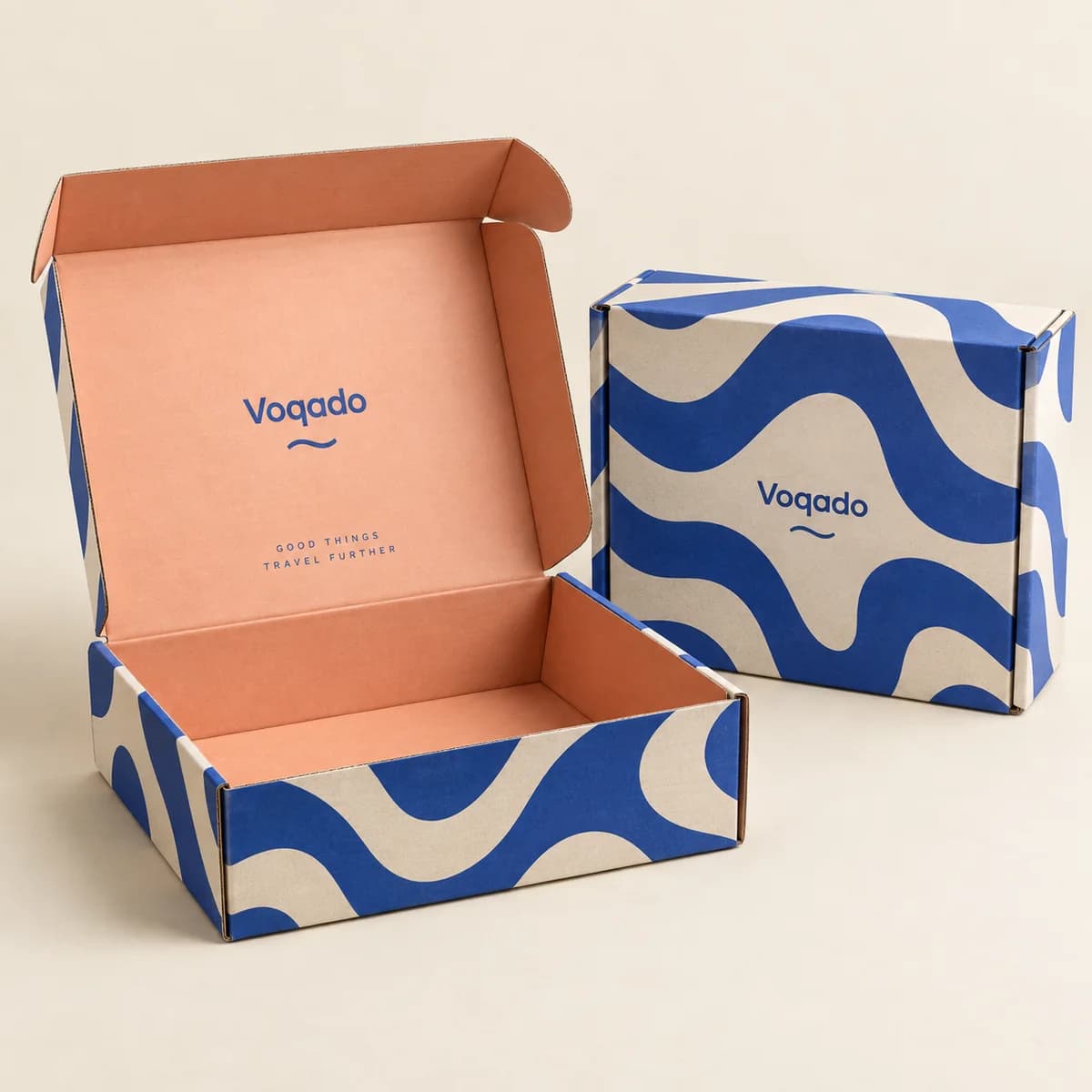
Mailer boxes here are 1/16 in white E flute corrugated at a 32 ECT rating, with the option to print inside, outside or both. E flute is thin enough to hold crisp print and rigid enough to resist crushing in a van, which is why it dominates ecommerce mailers. If you are shipping heavier or bulkier goods, a thicker C flute shipping box is the sturdier choice. The comparison of corrugated flute types explains what each flute height is good at.
Order a single sample before a production run and pack it with real product. Check three things: the garment goes in without forcing the flap, the box does not rattle when shaken, and the printed inside panel is actually visible when the lid opens rather than hidden behind tissue.
Design on the dieline, not on a rectangle
A box is folded and assembled from a flat blank, so a rectangle on a screen cannot show which panel is which, where the folds and glue tabs fall, or which faces end up inside. Nothing drawn on a design canvas is a cut, fold or crease line. Ask us for this product's dieline and lay your artwork out on it, then send print ready artwork on that dieline so our team can check the panels with you before production. The guide to what a dieline is walks through how to read one.
Sizing checklist
- Fold three real garments the way your packers will fold them and measure the stack.
- Size on your heaviest fabric, not your lightest.
- Add 0.5 to 1 in of clearance on length and width only.
- Keep depth as shallow as the stack allows, because depth drives dimensional weight.
- Compare the box against a poly or kraft mailer for soft goods that cannot be crushed.
- Order one sample and pack it with real product before committing to a run.
- Lay artwork out on the dieline, never on a plain rectangle.
Frequently asked questions
What size mailer box fits one T shirt?
A folded adult tee is roughly 9 x 7 x 1.25 in, so a mailer box around 10 x 8 x 2 in fits it with enough clearance to pack quickly without creasing. Fold three of your own shirts and measure the stack before ordering, because a heavyweight cotton tee folds noticeably thicker than a lightweight one.
What size box do I need for a hoodie?
A folded adult hoodie is commonly about 12 x 9 x 3.5 in, which points to a mailer box near 14 x 10 x 4 in. Hoodies vary far more than tees because of fleece weight and hood bulk, so measure your specific garment and size on the thickest one you stock.
Does box size affect shipping cost for clothing?
Yes, usually more than weight does. Carriers charge on the greater of actual weight and dimensional weight, which is length times width times height divided by a published divisor. FedEx states 139 for United States shipments and UPS publishes 139 for daily rates, so apparel almost always bills on volume.
Should I use a mailer box or a poly mailer for apparel?
Use a poly or kraft mailer when the goods cannot be crushed and the opening is not part of the experience. Use a mailer box when the unboxing matters, such as gifts, launches and subscriptions, or when the order includes something rigid alongside the garment.
Sources & specification notes
The references below support the relevant technical or product details in this guide. Examples and checklists are not claims of practical testing or universal supplier requirements. Confirm the current specifications for your chosen product before production.
- FedEx: What is dimensional weight? ↗
States the dimensional weight calculation and the divisor of 139 for United States, Puerto Rico and international shipments.
- UPS: Shipping Dimensions and Weight ↗
Publishes the dimensional weight divisors used by UPS, including 139 for daily rates and 166 for retail rates.
- TAPPI T 811: Edgewise compressive strength of corrugated fiberboard ↗
The test method behind the ECT value quoted for corrugated board such as the 32 ECT rating on these mailer boxes.