Your card's real job is the rebook
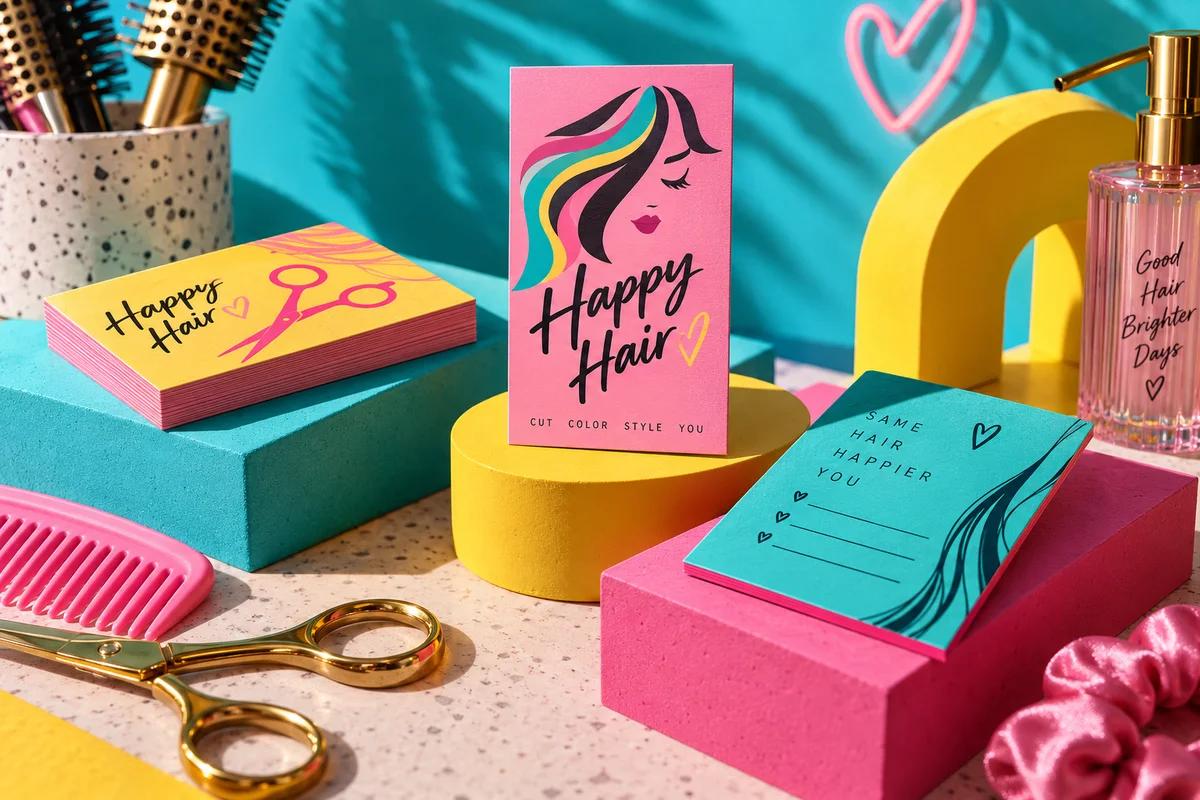
New clients find stylists through photos, referrals and walk by traffic, but a stylist's income is built on returning clients. The card is the physical reminder of the next appointment. When you write the date and time on the back while the client is still in the chair, the card becomes a personal note rather than a flyer, and it lands in a wallet instead of a trash can.
That moment also prompts the rebooking conversation. Holding a pen over the card and asking whether the same time in six weeks works is simpler than asking whether they would like to book again. Design every part of the card to support that exchange.
What to print on the front
- Your name, in the largest type on the card.
- Two or three service words that describe your work, such as Color, cutting, extensions.
- Your booking link, shortened, or a QR code that opens it.
- Your Instagram or TikTok handle, since that is your portfolio.
- Salon name, or suite name and suite number if you rent.
- A phone number that accepts texts, labeled Text to book if that is how you work.
If you work from a licensed home studio, print your neighborhood instead of your full street address and add Address sent after booking. A full address on a card that circulates widely invites unannounced visitors, and a neighborhood line keeps you in control.
License lines and titles by trade
State cosmetology boards typically require your license to be displayed at your station, not on a business card, so a license number is optional. If you work freelance at weddings or events where there is no station, Licensed cosmetologist under your name is a simple, factual reassurance. The other trades follow a similar pattern, with a few differences.
| Trade | Typical rule | What to print |
|---|---|---|
| Hair stylist | License displayed at your station | Optional; Licensed cosmetologist for events |
| Barber | License posted at the station, not on marketing | No license number needed |
| Nail tech | Most states license nail techs and require display at the workstation | Optional; Licensed nail technician for mobile or event work |
| Makeup artist | Some states require a cosmetology or esthetician license for paid makeup; others exempt makeup only work or theatrical and film settings | A license line only if you hold one, with its exact title |
| Tattoo artist | Many states and counties license artists and shops; the license is typically displayed in the shop | Licensed tattoo artist for guest spots, if you hold the local permit |
Be careful with titles. Use master colorist only if a salon system or brand education program actually awarded it, and otherwise describe the work itself, such as Blonding and lived in color. Nail techs should avoid claiming a brand certification unless they completed that brand's program; describe the technique instead, like Builder gel overlays. Makeup artists should write Licensed esthetician, not certified makeup professional unless a named program actually certified them, and airbrush certified or lash certified should match a real certificate you could show a client who asks.
Listing a cosmetics brand you once worked for can imply a current endorsement or partnership. Describe the experience instead, such as Prestige retail artistry background. If you are a current brand ambassador with written permission to say so, follow the brand's guidance on how to phrase it.
Designing the appointment back
The back should be fast to fill in with a client waiting. Keep it to the essentials and give handwriting room.
| Field | Why it matters |
|---|---|
| Day and date | Writing the weekday catches mistakes |
| Time | Large enough to read at a glance |
| Service | Helps the client plan time and budget |
| Stylist | Useful in salons with several stylists |
| Policy line | One sentence on late arrivals or cancellations |
| Booking link | Lets them reschedule without calling |
Add a line such as Color refresh due in about six weeks for clients who do not rebook on the spot. They see it every time they open their wallet, and it plants the timing without pressure. Our appointment cards come laid out with lines that suit this. Choose the single policy you enforce most, such as Deposits secure your booking or Please arrive 5 minutes early, and leave everything else for your booking page.
Stock that survives the salon
Salon cards meet wet hands, leave in conditioner, hairspray and the bottom of a handbag. Uncoated paper absorbs those and can wrinkle, while gloss smears the pen ink you just wrote. A smooth matte business card at 16 pt is the practical middle: it resists moisture, takes ballpoint and looks clean in photos of your station.
| Stock | Moisture | Writable | Salon fit |
|---|---|---|---|
| Matte 16 pt | Good | Yes | Best all round |
| Uncoated | Poor | Excellent | Dry stations only |
| Gloss | Good | Smears | Front only, never the back |
| Soft touch | Fair | Poor | Luxury salons, no handwriting |
If you love the velvety feel of soft touch, reserve it for a front only card and keep a separate appointment card for writing. The matte vs gloss guide explains coatings in more detail. Each trade section below notes where its needs differ, from stamp friendly uncoated stock for barbers to ultra thick stock for tattoo artists.
Suite renters, salon employees and referrals
If you work at a salon that sets the brand, your card usually follows its template, and your name and booking details slot in. Check whether the salon allows your personal handle on the card. If you rent a suite or chair, the card is your brand, and it should be portable: a booking link and handle that belong to you mean clients follow you if you ever move. Print the suite number clearly, because salon suite buildings are confusing and a lost first time client often gives up at the lobby directory.
A QR code business card is useful here. Point it to a booking page you control, not to a specific salon's system, so the card never expires with a move.
Clients who love their hair are your best marketers. A second version of your card, or a line on the back, can turn that into bookings: Referred by, with a line for the client's name, and a clear offer such as Both of you receive a complimentary deep conditioning treatment. Give three to each regular after a great service. When the referral card comes back, you know who to thank. Keep the offer simple and service based, because discounts on price can train clients to wait for deals.
Colors, fonts and photos that suit your chair
Your card should look like your work. A stylist known for soft blondes and lived in color might use warm neutrals and a clean serif, while a stylist known for vivid fashion color can carry a bold accent on the front. Resist the urge to print a photo of a haircut or a nail set: at 3.5 × 2 in, even a sharp image loses detail, and colors shift in print. Point to your feed instead, where color is shown on a lit screen.
Keep your name at 12 to 16 pt and contact details at 8 pt or larger. Script fonts are popular in salons, but limit them to your name and set everything else in a simple sans serif, so a client can read your handle in dim restaurant light when recommending you to a friend. Script type is especially hard to read in a handle full of underscores and dots. If you use a dark background, make sure the back stays light so your ink shows.
Barber cards with a loyalty back
Barbershops run on rhythm. A regular fade needs a cleanup every two to three weeks, and a client who drifts to another shop once may never come back. A loyalty back gives every visit a visible reason to return to your chair, and keeps your booking link in the wallet when the neckline grows out. On the front, add your chair number or station name, hours (including walk in hours if they differ from booking hours), the booking app, such as Book on Booksy or Squire, and a parking or entrance note if the shop is hard to find. For walk in shops, the hours are the most useful line. State services plainly: Fades, tapers, beard sculpting and hot towel shaves.
Make stamp spaces at least 0.3 in across so a stamp fits inside, with the reward line in bold type.
| Structure | Stamps | Reward | Best for |
|---|---|---|---|
| Classic | 10 | 10th cut free | High volume shops |
| Short cycle | 6 | Free beard trim | Clients on a two week cycle |
| Upgrade | 8 | Free hot towel shave | Shops selling add on services |
| Referral | 5 | Free cut after 5 referrals | New shops building a base |
Add one rules line: One stamp per paid haircut. No cash value. If your shop has several barbers, decide whether stamps are shop wide or per barber and print it. Dedicated loyalty cards come with stamp grids ready to customize.
Barber stamps, stock and quantities
A pen checkmark is easy to fake. A custom self inking stamp with your shop logo is cheap, fast and hard to copy, and a shaped hole punch, such as a star or a razor, never smudges. Add your initials on the tenth box before you redeem. Uncoated business cards absorb stamp ink in seconds, while coated matte and gloss let it sit on top and smear in a pocket for an hour. Kraft also takes stamps well and suits a vintage look. Cards ride in back pockets and phone cases, so choose 16 pt or thicker and consider rounded business cards, since square corners fray and curl first.
Keep a holder and stamp at each station mirror, hand the card over while brushing off the client, and put a QR code sticker on the mirror or register that opens your booking page. Replace a full card right after redeeming. Owners can run one shop branded loyalty card, which protects the business when a barber leaves, plus personal cards for each barber; set one template and let barbers change only the name, chair and handle.
A regular on a three week cycle fills a ten stamp card in roughly seven months. One barber with 12 new clients a month and 150 regulars needs about 144 cards a year for new clients plus about 260 replacements, so 500 per barber covers a year. Sample: Northside Barber Co., Marcus Bell, Chair 3, Walk ins Tue to Sat, 9 am to 7 pm, Book Marcus on Booksy, with Your 10th cut is on us on the back.
Nail tech cards with a fill reminder back
Gel manicures, acrylic sets and soft gel extensions usually need a fill or a fresh set every two to four weeks, so your card should answer three questions: who did my nails, when am I due, and how do I book. Cards meet lotion, cuticle oil and stray acetone. Uncoated paper absorbs oil and shows every fingerprint, and gloss smears notes. Soft touch business cards are the favorite for nail techs because the suede feel mirrors the salon experience and survives handling, but they do not take ballpoint well, so keep a matte back or pair them with appointment cards. A foil accent card can echo chrome and metallic nail work, with foil on your name or logo only. A single swatch shape, such as an almond outline, suggests nails without clip art.
| Field | Example |
|---|---|
| Set applied | 3/14 |
| Service | Soft gel extensions, short almond |
| Next fill due | 3/31 to 4/4 |
| Booked for | Thu 4/2, 11:30 am |
| Reminder | Rebook or change online anytime |
A date range for the next fill respects that clients plan around life, and the card they bring back shows how long the set lasted. Hand the card over before the final top coat, since freshly cured nails make it hard to slip a card into a wallet, or drop it into an aftercare pouch with a cuticle oil sample. Sample: Lacquer and Linen Nail Studio, Priya Nair, Licensed Nail Technician, Winter Park studio, address sent after booking, with Deposits secure your booking on the back.
Makeup artist cards for bridal and editorial work
Makeup artists are mostly mobile, so cards leave your hand at bridal expos, wedding mornings, photo shoots and retail counters, where a brand may limit what personal material you share. Many artists carry a bridal card and a general creative card.
| Work type | What to lead with | What to add |
|---|---|---|
| Bridal | Bridal makeup and hair, service area | Trials offered, inquiry link |
| Editorial and commercial | Name, portfolio handle | Agency or booking contact |
| Special effects and theater | Specialty line | Portfolio link, union status if relevant |
| Events and lessons | Occasion list | Booking link, studio or mobile |
Name your service area: Serving Tampa Bay and destination weddings statewide is clearer than Available to travel. A bridal back can read Bridal trials by appointment, On location service for the wedding party, Deposit secures your date, and Check your date with a QR code at least 0.75 in square with a quiet margin, linked to a form that asks for date, location, party size and getting ready time.
Pearl business cards carry a soft shimmer that catches light like highlighter; use deep ink such as espresso, plum or navy, because pale pinks and golds disappear. Soft touch shows powder fingerprints, and foil should stay on one element. On a wedding morning, hand cards over only when asked. Seal the bride's touch up bag with a business card sticker, and send the couple a thank you card with two business cards inside.
Tattoo artist cards that work like flash
For a tattoo artist, the design is the credential. Put one strong image on the front, such as a single rose in your traditional style or a fine line botanical, rather than a collage. Print your artist name as clients search it on Instagram, your shop or Guest spots and conventions, two or three style words, your booking method, and a link to your books open status rather than printed dates. Add Deposit required to book, nonrefundable and 18 and over with valid ID. Most states set a minimum age for tattooing, commonly 18, with some allowing minors only with parental consent, so check your state before printing an age line.
Ultra thick business cards suit an industry built on permanence. Add a painted edge in a signature color, such as red for traditional or teal for neotraditional, foil for gold traditional work, or black stock with white ink for blackwork and dotwork. To print line work cleanly, work at 300 PPI at final size or supply vector art, keep lines at least 0.25 pt thick, convert to CMYK and check reds and teals (our RGB vs CMYK guide shows the shift), use rich black for large areas and plain black for thin lines and small text, and extend edge art 0.125 in past the trim.
The back helps during healing without medical advice: Follow the aftercare sheet your artist gave you, Questions while healing? Message us, Signs of infection? Contact a medical professional, a session date line, and only a touch up policy you honor, such as Free touch up within 3 months of your session. For conventions, bring several hundred cards with your booth number and dates, and hand out a die cut sticker of your flash with your handle. Sample: Rook Alvarez, Fine line and blackwork, Iron Lotus Tattoo, Book through the form at rookalvarez.com.
Wording example for a stylist card
- Ava Chen
- Color, cutting and curly hair
- Studio 14 at Magnolia Salon Suites
- 912 Magnolia Avenue, Suite 14, Orlando, FL 32803
- Text to book 407.555.0163
- @avachenhair
- Book online at avachenhair.com
Back: Your next appointment, then day, date, time and service lines, then Color refresh due in about six weeks and Please give 24 hours notice to reschedule.
The Business Card Launch Kit has a printable 3.5 × 2 in spec sheet with bleed and safe area, a wording worksheet for your service line and a quantity planner based on how many clients you see each week, or for each chair, expo season or convention season.
Beauty and grooming card checklist
- Put your name and two or three service words on the front.
- Use a booking link and handle that belong to you, not the salon.
- Print the suite number clearly if you rent, or a neighborhood line for a home studio.
- Print a license or certification only as actually held.
- Add an appointment, fill, loyalty or aftercare back that suits your trade.
- Choose 16 pt matte for writing, uncoated or kraft for stamps, pearl or soft touch for beauty, ultra thick for tattoo work.
- Keep gloss and soft touch off the writing side.
- Proof the handle and link by scanning and typing them from a printed sample.
Frequently asked questions
What should a hairstylist put on a business card?
Your name, a few words on the services you do best, your booking link, social handle, salon or suite address and a text friendly phone number. Use the back for the next appointment.
Do beauty and grooming professionals need a license number on business cards?
Usually not. Cosmetology, barber and nail licenses are typically displayed at the station and tattoo licenses in the shop. Makeup licensing depends on the state, so print a license line only if you hold one.
Should I use matte or glossy cards in a salon?
Matte is the safer choice because it resists moisture and accepts pen ink for appointment notes, while gloss smears.
How many stamps should a barber loyalty card have?
Ten stamps for a free cut is the most common structure. Shorter cards with six or eight stamps work well for smaller rewards like a beard trim.
What paper works best for stamped loyalty cards?
Uncoated or kraft stock, because stamp ink soaks in and dries quickly instead of smearing on a coated surface.
Should I put my home studio address on my cards?
Printing your neighborhood and sending the full address after booking is safer and still tells clients where you are.
Can I list brands I have worked for on my card?
Naming a brand can imply a current endorsement. Describing your retail or brand artistry experience in general terms is safer unless you have permission.
How many business cards does a hair stylist need?
If you hand a card to every client at checkout, estimate your weekly client count times 52, then add a few hundred for referrals.
Sources & specification notes
The references below support the relevant technical or product details in this guide. Examples and checklists are not claims of practical testing or universal production requirements. Confirm the current specifications for your chosen product before production.
- Legal Information Institute: Florida Board of Cosmetology rule on Display of Documents
Supports the statement that cosmetology licenses are displayed at the stylist's work station rather than on a card.
- National Institute on Aging via GovInfo: Making Your Printed Health Materials Senior Friendly
Supports limiting script fonts and setting details in a plain, readable typeface.
- Legal Information Institute: Florida Barbers Board rule on Display of License
Supports the statement that barber licenses are posted in view of the work station rather than printed on marketing.
- Florida Statutes: Section 477.013, Definitions
Supports the statement that states license nail work such as manicuring and nail extensions.
- Florida Statutes: Section 477.0135, Exemptions
Supports the statement that some states exempt makeup only work and theatrical or film settings from licensing.
- DENSO WAVE: Point for determining the code area
Supports the advice to give a QR code a quiet margin, since the standard requires a four module clear area.
- Legal Information Institute: Florida rule on Licensure Requirements for a Tattoo Artist
Supports the statement that states license individual tattoo artists.
- Legal Information Institute: Florida rule on Registration Requirements for a Guest Tattoo Artist
Supports the advice that guest spots require holding the local permit or registration where you tattoo.
- Southwestern Oklahoma State University Press: How to Prepare Files for Print
Supports the file rules of 300 PPI, CMYK conversion and 0.125 in bleed for art that runs off the edge.
Shop the products in this guide
Each price is the starting price for the quantity shown. Choose your options on the product page, or upload your design and start now.