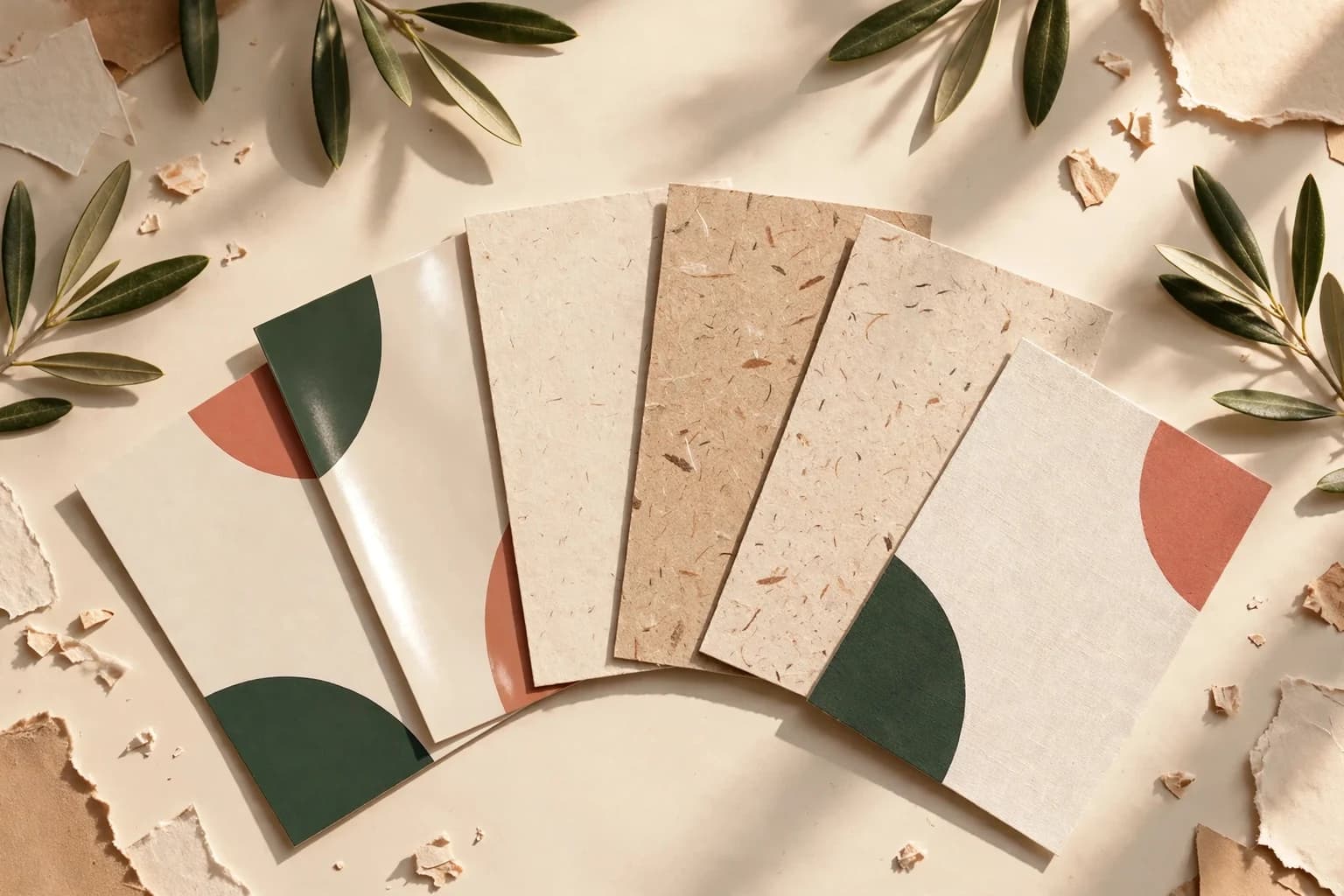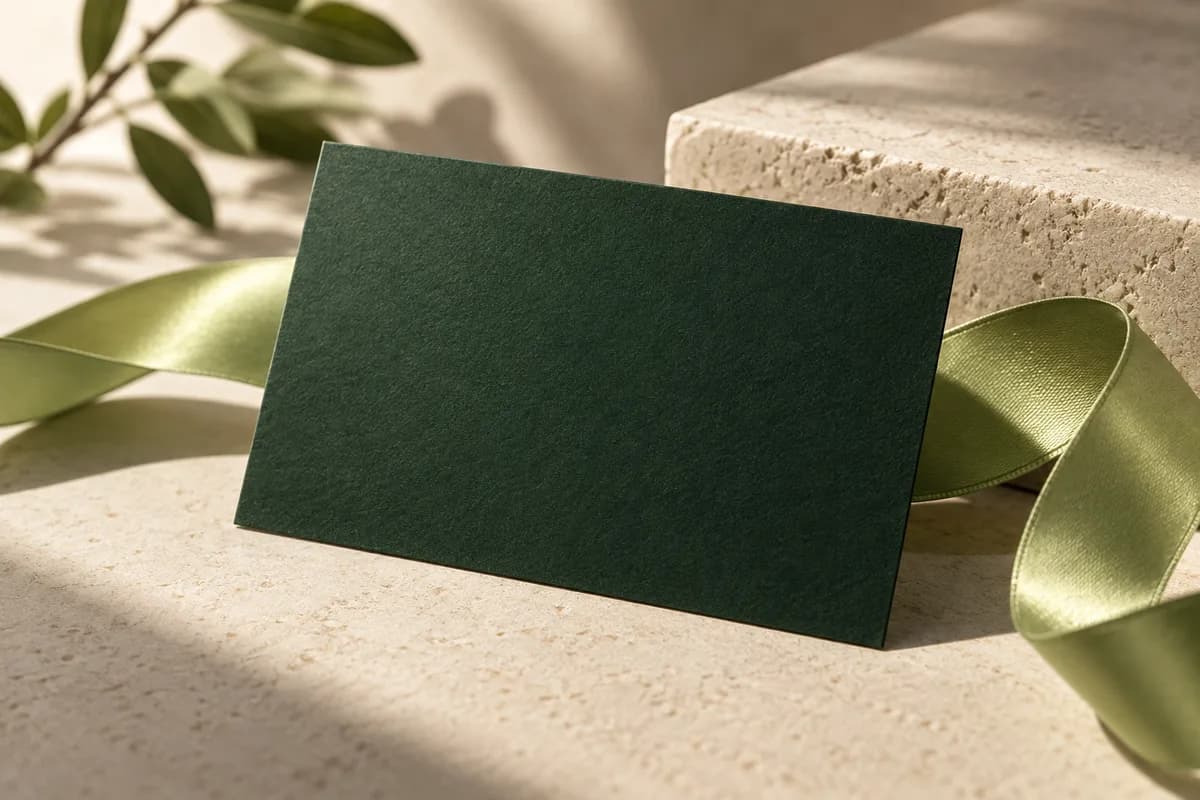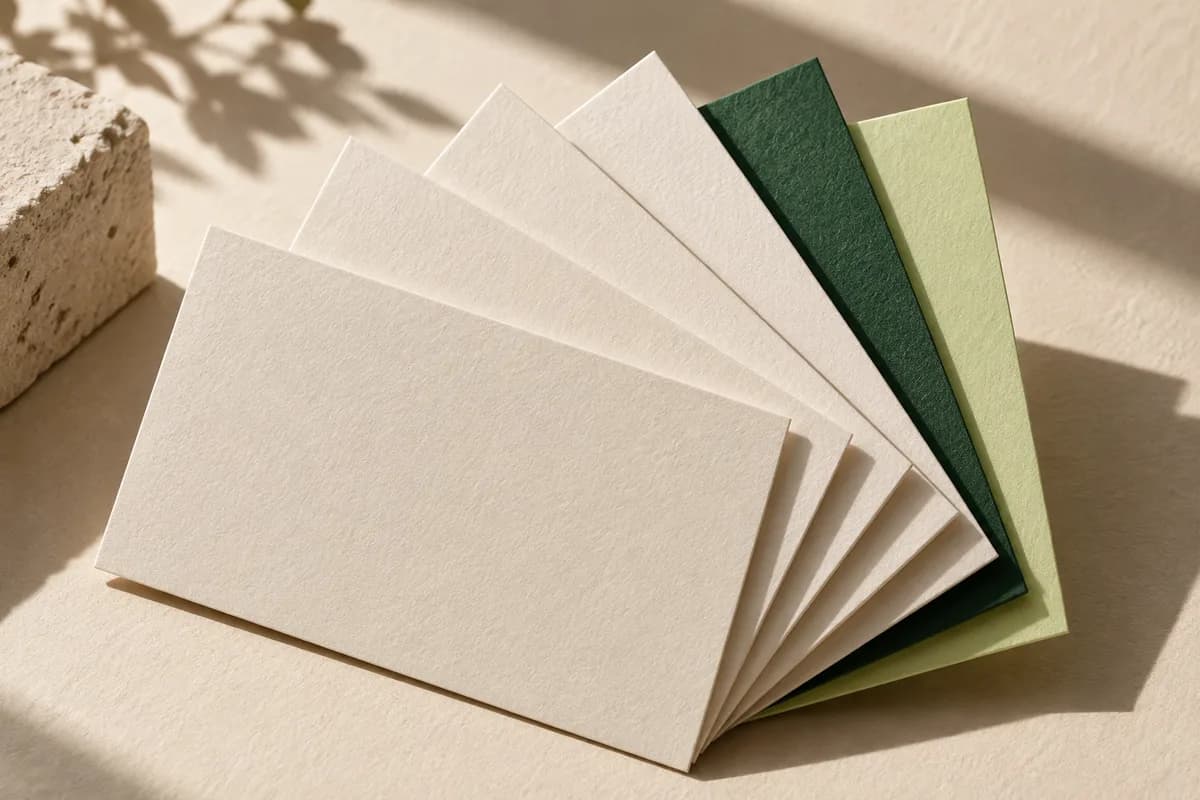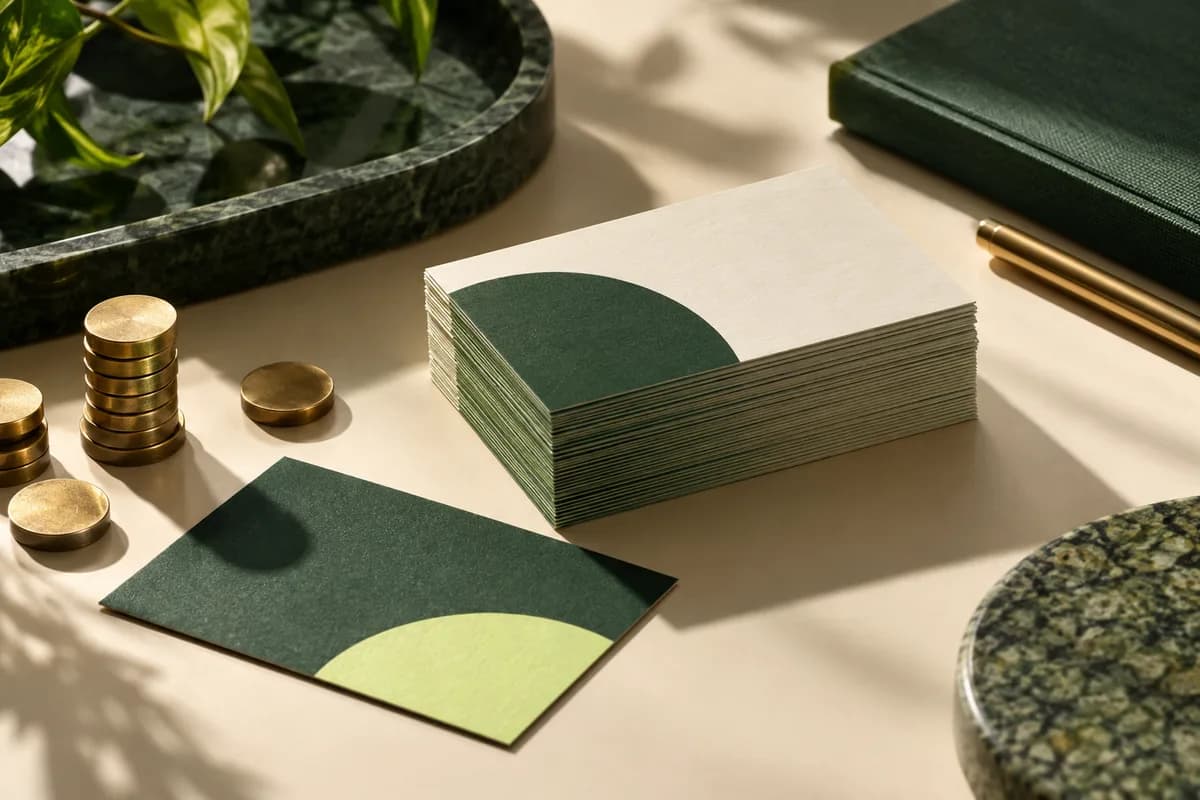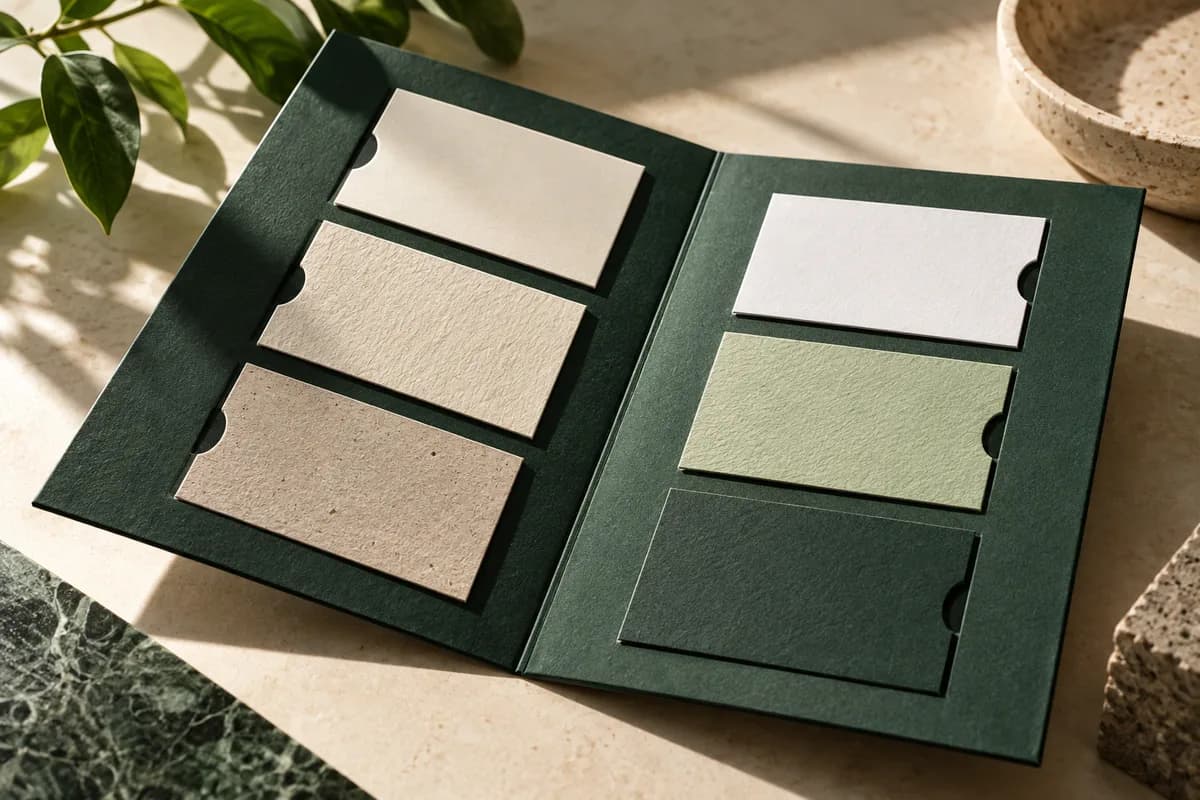
What comes in a business card sample kit?
Most kits mix everyday stocks with premium options so you can feel the whole range at once. A typical set includes smooth matte and gloss papers, textured and uncoated stocks, specialty surfaces such as soft touch, linen, kraft and pearl, heavier builds such as ultra thick or painted edge, and at least one finishing effect such as raised foil. Some kits also include shaped cards with rounded corners or die cut outlines.
The samples are printed with example designs chosen to flatter each material, and the exact mix can change as the product range changes. Treat the kit as a guide to surfaces, not a preview of your own artwork. When the box arrives, lay every card out on a plain table before you start, sort them into rough groups such as smooth, textured and specialty, and set aside any shape or finish you already know you will not use. Narrowing the field early keeps the detailed checks focused on real candidates.
Why order a sample pack instead of judging on screen?
A screen cannot show thickness, stiffness, texture or how a surface catches light. It also displays color with backlit red, green and blue light, while a printed card reflects light through ink on paper, so the same file will never look identical in both places. Photos of paper on a product page help, but they are lit and edited to look their best.
Holding the card answers the questions that decide most orders: does it feel substantial enough, can you write on it, does the finish show fingerprints, and does it fit the holder or wallet you use.
How do you test each sample?
Pick a quiet half hour and work through the kit with the tools you will actually use. For each card, write with your usual pen, look at it under the lighting where you hand cards out, bend it gently to feel the stiffness, and slide it in and out of a wallet a few times. If the card will carry a photo, look at how dark areas render. If it will carry a loyalty stamp, stamp it.
Record what you observe in plain words, such as smears after a thumb rub or stays flat in a pocket, instead of adjectives like premium. Specific notes make the choice easy to explain to a colleague and repeatable next year.
| Criterion | What to do | What to record |
|---|---|---|
| Thickness and stiffness | Bend gently, stack five cards | Too flimsy, right, or too stiff for holders |
| Writing | Write a date and time with your usual pen | Clean, skips, or smears after a thumb rub |
| Glare | View under your normal lighting | Readable from every angle or not |
| Color | Compare dark and light areas | Deep, muted, or uneven |
| Handling marks | Carry in a pocket for a day | Scuffs, fingerprints, bent corners |
| Holder fit | Try your card holder and wallet | Fits, tight, or will not fit |
| Availability | Match the sample to a product page | Available in your size and quantity or not |
How do you compare thickness fairly?
Suppliers describe card thickness in points, where one point is a thousandth of an inch, or in grams per square meter, which measures weight rather than thickness. The two scales do not convert exactly because density varies by paper. The explainer on gsm vs pt business cards shows why, and the 14pt vs 16pt comparison explains what the extra thickness changes in the hand. When two samples feel similar, stack five of each and compare the height of the stacks.
What should a sample kit not decide for you?
A sample shows the material, not your layout. Your fine logo, dark background or small text may behave differently from the example design, so the final check is always a proof of your own file. A sample also cannot prove durability over months of use, and it does not establish environmental claims. The FTC's Green Guides expect recycled or recyclable claims to be qualified and backed by evidence, so confirm the paper's specification in writing before you describe a card that way.
How do you move from a sample to an order?
- Label each sample with its product name as soon as you open the kit.
- Shortlist two stocks that passed your writing and handling tests.
- Confirm the shortlisted stock is offered in your size, shape and quantity.
- Upload your own artwork and review the proof on screen at actual size.
- Keep the chosen sample with your order notes for the next reorder.
If two stocks score the same, choose the one that is available on the most products you use, such as cards, stickers and postcards, so your printed pieces feel consistent.
The paper stock guide explains the main paper families if you want context before you start. Once you know the surface you want, the standard business card listing shows which stocks are available on the everyday card, and the matte vs gloss comparison helps you weigh the two most common coated finishes against your design.
Is a sample kit worth it for a small first order?
For most people, yes. Paper is the one choice you cannot undo after printing, and it affects how every card feels. At $1 with free shipping, the kit costs less than a single reprint, and it removes guesswork for everyone on a team who needs to agree on the card. Order it early, allowing for the kit to arrive, a few days of testing, and then the production and transit time of the finished cards. If several people will sign off on the card, pass the kit around with a copy of the scorecard so everyone records the same criteria, then compare notes before you choose.
Frequently asked questions
What is in a business card sample kit?
A business card sample kit is a set of printed cards on a range of papers, finishes and shapes. The kit sold here holds 16 samples across everyday and premium materials, such as soft touch, linen, kraft, pearl, ultra thick, painted edge and raised foil. The exact mix can vary as the range changes, and the samples use example designs rather than your artwork.
How much does a business card sample pack cost?
Prices vary by printer. The business card sample kit on this site is $1 with free standard US shipping and is limited to one kit per order. Because paper is the choice you cannot change after printing, a sample pack usually costs far less than a single reprint caused by picking the wrong stock.
Can I get my own design printed on sample cards?
Sample kits normally use example designs so you can judge paper and finish, not your layout. To check your own artwork, shortlist a stock from the kit, upload your file and review the proof at actual size before approving. Keep screen review, material sampling and production proofing as separate steps so each one answers its own question.
How do I compare thickness between business card samples?
Thickness is usually listed in points, where one point equals a thousandth of an inch, or as weight in grams per square meter. The scales do not convert exactly because paper density varies. The simplest fair comparison is physical: stack five cards of each sample and compare the stack heights, then bend one card of each gently to feel stiffness.
Sources & specification notes
The references below support the relevant technical or product details in this guide. Examples and checklists are not claims of practical testing or universal supplier requirements. Confirm the current specifications for your chosen product before production.
- FTC: Green Guides (16 CFR Part 260) ↗
General principles for truthful, substantiated environmental marketing claims, including recyclable and recycled content claims.
- FTC: Environmental Marketing business guidance ↗
FTC hub for the Green Guides: environmental claims in ads or on products need competent and reliable evidence behind them.
- W3C: Understanding WCAG 2.2 Success Criterion 1.4.3 Contrast (Minimum) ↗
Contrast ratios for readable text, a helpful reference when judging printed text under normal lighting.