What the hoodie listing offers
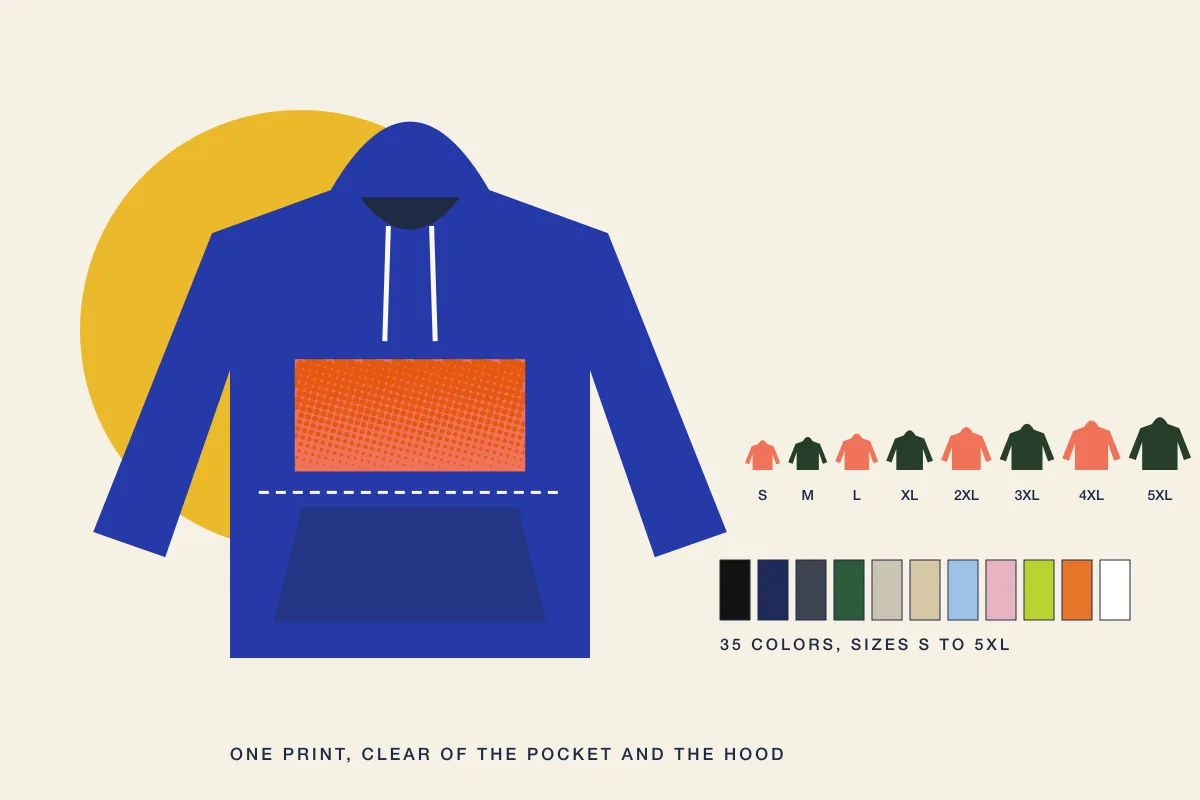
Our hoodies and sweatshirts listing is a hooded sweatshirt in a unisex fit, made of 50% cotton and 50% polyester fleece at 7.8 ounces per square yard. It comes in sizes S to 5XL and 35 colors, from Black, Navy and Charcoal Heather to Safety Green, Texas Orange and White. The design is a heat transfer print on the front, and you can order from a single hoodie up to 10,000.
| What you choose | What is on record |
|---|---|
| Garment | Hooded sweatshirt, unisex fit |
| Fabric | 50% cotton, 50% polyester fleece, 7.8 oz per square yard |
| Sizes | S, M, L, XL, 2XL, 3XL, 4XL, 5XL |
| Colors | 35, including Black, Navy, Charcoal Heather, Ash, Sand, Safety Green and White |
| Decoration | Heat transfer print on the front |
| Front print area on record | 11.024 × 8.661 in, 3308 × 2599 px at 300 ppi |
| Order quantity | 1 to 10,000 |
Fabric weight is a measured figure, mass per unit area, so 7.8 ounces per square yard can be compared directly with other garments described the same way. Our T shirt fabric weight guide explains how to read those numbers.
Hoodie or T shirt for your team
They do different jobs, and many teams end up with both.
| Question | Hoodie | T shirt |
|---|---|---|
| When it is worn | Cool mornings, evenings, outdoor shifts, travel | Every day, warm weather, under other layers |
| How long people keep it | Often years, as a personal favorite | Often a season or one event |
| Print area | One front panel, kept clear of the pocket | Front, back and sleeves on many garments |
| Sizing | Roomier; people often size by preference | Closer to everyday size |
| Best use | Staff gifts, crews, volunteers, year end thank yous | Uniforms, events, giveaways in volume |
If the garment is a uniform worn every shift, start with T shirts and add hoodies for the cold months. If it is a thank you, a hoodie is usually the one people keep. Our guide to ordering custom T shirts covers the shirt side of the same decisions.
Plan the print for the front panel
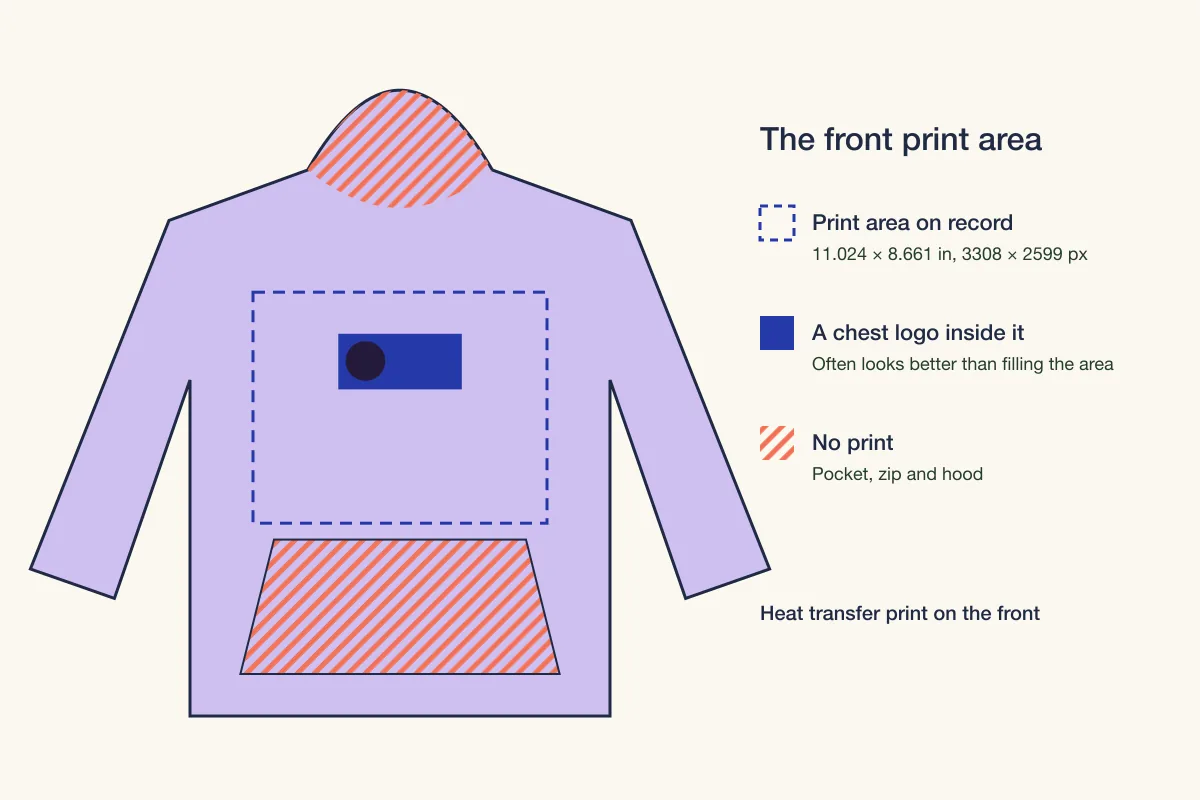
The listing prints on the front, and the area on record is 11.024 inches wide by 8.661 inches tall. That is a landscape shape, so a wide logo with a word mark beside it fits better than a tall stacked one. Supply vector artwork (EPS or SVG) where you can, or a raster file at 300 pixels per inch at print size, which for the full area is 3308 × 2599 pixels.
Keep the design clear of the pocket, the zip if there is one, and the hood. The product page is direct about it: the print must stay off pockets, zippers and hood coverage so it prints and sits cleanly. In practice that means the design sits on the chest, above the front pocket, and the full area is a maximum, not a target.
A chest logo smaller than the full area often looks better on a hoodie than a print that fills the panel, especially across a size run from S to 5XL. Our T shirt print placement guide explains how the same print sits differently on small and large garments, and the advice carries over.
Heat transfer prints a solid film onto the fabric. Very fine lines and tiny text can be lost, so keep strokes bold, and choose a print color with strong contrast against the garment. Our guide to printing on dark shirts covers what changes when the hoodie is black or navy.
Sizes, colors and the size run
A size run is the order's biggest risk. Ask people for their size rather than guessing, and remember that many people like a hoodie roomier than their T shirt size. The product page advice is to measure a garment that already fits well and compare it to the size chart before ordering for a group.
- Collect sizes by name, in writing, before you order.
- Offer the full run, S to 5XL, so nobody is left out.
- Order one or two spares in the middle sizes for new starters.
- Pick one garment color for the whole team so the print color works on every piece.
- Check that the print color still reads on the lightest and darkest garments you choose.
Our T shirt size run guide has a worked method for splitting quantities across sizes when you cannot ask everyone.
Colors that work with one print
One print across a whole order keeps the cost and the look simple, so choose garment colors that all work with it. A light print reads on Black, Navy, Charcoal Heather, Deep Forest and the other dark colors. A dark print reads on White, Ash, Sand, Light Blue and Pale Pink. Mixing a dark garment and a light garment in one order usually means two print versions.
Bright colors such as Safety Green, Texas Orange and Lime are a color choice, not safety equipment. A hoodie in Safety Green is not a certified high visibility garment, so if your crew works near traffic or machinery and needs certified high visibility clothing, buy that separately and keep the branded hoodie for breaks, travel and the office.
If your brand color is close to one of the 35 garment colors, consider using that garment and printing the logo in white or black. It often looks more considered than a brand colored logo on a neutral hoodie.
Care, and hoodies for children
Finished garments carry the manufacturer's permanent care label. The FTC Care Labeling Rule requires care instructions to be permanently attached and to cover washing, bleaching, drying, ironing and warnings. Pass on the usual advice for decorated garments: wash inside out, and do not iron over the print.
Our listing is an adult unisex garment from size S. If you are ordering hoodies for a youth team or a school, children's upper outerwear has its own federal rules, including no hood or neck drawstrings in sizes 2T to 12. Our guide to custom kids apparel safety covers what to ask for before you order.
When to order
Standard delivery as soon as 6 business days, production included, and the product page and cart show the estimated day for your quantity, which can be longer for large orders. Count back from the day the hoodies are handed out, whether that is a team kickoff, a cold season or a year end thank you, and leave time to collect sizes. If the hoodies are a year end gift, a branded calendar is the other gift people use every day; our guide to custom calendars for business compares the formats.
Hoodie order checklist
- Decide whether it is a uniform or a gift.
- Choose one garment color for the team.
- Design for the landscape front area, clear of the pocket and hood.
- Supply vector artwork or 300 ppi at print size.
- Collect sizes in writing and add spares.
- Order one hoodie first if you want to check color and fit.
- Count back from the hand out date.
Frequently asked questions
What is the print area on a custom hoodie?
On our hoodie listing the front print area on record is 11.024 inches wide by 8.661 inches tall, which is 3308 × 2599 pixels at 300 ppi. Keep the design clear of the front pocket, any zip and the hood, and treat the full area as a maximum rather than a target.
What fabric are the custom hoodies?
A hooded sweatshirt in a unisex fit, 50% cotton and 50% polyester fleece at 7.8 ounces per square yard, in sizes S to 5XL and 35 colors, decorated with a heat transfer print on the front.
Can I order just one custom hoodie?
Yes. The listing runs from a single hoodie up to 10,000, so you can order one to check the color, fit and print before ordering for the whole team.
Are hoodies or T shirts better for staff?
T shirts suit a uniform worn every shift and giveaways in volume. Hoodies suit cool weather, outdoor crews and thank you gifts, and people tend to keep them longer. Many teams order T shirts as the uniform and hoodies for the cold months.
Sources & specification notes
The references below support the relevant technical or product details in this guide. Examples and checklists are not claims of practical testing or universal production requirements. Confirm the current specifications for your chosen product before production.
- ASTM D3776/D3776M: Standard Test Methods for Mass Per Unit Area (Weight) of Fabric
Supports reading 7.8 ounces per square yard as a measured mass per unit area that can be compared with other fabrics.
- FTC: Clothes Captioning, Complying with the Care Labeling Rule
Care labels must be permanently attached and cover washing, bleaching, drying, ironing and warnings.
- CPSC: Drawstrings in Children's Upper Outerwear
Hood and neck drawstrings are prohibited in children's upper outerwear in sizes 2T to 12.
- Voqado: Hoodies and sweatshirts specifications
Unisex hooded sweatshirt, 50% cotton 50% polyester fleece at 7.8 oz per square yard, sizes S to 5XL, 35 colors, heat transfer front print, 1 to 10,000 pieces, front area 11.024 × 8.661 in.