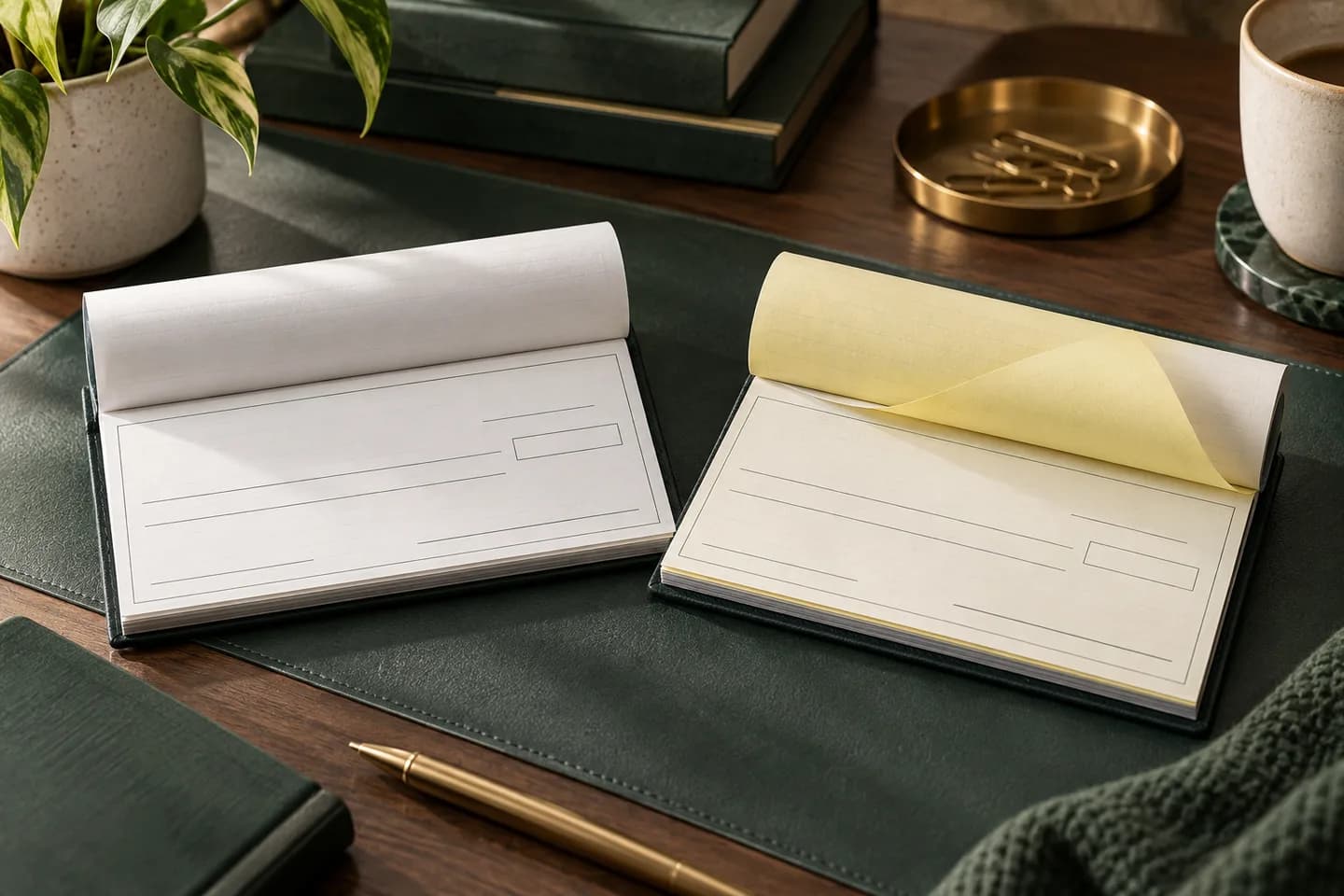
What is the difference between duplicate and single checks?
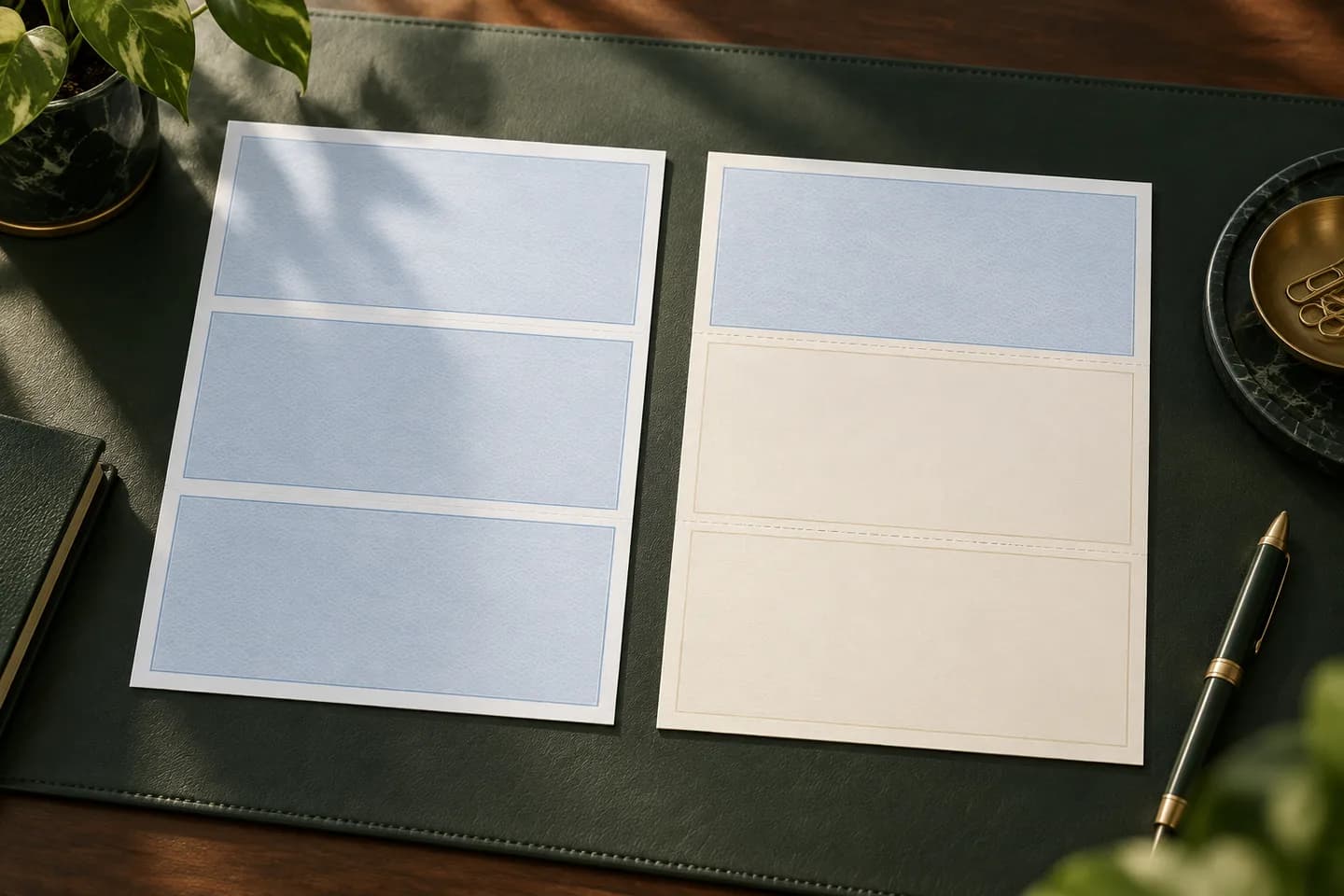
A single check is one sheet: you write it, tear it out and the only record is whatever you note in your register. A duplicate check has a second, thinner sheet bound underneath. As you write, the pressure of your pen transfers the date, payee, amount and signature onto that copy, which stays in the checkbook after the check is torn out.
Both kinds clear through the bank in exactly the same way. The copy is not a negotiable check and cannot be deposited; it is purely your record of what you wrote.
How do carbonless duplicate checks work?
Modern duplicate checks use carbonless paper rather than a loose sheet of carbon. The back of the check and the front of the copy are coated so that pen pressure creates a mark on the copy directly beneath your writing. There is no ink transfer to your hands and nothing to insert.
Because the copy depends on pressure, write firmly and on a hard surface. A light touch or a soft surface underneath, such as a notebook, can leave faint copies that are hard to read months later.
How do duplicate and single checks compare?
| Factor | Duplicate checks | Single checks |
|---|---|---|
| Record of each check | Automatic copy under every check | Only what you write in a register |
| Accuracy of record | Exact copy of what you wrote, including the payee spelling | Depends on you copying details correctly |
| Missed entries | Nearly impossible, the copy always exists | Common when writing checks in a hurry |
| Cost | Higher, because of the extra sheet | Lower |
| Checkbook thickness | Roughly twice as thick | Slim |
| Privacy | Copies carry payee, amount and signature | No extra copies to secure |
| Best for | Owners who write checks on the go | Owners with a reliable register or software |
Chase notes that duplicate checkbooks typically cost more, take up more storage space, and that two copies of a check mean two sources of sensitive information. It also notes that some financial institutions no longer offer duplicate checks, so you may need to order them from a check printer instead.
Who benefits most from duplicate checks?
Duplicates pay for themselves when the real risk is a missing record. That is most common for people who write checks away from the office and enter them into the books later.
- Contractors and tradespeople paying suppliers on site.
- Landlords and property managers writing refunds or repairs from a truck.
- Owners who share a checkbook with a partner or office manager.
- Anyone who has had a surprise overdraft from an unrecorded check.
- Businesses whose bookkeeper needs to see exactly what was written, not a summary.
If you write checks at a desk and enter each one into accounting software as you go, the copy adds little. The same is true if you print checks from software, since the software already holds the record. Our comparison of laser checks vs wallet checks explains when printing from software makes more sense.
Is a check register just as good as a duplicate?
A register works if you use it every time. The weakness is behavioral, not technical: when you are in a hurry you write the check and promise yourself to log it later. A duplicate removes that step because the record creates itself.
A register has advantages too. It is compact, it keeps a running balance on one page, and it is easier to total when reconciling. Many owners who buy duplicates still keep a register for the balance and use the copies as proof. Our guide on how to balance a checkbook and keep a check register covers the monthly routine.
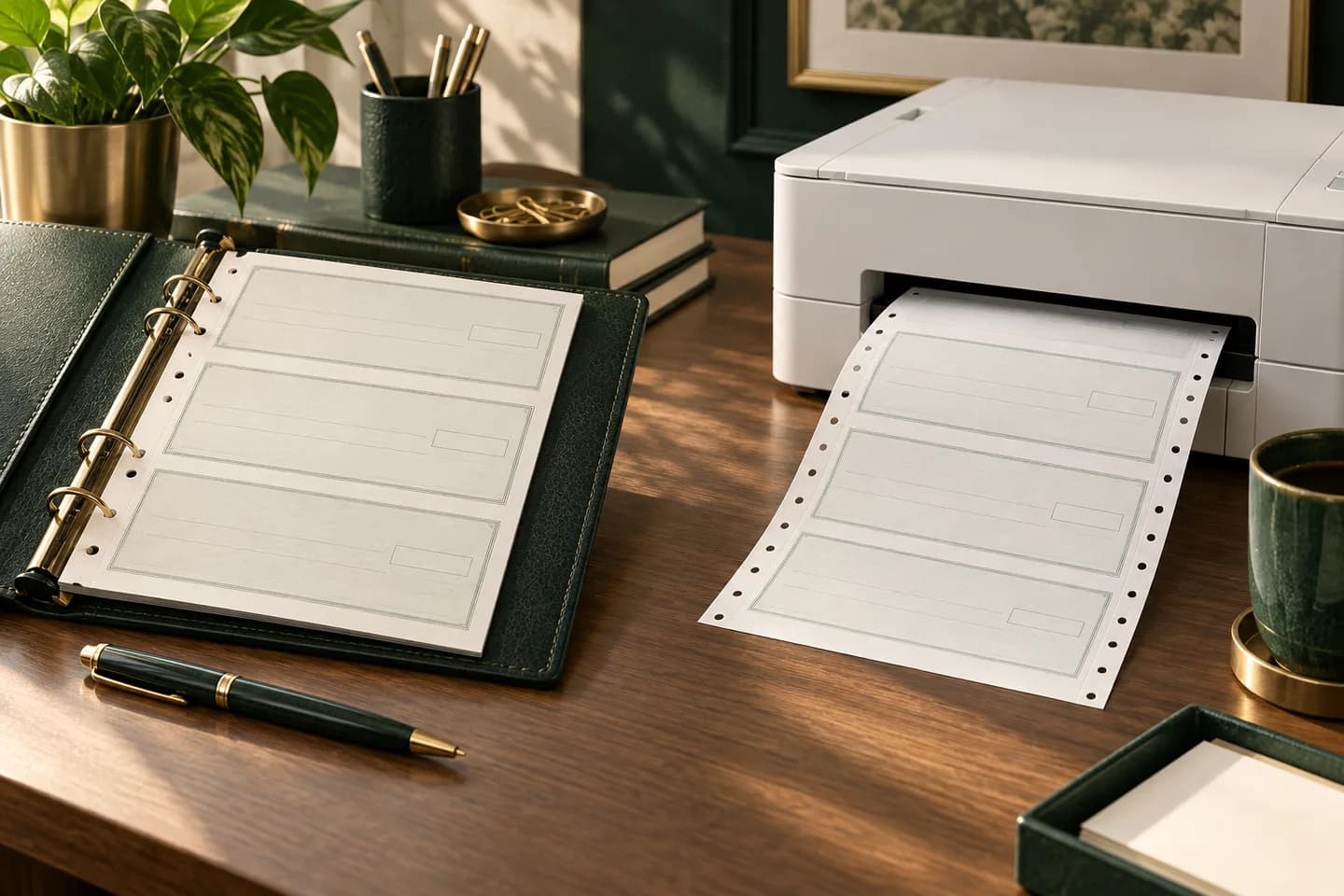
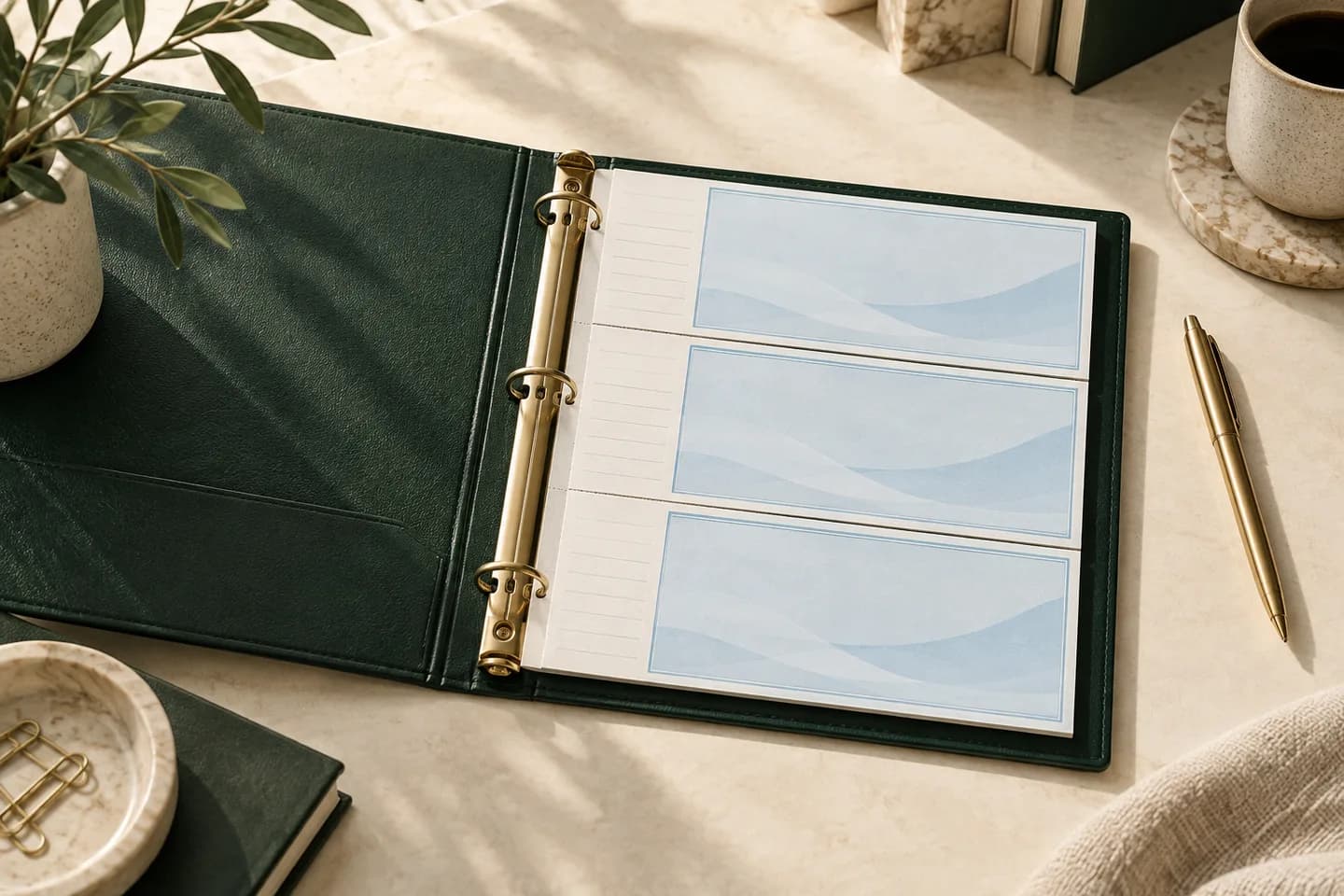
Stubs are a third option. Three per page binder checks keep a stub beside each check, and some suppliers also sell them with a carbonless copy. See our guide to three per page checks for how that desk format works.
How much more do duplicate checks cost?
Expect to pay more per box for duplicates, because each check carries an extra coated sheet. The exact difference depends on the supplier, quantity and design, so compare the single and duplicate price for the same quantity side by side before ordering.
To judge whether the premium is worth it, weigh it against one missed entry. A single unrecorded $600 check can cause an overdraft fee, a returned payment and an hour of reconciliation. If duplicates prevent even one of those a year, they have likely paid for themselves. If you have never missed an entry, single checks are the sensible saving.
How should you store and dispose of duplicate copies?
The copies carry the payee, amount, your signature and the check number, so treat used checkbooks like bank statements.
- Keep finished checkbooks in a locked drawer or cabinet, filed by date.
- Keep them as long as they support your tax records; the IRS says to keep canceled checks and supporting documents until the period of limitations for the return expires, generally three years.
- Shred old copies once they are past your retention period, rather than recycling them.
- Never leave a used checkbook in a vehicle or shared space.
Many banks also provide check images with statements or online, so the copy is a convenience and early warning tool, not your only proof of payment.
How do you choose and order?
- Write checks away from your desk or forget to log them: duplicate.
- Keep a reliable register or record every check in software: single.
- Want to try a design before committing to a full box: start with a small trial run.
- Share the checkbook with someone else: duplicate, so both see exactly what was written.
- Short on storage or carrying the checkbook daily: single.
Voqado wallet checks measure 6 x 2.75 inches, come in single or duplicate, and start at $11.99 for 100. Wallet trial checks start at $5.99 for 25 if you want a small first run. For writing tips that keep both the check and the copy legible, see our guide to the best pen for writing checks.
Frequently asked questions
Are duplicate checks worth it for a business?
They are worth it if you write checks away from your desk or sometimes forget to record them. The copy gives you an exact record of every check without extra effort. If you enter each check into accounting software as you write it, or print checks from software, single checks are usually enough and cost less.
Can a duplicate check copy be cashed?
No. The copy under a duplicate check is a record only, printed on thin carbonless paper, and it is not a check that a bank will process. It still carries sensitive details, including your signature, payee and check number, so store used checkbooks securely and shred them when you no longer need them.
Do duplicate checks work with gel pens?
They work with any pen, because the copy is created by pressure, not by ink. What matters is pressing firmly on a hard surface so the copy is clear. Many people use a gel pen with permanent ink for the check itself, since it is harder to wash off, and simply press a little harder.
Why don't banks offer duplicate checks anymore?
Some banks still do, but Chase notes that some financial institutions no longer offer duplicate checks. Check printers generally still sell them, including wallet checks in single or duplicate versions. Ask your bank first if you prefer to order there, and compare the price with a direct order.
Sources & specification notes
The references below support the relevant technical or product details in this guide. Examples and checklists are not claims of practical testing or universal supplier requirements. Confirm the current specifications for your chosen product before production.
- Chase: Duplicate checks, explained ↗
Explains how duplicate checks work, their record keeping benefits, higher cost, storage and privacy drawbacks, and that some institutions no longer offer them.
- TechChecks: Standard 3 on a Page Business Checks ↗
Shows three per page binder checks sold in one part and two part (duplicate) versions.
- IRS: Topic no. 305, Recordkeeping ↗
Says to keep canceled checks and supporting records until the period of limitations expires, generally three years.