What are 3 per page business checks?
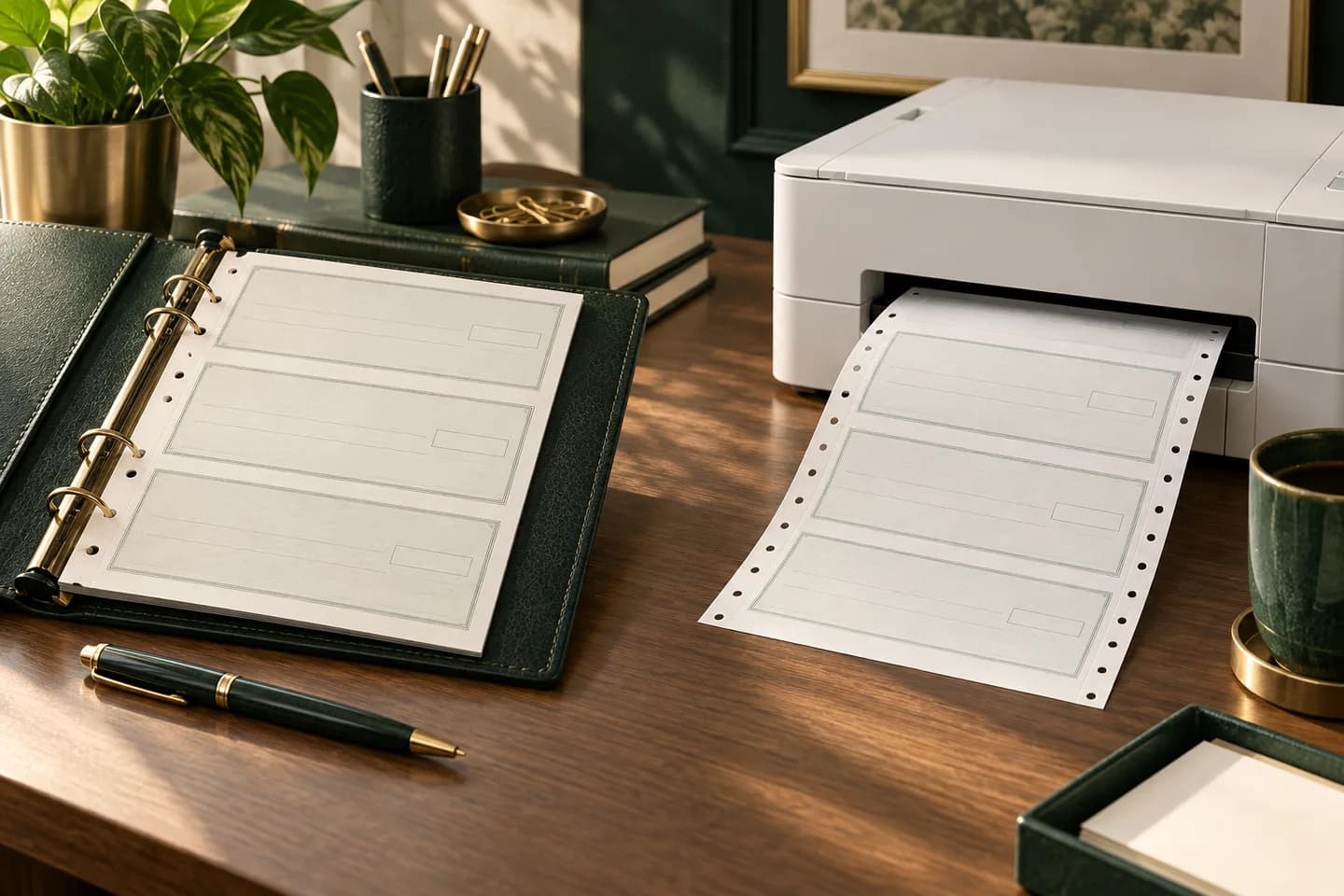
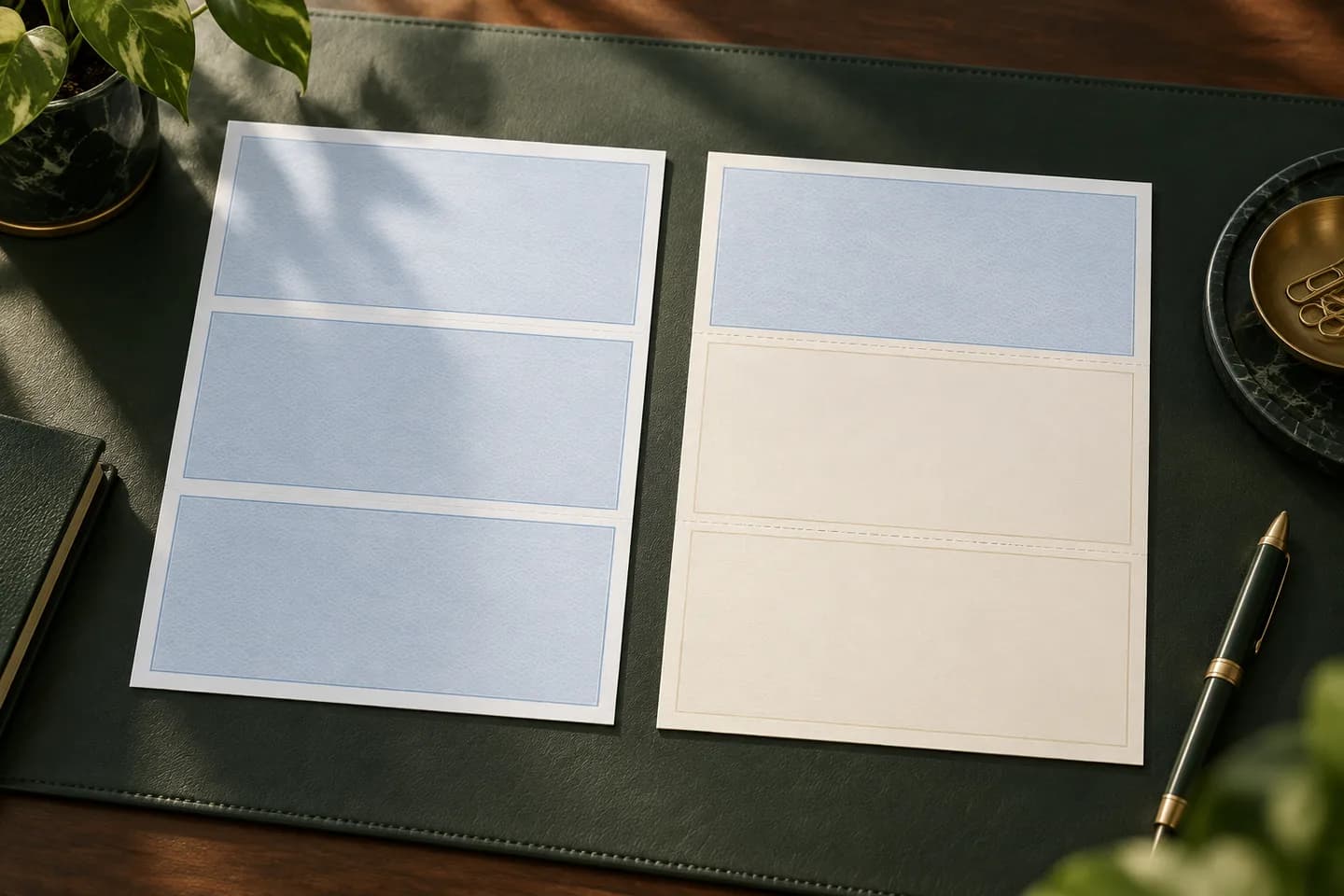
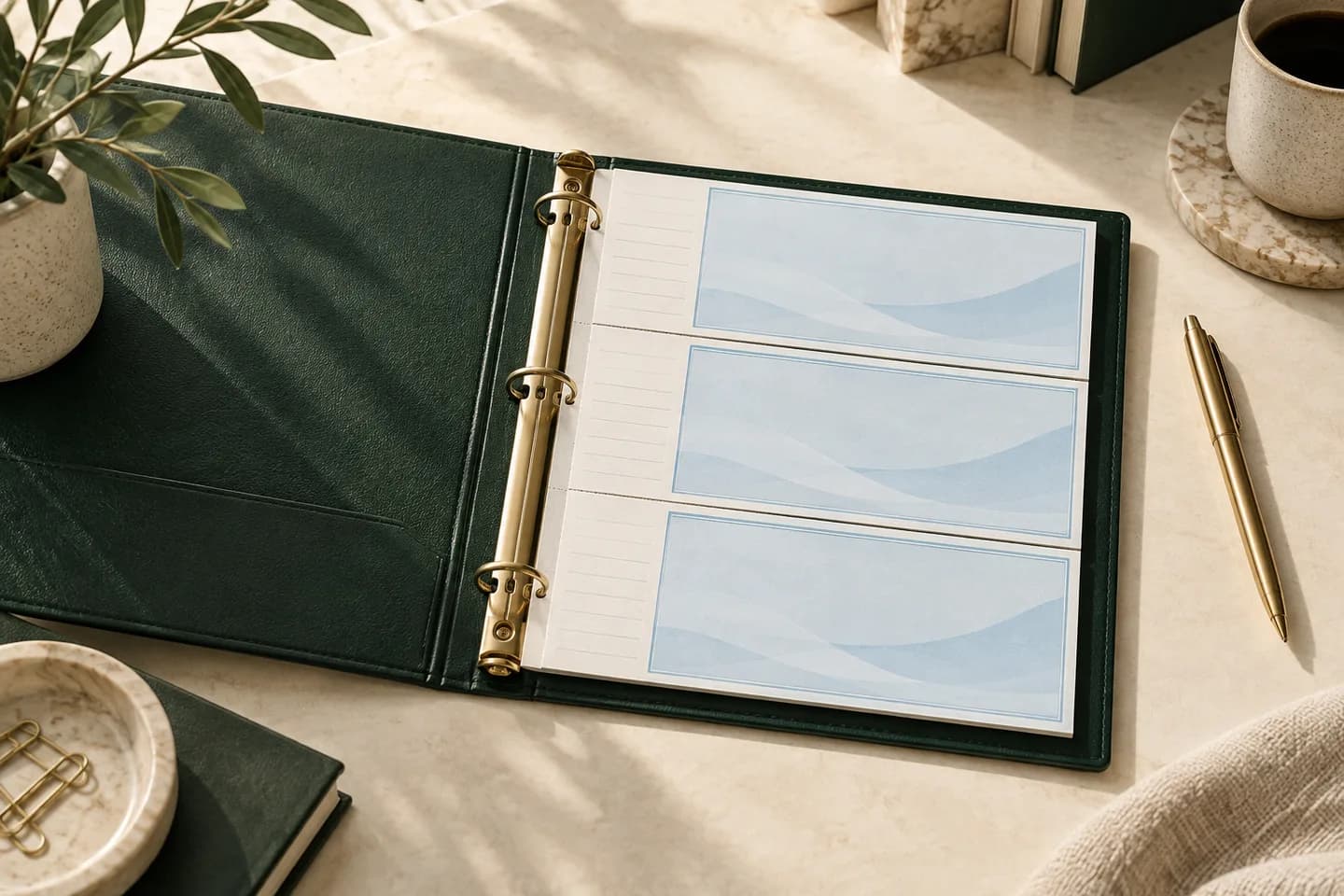
Three per page business checks, also called desk checks, manual checks or end stub checks, are the classic office checkbook. Each sheet holds three business sized checks stacked one above the other, and each check has a stub beside it for the record. The sheets are punched to sit in a ring binder, so the whole checkbook lies flat on a desk.
You write these checks by hand, the same way as a pocket checkbook. The format exists because a business check needs more room than a personal check for a longer company name, an address block and a clear amount line, and because an owner or bookkeeper wants every payment recorded on a stub that stays behind.
How big are three per page checks and binder sheets?
Sizes vary by supplier, so confirm the exact sheet size before you buy a binder. One widely sold specification, listed by TechChecks, is a 13 x 9 inch page holding three checks of about 8 1/4 x 3 inches each, pre punched for a seven ring binder.
| Part | Typical specification | What to confirm |
|---|---|---|
| Sheet | About 13 x 9 in, landscape | Exact sheet size from your supplier |
| Check | About 8 1/4 x 3 in | Check width if you use window envelopes |
| Stub | Beside the check, perforated | Stub side and fields |
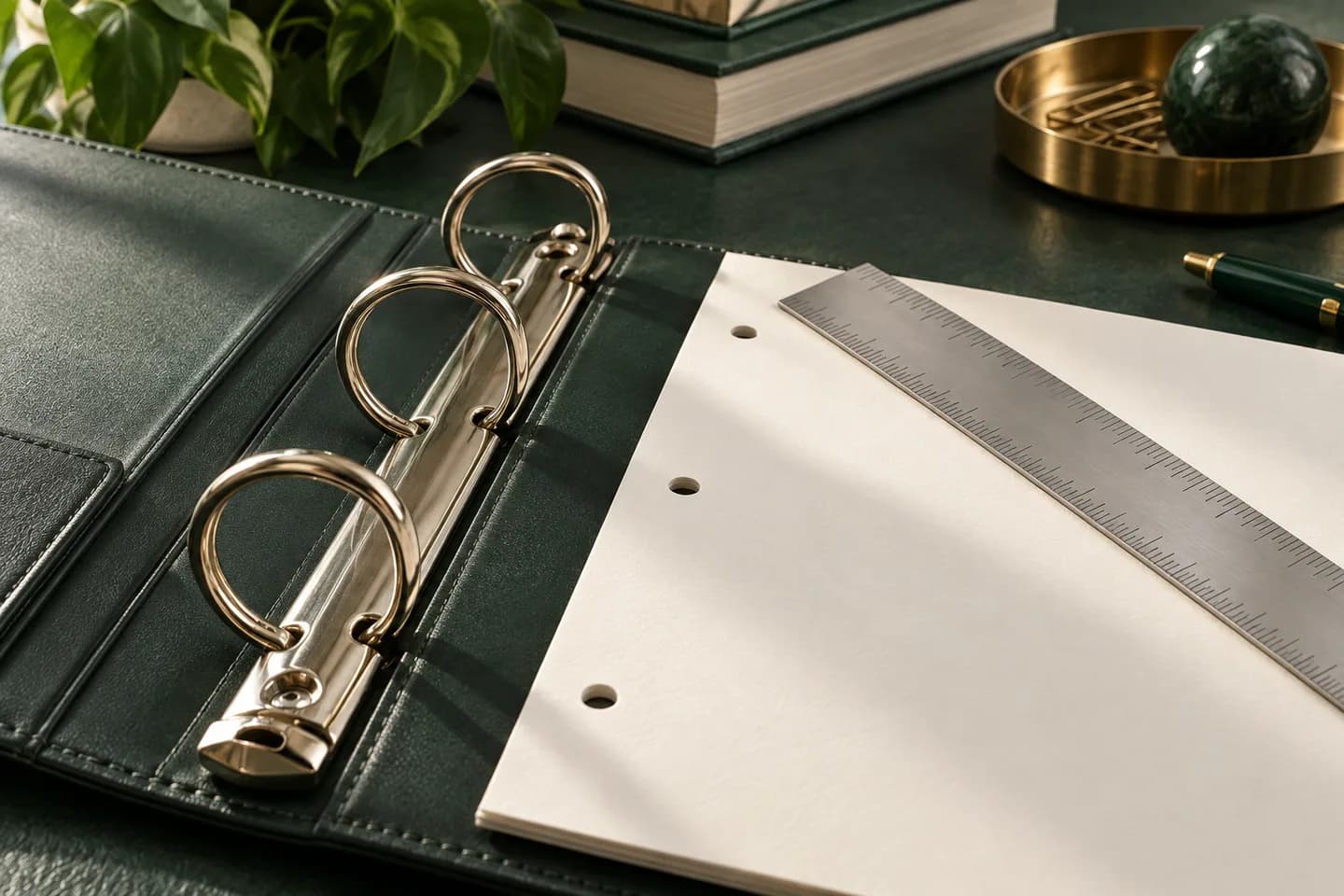
| Holes | Seven hole punch on the binding edge | Binder ring count and spacing |
| Binder | Seven ring desk binder | Capacity for your yearly volume |
A regular three ring letter binder will not work, because the holes on check sheets do not line up with it. Checkomatic describes a one inch seven ring binder as holding roughly 225 sheets, or about 675 checks, which is more than most small businesses write in a year.
How do you write a check and fill in the stub?
Fill in the stub first. That single habit prevents most bookkeeping gaps, because the record exists before the check leaves your hand. A typical stub has lines for the date, payee, purpose, amount, the balance brought forward, deposits and the new balance.
- Write the date, payee and what the payment is for on the stub.
- Enter the amount and subtract it from the running balance on the stub.
- Write the check itself: date, payee, amount in figures and words, memo.
- Sign the check with a pen that uses permanent ink.
- Tear the check along the perforation and leave the stub in the binder.
- Enter the payment in your books the same day if you also use software.
If you void a check, write VOID across it, keep it in the binder or file it with your records, and note it on the stub so the numbering has no unexplained gap.
Who uses the three per page format?
The format fits businesses that write checks at a desk and keep books by hand, or that keep a paper record alongside software. Common examples include property managers paying contractors, small medical and dental offices paying suppliers, churches and nonprofits paying bills approved at a meeting, and family businesses where one person signs every check.
It is less suited to anyone who pays from accounting software, because every check would be typed twice. If your bills already live in QuickBooks or Xero, compare this format with printed laser checks in our guide to laser checks vs wallet checks before you reorder.
Is a stub better than a check register?
A stub and a register do the same job in different places. A register is a separate log where you list every check in order. A stub is attached to the check it describes, so the record cannot be separated from the check number or skipped when you are in a hurry.
| Record method | Where it lives | Strength | Weak spot |
|---|---|---|---|
| Stub | Beside each check in the binder | Cannot skip a check number | Bulky over many years |
| Register | Separate booklet or page | Compact, easy to total | Easy to forget an entry |
| Carbonless duplicate | Copy under each check | Exact copy of what you wrote | Copies hold sensitive data |
| Accounting software | Your ledger | Reports and reconciliation | Manual checks need entry |
Some suppliers also offer three per page checks with a carbonless copy. If you want to know whether a copy adds anything to a stub, read our guide on duplicate checks vs single checks. For the monthly routine of matching stubs to your bank statement, see how to balance a checkbook and keep a check register.
How long should you keep check stubs?
Keep stubs for as long as they support your tax records. The IRS says to keep canceled checks and other documents that support income, deductions or credits until the period of limitations for that return runs out, which is generally three years from filing. If you pay wages by check, the IRS asks employers to keep employment tax records for at least four years after filing the fourth quarter return for the year.
Ask your accountant whether your situation calls for longer, then box old binder sheets by year so they are easy to find.
How many checks should you order and when should you reorder?
Count your average monthly checks, then plan for the reorder lead time. A standard shipped order takes time to produce and deliver, so reorder while you still have at least a month of checks left.
Worked example: a small office writes 12 checks a month. A pack of 54 checks, which is 18 sheets, lasts about four and a half months. Standard shipping means 2 to 4 business days of handling plus 5 to 8 business days in transit, so roughly two to three weeks door to door. Reorder when about 15 checks remain. An office writing 40 checks a month should order several hundred at a time to avoid reordering every few weeks.
When you reorder, continue the numbering from your last check so your stubs and bank statements stay in sequence. Our guide on what number your checks should start at explains how to choose and continue a sequence.
What should you check before ordering binder checks?
- Your legal business name and address exactly as the bank account shows them.
- Routing number and account number, entered through a secure form and never by email.
- Starting check number that continues your current sequence.
- Layout: general purpose, invoice or payroll stub, depending on what you record.
- Binder: a seven ring binder that matches the hole pattern, if you do not have one.
- Quantity based on your monthly count and the reorder lead time.
Voqado three to a page business checks start at $10.79 for 54 and come with a check plus side stub in general purpose, invoice or payroll layouts. Bank details are entered in a protected form, and a production proof is reviewed before printing.
Frequently asked questions
What size binder do 3 per page checks use?
Three per page checks use a seven ring desk binder, not a standard three ring letter binder. The sheets are larger than letter paper, commonly about 13 x 9 inches, and the holes follow a seven hole pattern. Confirm the sheet size and hole spacing with your check supplier, since specifications vary, and buy a binder made for that format.
Can I print on three per page checks with my printer?
Usually not. Three per page binder checks are made to be written by hand, and the wide sheets do not match letter size printers or accounting software layouts. If you want to print checks from software, order laser checks instead. QuickBooks calls its three checks per letter sheet layout standard, which is a different product.
What is the stub on a business check for?
The stub is your record of the check. You write the date, payee, purpose and amount on it and update the running balance before tearing the check out. The stub stays in the binder, so you can reconcile your bank statement, answer vendor questions and support your tax records without relying on memory.
How many checks are in a book of three per page checks?
It depends on the quantity you order, since each sheet holds three checks. For example, 54 checks is 18 sheets and 300 checks is 100 sheets. Most suppliers sell quantities in multiples of three for that reason. Choose a quantity that covers several months of payments plus the reorder lead time.
Sources & specification notes
The references below support the relevant technical or product details in this guide. Examples and checklists are not claims of practical testing or universal supplier requirements. Confirm the current specifications for your chosen product before production.
- TechChecks: Standard 3 on a Page Business Checks ↗
Lists a 13 x 9 inch page, 8 1/4 x 3 inch checks, perforated stubs and seven ring binder punching.
- Checkomatic: 7 Ring Check Binders guide ↗
Explains why seven ring binders are needed and estimates about 225 sheets per one inch binder.
- IRS: Topic no. 305, Recordkeeping ↗
Says to keep canceled checks and supporting documents until the period of limitations expires, generally three years.
- IRS: Employment tax recordkeeping ↗
Says to keep employment tax records at least four years after filing the fourth quarter return.