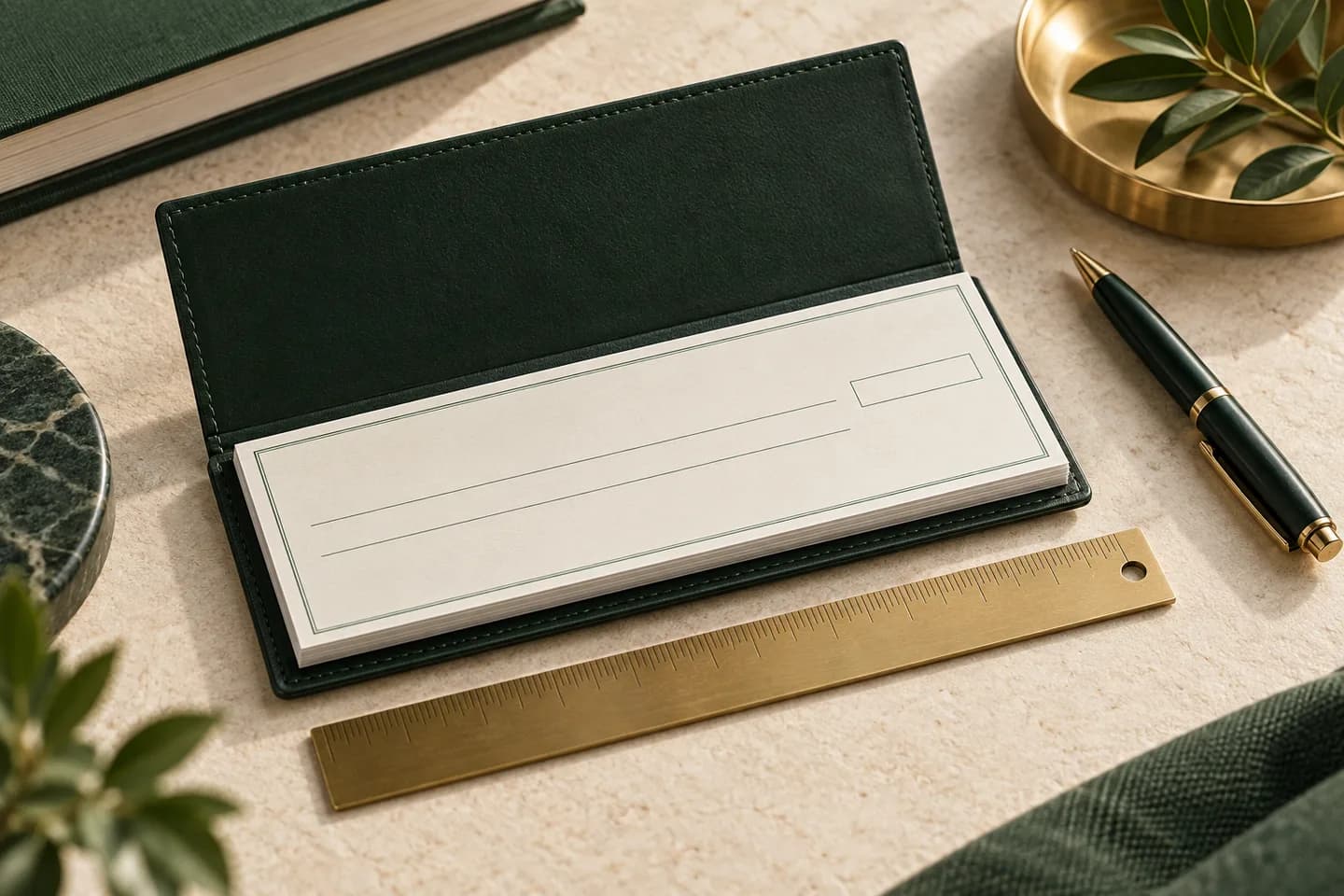
What are the standard check dimensions?
Check sizes are not one number. They depend on format, and they vary slightly by supplier, so always confirm the exact size on the product page before you buy binders, covers or envelopes. These are the common sizes in the United States.
| Check type | Check size | Sheet or book | Typical use |
|---|---|---|---|
| Personal or wallet check | 6 x 2.75 in | Bound book, one check per leaf | Handwritten, carried in a cover |
| Business desk check, three on a page | About 8.25 x 3 in | About 12.94 x 9 in sheet with side stubs | Handwritten at a desk |
| Laser check, voucher layout | About 8.5 x 3.5 in | 8.5 x 11 in sheet, one check plus stubs | Accounting software |
| Laser check, standard layout | About 8.5 x 3.5 in | 8.5 x 11 in sheet, three checks | Accounting software |
| ANSI minimum | 6 x 2.75 in | Not applicable | Smallest allowed |
| ANSI maximum | 8.75 x 3.66 in | Not applicable | Largest allowed |
The general purpose three on a page check from Checks Unlimited, for example, is listed at 8 1/4 x 3 inches on a sheet 12 15/16 x 9 inches. The laser sizes come from the letter sheet itself: a sheet 11 inches tall split into a check of about 3.5 inches and a stub area of about 7.5 inches, which is how Sage describes its extended voucher stub.
What size is a personal or wallet check?
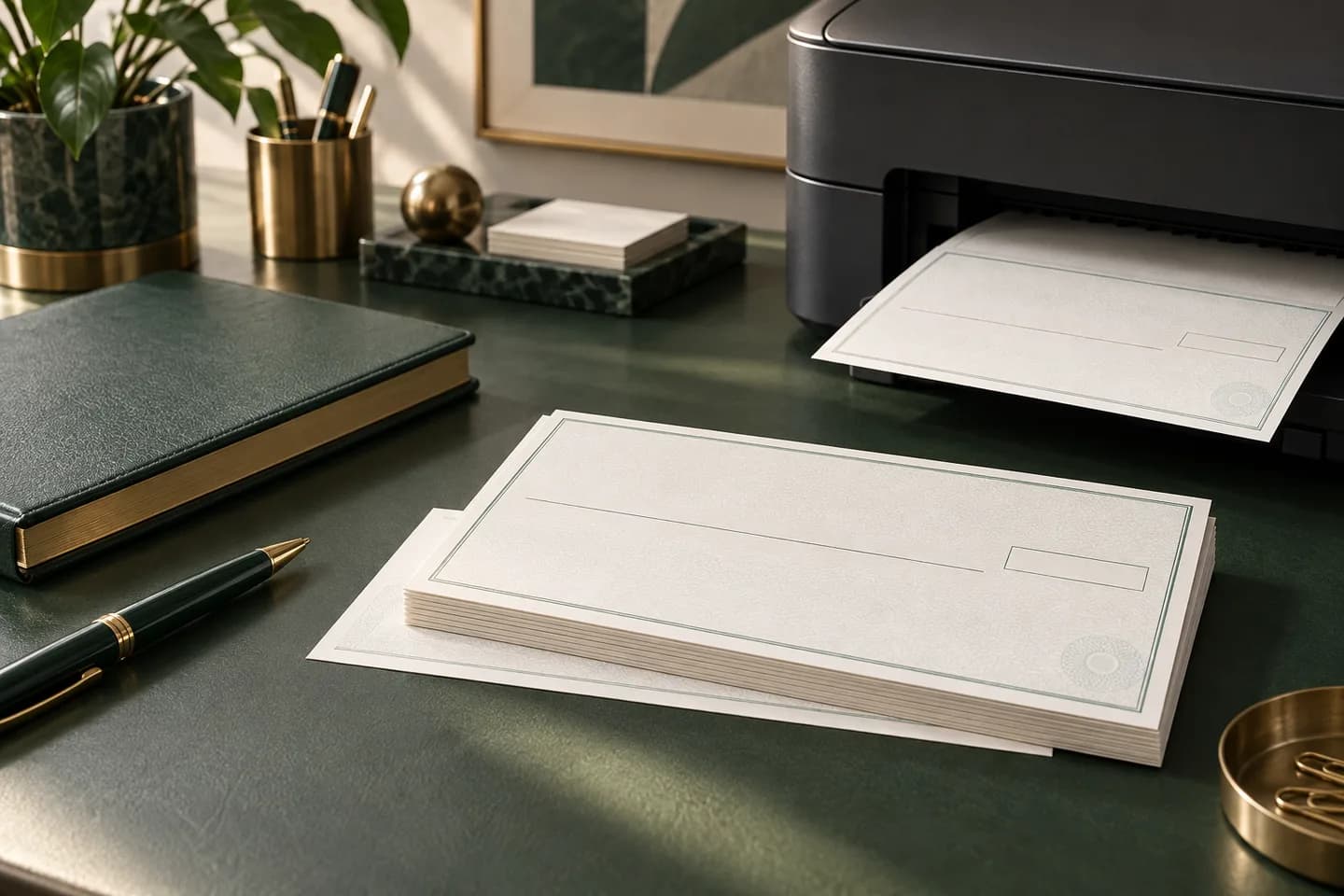
The familiar wallet check is 6 inches wide and 2.75 inches tall. That is also the minimum size in the ANSI window, which is why personal checks rarely get smaller. Wallet checks fit a standard checkbook cover and come single or duplicate, with a carbonless copy under each check.
Short checks have one layout quirk. The MICR Gauge summary of E-13B layout notes that the auxiliary on us field, which carries the check serial number on business checks, appears only on checks longer than 6.5 inches. On a 6 inch check the check number moves inside the main account field instead. Our walk through the parts of a check shows where each number sits.
What size is a business check?
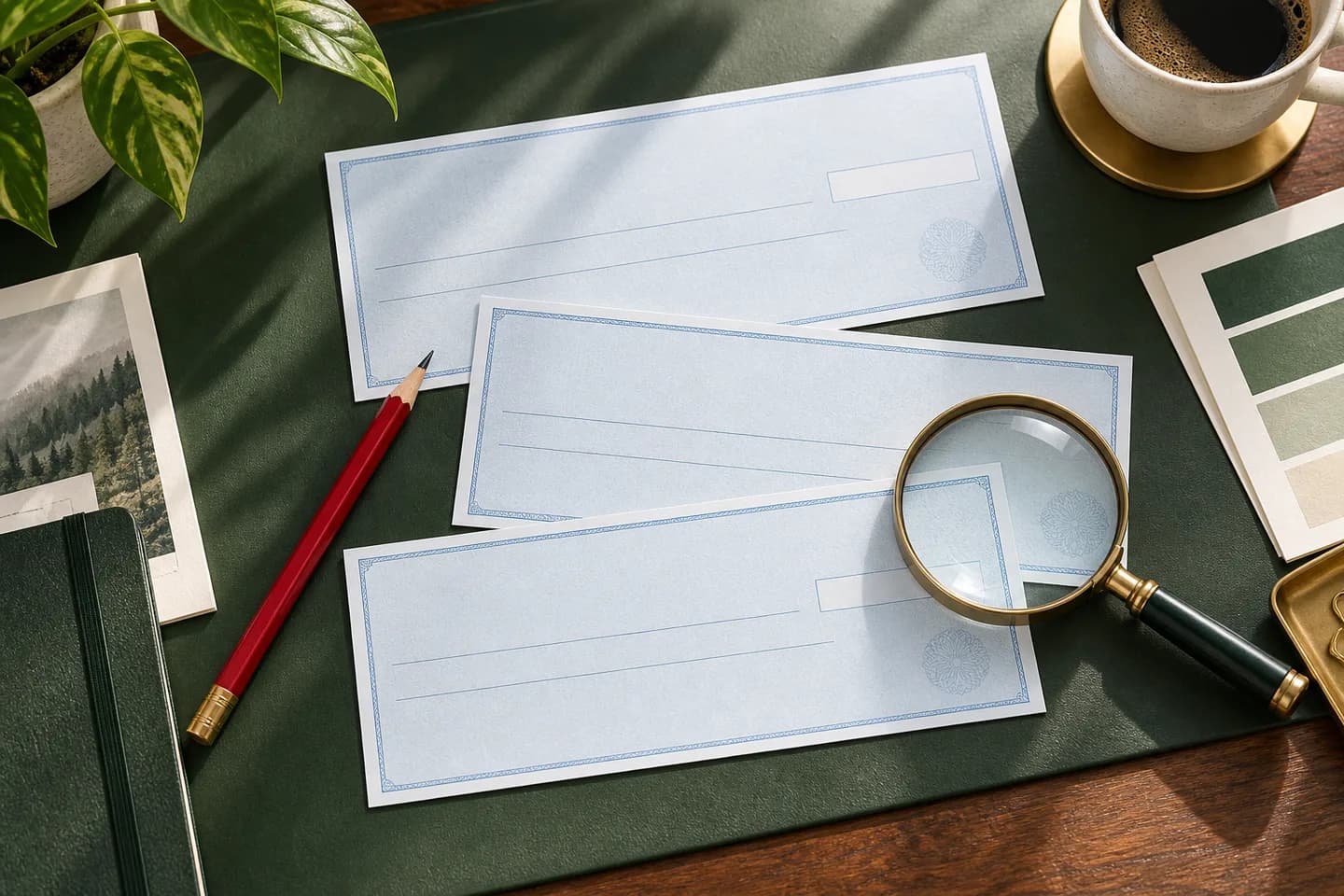
Business checks are longer, commonly between 8 and 8.75 inches wide. The extra width leaves room for a larger company block, a logo, two signature lines and the auxiliary field in the magnetic line.
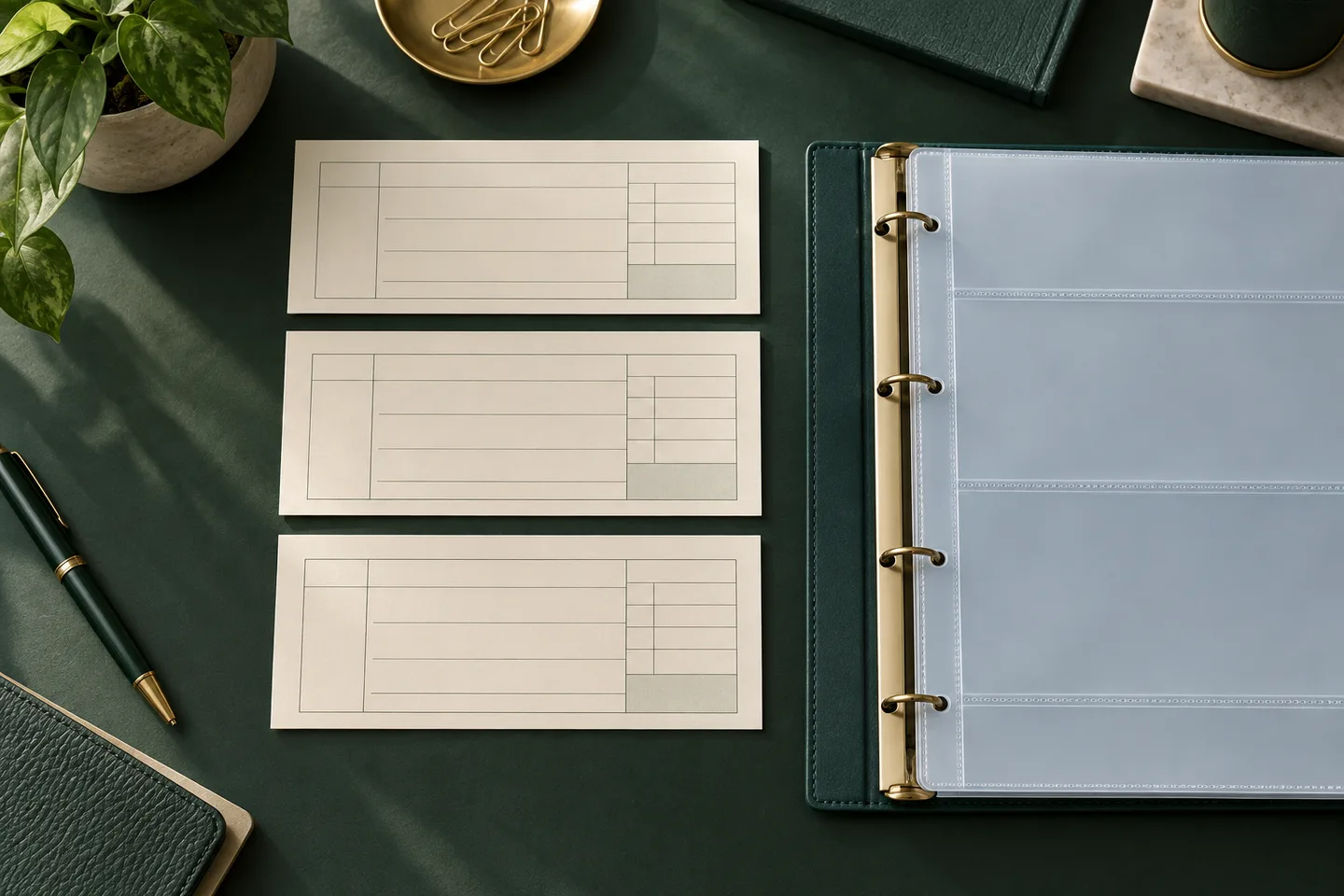
Desk style business checks usually sit three to a page in a binder, each with a stub on the left for notes. Laser business checks are printed from software on letter size sheets. A wallet size business check is also common for owners who pay suppliers in person; a business check does not have to be large.
At Voqado, wallet checks are 6 x 2.75 inches in single or duplicate, three to a page checks pair each check with a side stub, and laser checks come in multipurpose, payroll and accounts payable layouts. Check the product page for the exact dimensions of the layout you choose before buying a binder or envelopes.
How big is a voucher check?
A voucher check is a full 8.5 x 11 inch letter sheet with one check and one or two perforated stubs. The check can sit at the top, middle or bottom of the sheet, and the stubs carry invoice details or payroll earnings.
QuickBooks Online supports two check types when printing: voucher, with one check per page and stubs, and standard, with three checks per page. Match the check position on the paper to the setting in your software before you order. Our check format guide explains how the layouts differ.
What do banking standards say about check size?
Check dimensions come from the X9 standards maintained for the banking industry. The TROY MICR handbook, summarizing those ANSI specifications, sets the width at 6.00 to 8.75 inches and the height at 2.75 to 3.66 inches. The same handbook cites ANSI X9.18 for a minimum paper weight of 20 pound, long grain stock and recommends 24 pound stock for durability, because a check may pass through reader sorters many times.
A check outside the window can jam sorting machines or fail imaging, so custom sizes are not a design option. A quick test: a check measuring 8.5 x 3.5 inches fits because both numbers sit inside the window, while a 9 inch wide novelty check would not. Stay with standard layouts; the check printing guide covers the options.
How big is the MICR clear band?
Every check reserves a strip along the bottom edge for the magnetic line. The TROY handbook gives a minimum clear band height of 5/8 inch, measured from the bottom edge, with the bottom of the MICR characters about 3/16 inch above the edge. Nothing else may print in that band, including signatures, logos and background art.
The MICR characters themselves are small and evenly spaced at 1/8 inch per character. For the full picture of the line, read what MICR is and why it matters.
What envelope fits each check size?
Laser checks with a check at the top of the sheet are usually folded in thirds and mailed in a double window envelope, so the payee address and your return address show through. A common size is 3 5/8 x 8 5/8 inches; TechChecks lists that size as its most common double window check envelope. Always compare window positions with your layout, and see our guide to double window envelopes for checks.
Wallet and desk checks are small enough for standard business envelopes. Test the fold with a printed sample before ordering a large box.
How do you measure the checks you already have?
If you are reordering and are not sure which size you use, measure one before you choose a format. Use this list.
- Measure the detached check only, not the stub, in inches
- Note whether the stub sits on the left side or below the check
- Count checks per sheet: one, three or bound in a book
- Note which edge has perforations
- Check whether your software prints the check at the top, middle or bottom
- Write the measurements down with the name of your binder or cover
Then compare check formats by size and pick the one that matches what you have.
Frequently asked questions
What is the standard size of a check in inches?
A standard personal or wallet check is 6 inches wide by 2.75 inches tall. Business checks are larger: desk style checks are commonly about 8.25 x 3 inches and laser checks about 8.5 x 3.5 inches. All must fall within the ANSI window of 6 to 8.75 inches wide and 2.75 to 3.66 inches tall.
How big is a business check compared with a personal check?
A business check is usually 2 to 2.75 inches wider than a 6 inch personal check and a little taller. The extra space fits a larger company block, a logo, two signature lines and an extra field in the magnetic line for the check serial number. Wallet size business checks also exist for owners who write checks on the go.
What size paper are laser checks printed on?
Laser checks are printed on standard 8.5 x 11 inch letter sheets. A voucher layout puts one check of about 8.5 x 3.5 inches at the top, middle or bottom with stubs filling the rest. A standard layout puts three checks on the sheet. Confirm which layout your accounting software expects before ordering.
Can I print checks in a custom size?
Not outside the banking limits. Checks must fit within about 6 to 8.75 inches wide and 2.75 to 3.66 inches tall and keep a clear 5/8 inch band at the bottom for the MICR line. Oddly sized checks can jam bank sorters or fail imaging, so choose a standard format and customize the design instead.
Sources & specification notes
The references below support the relevant technical or product details in this guide. Examples and checklists are not claims of practical testing or universal supplier requirements. Confirm the current specifications for your chosen product before production.
- TROY Group: MICR Basics Handbook ↗
Manufacturer handbook summarizing ANSI check size limits, the E-13B character set, MICR field positions, the 5/8 inch clear band and reject fees.
- Checks Unlimited Business: General purpose three on a page checks ↗
Lists a common three on a page desk check at 8 1/4 x 3 inches on a 12 15/16 x 9 inch sheet; this corrects the plan's assumption that three per page desk checks are 8.5 x 3.5 inches, which is the laser layout.
- Sage Checks and Forms: Blank laser extended voucher check, top ↗
Shows a laser voucher check on an 8 1/2 x 11 inch sheet with a 7.5 inch stub below the check.
- MICR Gauge: About MICR and E-13B ↗
Lists the fourteen E-13B characters, the MICR field order and notes that the auxiliary on us field appears only on checks longer than 6.5 inches.
- TechChecks: QuickBooks compatible voucher check ↗
Lists 3 5/8 x 8 5/8 inches as its most common double window check envelope size.